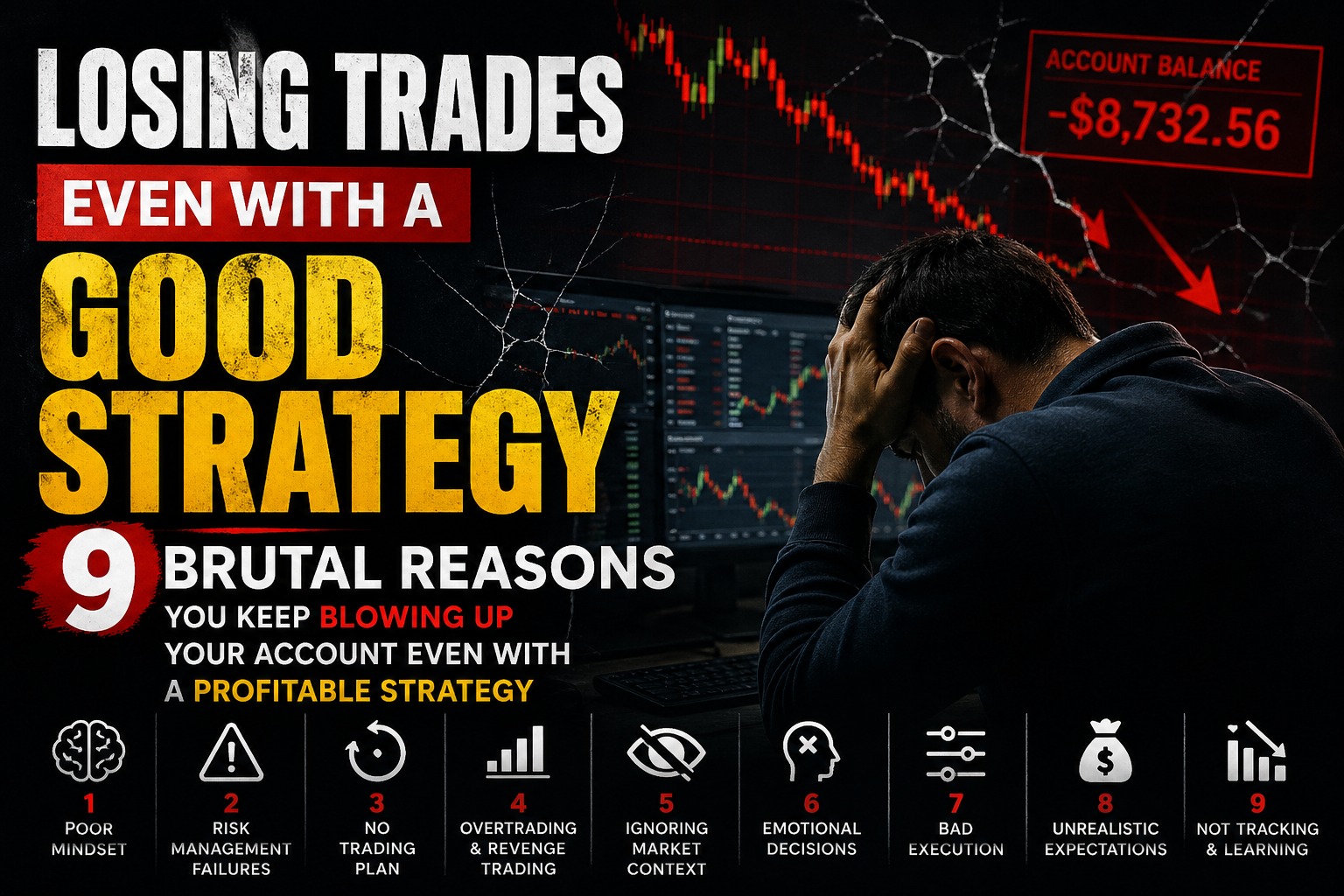
Losing trades even with a good strategy: 9 Brutal Reasons You Keep Blowing Up Your Account Even With a Profitable Strategy
Introduction:
“I’ve been there. I had a backtested strategy with a 67% win rate. I had confluence. I had a plan. And I still watched my account bleed out, week after week. This post is the conversation I wish someone had with me before I lost my third trading account.”
Let me ask you something painfully honest: How many times have you sat at your screen, watched the market do exactly what your strategy predicted, and still ended up in the red?
Maybe your entry was textbook. Maybe your analysis was clean. Maybe the setup checked every single box. And yet losing trades. Again.
If that sounds familiar, you are not alone, and more importantly, you are not crazy. This is one of the most common, most frustrating, and most misunderstood problems in trading. The industry loves to sell you the idea that a good strategy is the golden ticket. Find the right system, they say. Learn the right pattern. Copy the right trader.
But here’s the truth nobody puts in their course description: the strategy was never the whole problem.
According to research published by ACY Securities, roughly 90% of retail traders fail not because they lack profitable setups, but because they cannot execute those setups consistently under real market conditions. That number should stop you cold. Nine out of ten. With access to the same charts, the same indicators, the same strategies you and I use.
So what separates the 10% from the 90%? That’s exactly what this post breaks down in full detail, with zero fluff, and based on real experience from years in the market.

1. The Real Reason Losing Trades Happen (It’s Not What You Think)
Here’s a scenario that plays out in trading accounts around the world, every single day:
A trader spots a setup. It aligns with market structure. There’s confluence across timeframes. The risk-to-reward is solid 1:3, minimum. They’ve seen this setup work dozens of times in backtesting. They enter the trade.
And then the market stalls. A wick takes out the stop. Or they exit early in a panic. Or they move the stop loss “just a little” because they’re convinced the trade is right.
Losing trade.
The setup was never the issue. The trader was.
This isn’t about intelligence. Many of the most brilliant people I know have blown up trading accounts. This is about the gap between knowing what to do and actually doing it when real money is on the line and emotions are running high.
Mark Douglas, author of the legendary Trading in the Zone, spent decades studying exactly this phenomenon. His core argument was that trading is 80% psychology and 20% mechanics. While there’s reasonable debate about that exact ratio, the underlying truth is undeniable: even a profitable trading strategy will fail in the hands of a psychologically unprepared trader.
The losses are real. The damage is real. But the root cause? It lives between your ears.
2. Your Strategy Is Good But Is Your Execution?
There’s a massive difference between having a strategy and executing a strategy.
Think of it like this: imagine you have a proven gym program that’s helped thousands of people lose weight and build muscle. You buy it. You read through it. You feel that rush of motivation on day one.
Then day three rolls around. You skip legs because your knees feel “a bit stiff.” Week two, you modify the diet because a birthday came up. By week four, you’re doing a completely different program because you saw a new one on YouTube.
The original program wasn’t broken. Your execution was.
Trading works the same way. Most traders who are consistently bleeding losing trades are actually sitting on a perfectly functional strategy. The problem is:
- They deviate from the rules when the market gets uncomfortable
- They apply the strategy inconsistently across different emotional states
- They abandon the strategy after a small run of losses, right before the inevitable winning streak
- They modify entries and exits based on gut feelings rather than signals
As noted by Trade That Swing, learning to trade even one strategy well takes months because you can’t just learn the mechanics. You have to learn when the strategy works, when it doesn’t, how to handle variations in price action, and how to correct your own habitual mistakes. Most traders skip this entire process.
3. Trading Psychology: The Invisible Account Killer
Before we get into the specific reasons you’re losing trades, let’s address the elephant in the room: trading psychology.
The term gets thrown around a lot, but let’s make it concrete. Trading psychology refers to the emotional and mental patterns that influence every decision you make in the market. It includes:
- Fear – fear of losing, fear of missing out, fear of being wrong
- Greed – wanting more than your strategy targets, sizing up recklessly
- Ego – refusing to accept that a trade is wrong
- Overconfidence – believing a winning streak means you’ve “figured it out”
- Revenge – trying to “get back” what the market took from you
Here’s what makes psychology so dangerous: it doesn’t announce itself. You don’t think “I am now making a fear-based decision.” You think “this trade just needs a little more room.” You think “this setup looks even better than the last one.” You think “I’ll just make back the loss and then stop for the day.”
Dukascopy Bank’s research on trading psychology describes it clearly: your brain is wired for survival. Money is tied to survival instincts. Wins feel like victory. Losses feel like threat. When you’re experiencing a loss, your brain reacts as if you’re in genuine danger and danger triggers irrational, emotionally driven decisions.
That’s not weakness. That’s biology. The traders who win aren’t the ones who feel no emotion. They’re the ones who have built systems and habits that prevent emotions from hijacking their execution.
4. The 9 Brutal Reasons You Keep Losing Trades Even With a Good Strategy
Now we get into the meat of it. These are the nine reasons your losing trades continue to pile up, even when your strategy is sound. I’ve experienced every single one of them personally.
4.1. You’re Revenge Trading After Losses – And Destroying Your Account in the Process
This is probably the single most destructive pattern in retail trading, and it’s terrifyingly common.
Here’s how it works: you take a loss. Maybe it stings a little more than usual because you were confident in the setup. Your brain immediately fires up the “get it back” mechanism. So you jump back into the market often without a proper setup, with larger position size, with looser rules and you lose again.
Now you’re down even more. The urge to recover becomes even stronger. You enter again. And again.
Traders Second Brain’s analysis found that a trader who takes a single bad loss might be down 2% for the day. A trader who revenge trades after that same loss can end the day down 8–15%. That single day can take weeks to recover from if they recover at all.

The fix:
- Set a hard daily loss limit (2–3% of account is a common standard)
- When you hit that limit, you are done for the day. No exceptions. No “just one more.”
- After any loss, step away from the charts for at least 30 minutes before re-evaluating
4.2. You’re Moving Your Stop Loss – The Most Dangerous “Small” Decision in Trading
Moving a stop loss is so common it’s almost considered normal. It shouldn’t be.
When you entered the trade, you defined your risk. You said “if price reaches X, I was wrong, and I’ll accept the loss.” The stop loss is your risk management. Moving it because the trade is going against you doesn’t make the trade more right, it makes your loss larger.
As Mind Math Money highlights, moving your stop to avoid a loss is the cleanest, fastest way to turn a small, manageable loss into a catastrophic one.
The fix:
- Treat your stop loss as non-negotiable once you’re in a trade
- If you feel the urge to move a stop, recognize it as an emotional signal, not a rational analysis
- Pre-define entries, stops, and targets before you enter. Write them down.
4.3. You’re Taking Profits Too Early Shortchanging Your Own Strategy
This one is sneaky because it feels like discipline. You see your trade go green. You feel that little shot of relief. You think “I’ll just take profits here before it reverses.”
Except your strategy had a target of 3R. You took 0.8R. Now you need to win more trades just to stay even, because you’re no longer achieving the risk-to-reward your strategy was built around.
This pattern means your winners never actually win as much as they should. Your strategy’s expected value gets destroyed not by the losing trades, but by the undersized wins.
The fix:
- Set your target before entering the trade and let it run
- If you want to take partials, build that into your strategy systematically not emotionally
- Review your average actual R vs. your planned R in your trade journal
4.4. You’re Overtrading More Trades Does Not Mean More Profit
FOMO is relentless. The market is always moving. There’s always another setup, another breakout, another pair calling your name. And sitting on your hands feels impossibly passive when you could be “doing something.”
Overtrading is one of the most expensive habits in trading. It leads to:
- Taking low-quality setups that don’t meet your full criteria
- Increased transaction costs eating into your edge
- Decision fatigue that degrades your quality of execution over time
- Emotional exhaustion that makes you sloppy on the trades that actually matter
As CM Globals’ research on trading psychology points out, before every trade you should go through your entry checklist. If the setup doesn’t meet all criteria, you simply don’t trade. Missing one setup is insignificant over thousands of trades.
The fix:
- Define exactly how many trades you’ll take per session
- Grade your setups: only A-grade setups get executed
- Track your win rate by setup quality – you’ll quickly see how much overtrading costs you
4.5. Your Position Sizing Is Based on Emotion, Not Math
Here’s a scenario: you have a strong gut feeling about a trade. It “looks perfect.” So you size up maybe double your normal position. The trade loses.
Or the opposite: you just had two losses in a row, so you size down out of fear. The trade wins, but you barely made anything.
Emotion-driven position sizing is a silent killer. Writofinance’s analysis of common trading mistakes is clear on this: no trading setup is guaranteed to win. A single trade should never threaten your long-term capital. The standard recommendation is to risk 1–2% of your account per trade not because it’s conservative, but because it gives your strategy room to play out across a statistically meaningful sample size.
The fix:
- Use a fixed percentage risk model – 1% per trade, consistently
- Calculate your position size before you enter based on your stop distance
- Never adjust position size based on how “confident” you feel about any individual trade
4.6. You’re Abandoning Your Strategy Mid-Drawdown – Right Before It Recovers
Every strategy has drawdown periods. That’s not a flaw it’s a mathematical reality. Even a strategy with a 65% win rate will produce runs of 5, 6, or 7 consecutive losing trades. This is statistics, not failure.
But here’s what most traders do: after three or four losses, they start to doubt. “Maybe this strategy doesn’t work anymore.” “Maybe the market has changed.” So they switch strategies, modify their rules, or stop trading altogether right before the natural recovery period kicks in.
They’ve just taken all the pain of the drawdown with none of the reward of the recovery.
The fix:
- Backtest your strategy over a large sample size and know its historical max drawdown
- Set a maximum number of consecutive losses before taking a break — not switching strategies
- Trust the edge. A drawdown within normal parameters is not a signal to abandon ship.
4.7. You Have No Trading Journal – So You’re Repeating the Same Mistakes
This is the reason that deserves the most attention, and it’s the one most traders completely ignore.
Without a trading journal, you have no data. You have a vague impression of how you’re doing, colored by recency bias and selective memory. You remember the big winners and forget the patterns of mistakes that are consistently draining your account.
Professional traders at every serious firm – every prop desk, every hedge fund, every bank trading floor – review their trades as a non-negotiable part of the process. It’s not optional. It’s not something they do when they “have time.” And that systematic self-review is a major reason their success rates are dramatically higher than retail traders’.

The fix:
- Record every trade: instrument, entry, exit, setup type, emotional state, outcome
- Review your journal weekly and identify recurring mistake patterns
- After just one week of journaling, most traders identify at least one mistake they didn’t know they were making
4.8. You’re Undercapitalized And That Changes How You Trade
This is a structural problem that affects everything. When your account is too small, the dollar amounts on the screen feel disproportionately large relative to your life. A $200 loss feels catastrophic. A $500 gain feels life-changing. These emotional reactions override rational execution.
Trade That Swing makes an important point here: undercapitalization means you can’t position size properly, and you’re more likely to lose focus because gains in dollar terms come too slowly. You start taking shortcuts. You start sizing up to “make it worthwhile.” And that’s when accounts blow up.
The fix:
- Be honest about whether your capital base is adequate for the trading style you’re pursuing
- Trade smaller size while building capital, rather than betting big to compensate for a small account
- Consider working with systems that give you access to more capital — more on that below
4.9. You’re Ignoring Market Context – Applying Your Strategy in the Wrong Conditions
No strategy works in all market conditions. A breakout strategy in a ranging, choppy market is a recipe for serial losing trades. A mean-reversion strategy in a strongly trending market will get destroyed.
One of the most overlooked skills in trading is not just knowing how your strategy works, but knowing when it works and having the discipline to sit on your hands when conditions don’t favor it.
The fix:
- Define the market conditions your strategy is designed for
- Add a “market condition filter” to your trading plan
- If conditions don’t match your strategy’s parameters, there is no trade and that’s a win, not a loss
5. The Strategy vs. Psychology Debate: A Clear Breakdown
There’s an ongoing argument in trading communities: does strategy matter more, or psychology? The answer, as with most things, is nuanced — but the table below should clarify where each factor fits.
| Factor | Role in Trading Success | Common Failure Mode |
|---|---|---|
| Strategy | Provides positive expected value (edge) | Poor backtesting, chasing holy grails, constant switching |
| Psychology | Determines whether the edge is executed correctly | Revenge trading, FOMO entries, early exits |
| Risk Management | Protects capital during drawdowns | Oversizing, moving stops, ignoring max loss rules |
| Discipline | Ensures consistency across hundreds of trades | Breaking rules in “special” circumstances |
| Self-Awareness | Identifies recurring mistakes before they become fatal | No journaling, no post-trade review |
| Capital Adequacy | Enables proper position sizing and emotional neutrality | Trading scared money, oversizing to compensate |
The honest conclusion? You need all of them. A great strategy with terrible psychology produces losing trades. Great psychology with a losing strategy produces slow, managed losses. The 10% of traders who are consistently profitable have developed all six pillars not just one or two.
6. Risk Management Failures That Quietly Drain Your Account
Risk management deserves its own section because it’s the area where most traders make their most expensive, least-discussed mistakes.
Here are the most common risk management failures that turn good strategies into losing trades:
- Risking too much per trade: The 2% rule isn’t arbitrary. Traders who risk 5–10% per trade can be completely wiped out by just five or six consecutive losses which is statistically inevitable over enough trades, even with a positive-expectancy system.
- Setting stops and then moving them: This is arguably the most self-destructive habit a trader can have. It converts a planned 1R loss into an unplanned 3R or 5R catastrophe. One event like this can undo weeks of disciplined trading.
- Averaging down on losers: Adding to a losing position feels logical in the moment “it’s an even better price now.” The math does not agree. This is how small, manageable losses become account-ending disasters.
- Ignoring correlation: Opening simultaneous positions in EUR/USD, GBP/USD, and AUD/USD is not diversification. All three are heavily correlated to USD movement. You are effectively tripling your risk on a single directional bet.
- No daily loss limit: Without a hard stop on daily losses, one bad day powered by revenge trading can wipe out weeks of progress.
Proper risk management isn’t exciting. It doesn’t make for good trading highlight reels. But it is the single most reliable predictor of whether you survive in this market long enough to become consistently profitable.
7. How to Stop Losing Trades and Start Trading Consistently
Let’s get practical. Here’s a structured action plan not motivational fluff, but actual steps that work.
Step 1: Audit Your Last 50 Trades Before changing anything, understand exactly what’s been happening. Review your last 50 trades and categorize your losses:
- Losses from valid setups (part of normal strategy variance)
- Losses from rule violations (entries taken without full confluence)
- Losses from emotional decisions (moved stops, revenge trades, early exits)
Most traders find that a large percentage of their losses fall into categories 2 and 3. Those are the ones you can actually fix.
Step 2: Define Your Rules With Absolute Clarity Vague rules lead to vague execution. “I enter when the setup looks good” is not a rule. A rule sounds like:
- “I enter only when price has swept liquidity, shown a BOS on the 15-minute, and there is a valid FVG on the 5-minute as entry trigger.”
- “My stop loss is placed 5 pips below the last swing low. Period.”
- “I target the next significant liquidity pool. I do not move my target.”
Step 3: Build a Non-Negotiable Pre-Trade Checklist Every trade must pass through a checklist before execution. If any item is missing, there is no trade. This single habit eliminates the majority of overtraded, low-quality entries.
Step 4: Set Hard Limits And Enforce Them
- Daily max loss: 2% of account
- Max trades per session: define this clearly
- Weekly max loss: 4–5% of account
When limits are hit, the platform is closed. Not “one more trade.” Closed.
Step 5: Start Journaling Today Not Tomorrow A basic journal with entry reason, stop, target, emotional state, and outcome is enough to transform your self-awareness within weeks. You don’t need an elaborate system. You need consistency.
Step 6: Find a Community of Profitable Traders Your psychology mirrors your environment. Trading forums full of frustrated retail traders reinforcing losing habits is not the environment you want. Seek out traders who are actually profitable, who talk about process and discipline rather than “holy grail” systems.
8. The VTM Automated System: Trading Without the Emotional Sabotage
If you’ve read everything above and found yourself thinking “this makes complete sense, but I know I’ll still struggle with the emotional execution” you’re not alone, and you’re not being weak. You’re being honest.
That self-honesty is actually the starting point for one of the most powerful solutions available to retail traders: automation.
The VTM Automated System, available at vtmstrategy.com, was built specifically to address the gap between having a good strategy and executing it consistently. What an automated system does is remove the emotional variable entirely. It doesn’t revenge trade. It doesn’t move stops. It doesn’t exit early because it “feels nervous.” It executes the strategy exactly as designed, every single time.
This doesn’t mean you hand over control and walk away. You still define the parameters. You still monitor the system. But the execution — the part where human psychology consistently causes losing trades — is handled mechanically.
For traders who have a well-defined edge but consistently struggle with the emotional and behavioral execution of that edge, automation isn’t a shortcut. It’s a structural solution to a structural problem. If the problem is that your brain keeps sabotaging your strategy, the logical answer is to take your brain out of the execution loop.
9. Frequently Asked Questions About Losing Trades Even With a Good Strategy
Q: Can a good strategy still produce consistent losing trades?
Yes absolutely. A strategy with a genuine edge can still produce losing trades if executed inconsistently. If you deviate from the rules, move stops, exit early, or overtrade, the strategy’s expected value gets destroyed at the execution level. The strategy works; your execution of it doesn’t.
Q: How many losing trades in a row is normal before a strategy is considered broken?
This depends entirely on the strategy’s win rate. A strategy with a 55% win rate can statistically produce runs of 8–10 consecutive losing trades. Before abandoning any strategy, you need a statistically significant sample most professionals use 100+ trade samples. Never judge a strategy on 10 or 20 trades.
Q: Is trading psychology more important than having a good strategy?
Both are required. As Predicting Alpha’s analysis argues compellingly, you cannot psychologically discipline your way through a negative-expectancy strategy. Strategy provides the edge. Psychology determines whether you actually capture that edge. You need both.
Q: What is the most common reason traders lose money even with a good strategy?
Based on the research and personal experience, revenge trading and inconsistent execution are the top two culprits. Most traders know what to do. Most traders fail to do it under real market conditions when emotions are running high.
Q: How long does it take to become a consistently profitable trader?
There’s no fixed timeline, but most professional traders cite 2–5 years of deliberate, reflective practice before reaching consistent profitability. The traders who compress that timeline are the ones who journal obsessively, review mistakes ruthlessly, and have the discipline to prioritize process over profit.
Q: Should I use an automated trading system to avoid losing trades from emotional decisions?
For traders who have a proven edge but consistently struggle with emotional execution, automation is a legitimate and powerful tool. Systems like the VTM Automated System are designed precisely for this use case removing the emotional variable from execution while maintaining strategic oversight.
Q: What’s the first thing I should fix if I’m experiencing too many losing trades?
Start with a trade audit. Categorize your last 50 losses. If the majority are coming from rule violations and emotional decisions rather than valid setups that didn’t work out, the fix is behavioral and psychological not strategic. If the majority are valid setups that simply lost, revisit your strategy’s edge and backtesting quality.
Conclusion:
Here’s something that might feel counterintuitive: many of the traders who are experiencing the most frustrating losing trade cycles are actually closer to profitability than they think.
They have the strategy. They have the technical knowledge. They understand market structure, risk-to-reward, confluence. What they’re missing is the behavioral infrastructure the habits, systems, and self-awareness to execute what they already know.
That gap is closeable. It’s not a talent gap. It’s a process gap.
The traders who cross from the 90% to the 10% don’t do it by finding a better indicator or a more exotic strategy. They do it by getting brutally honest about their own execution failures, building systems that protect them from their own worst impulses, and showing up with the same process every single day whether they’re on a winning streak or in a drawdown.
Stop looking for a new strategy to solve a psychology problem. Start treating your trading like the high-performance skill it actually is: one that requires deliberate practice, systematic review, emotional regulation, and the humility to keep learning.
Your strategy might be fine. Your execution needs work. And that – unlike market conditions – is entirely within your control.
Ready to take the emotional variable out of your trading execution entirely? Explore the VTM Automated System at vtmstrategy.com – built for traders who are done letting psychology destroy a perfectly good strategy.
References:
- ACY Securities — Why 90% of Retail Traders Fail Even With Profitable Trading Strategies
- Mind Math Money — Mark Douglas Trading Psychology: Trading in the Zone Guide
- CM Globals — 5 Common Trading Psychology Mistakes and How to Avoid Them
- Traders Second Brain — Why 90% of Traders Lose Money
- Trade That Swing — The Real Reasons Most Traders Lose Money
- Dukascopy Bank — Trading Psychology
- Predicting Alpha — The Truth About Trading Psychology
- Writofinance — Common Trading Mistakes: Strategies & Mindset Failure