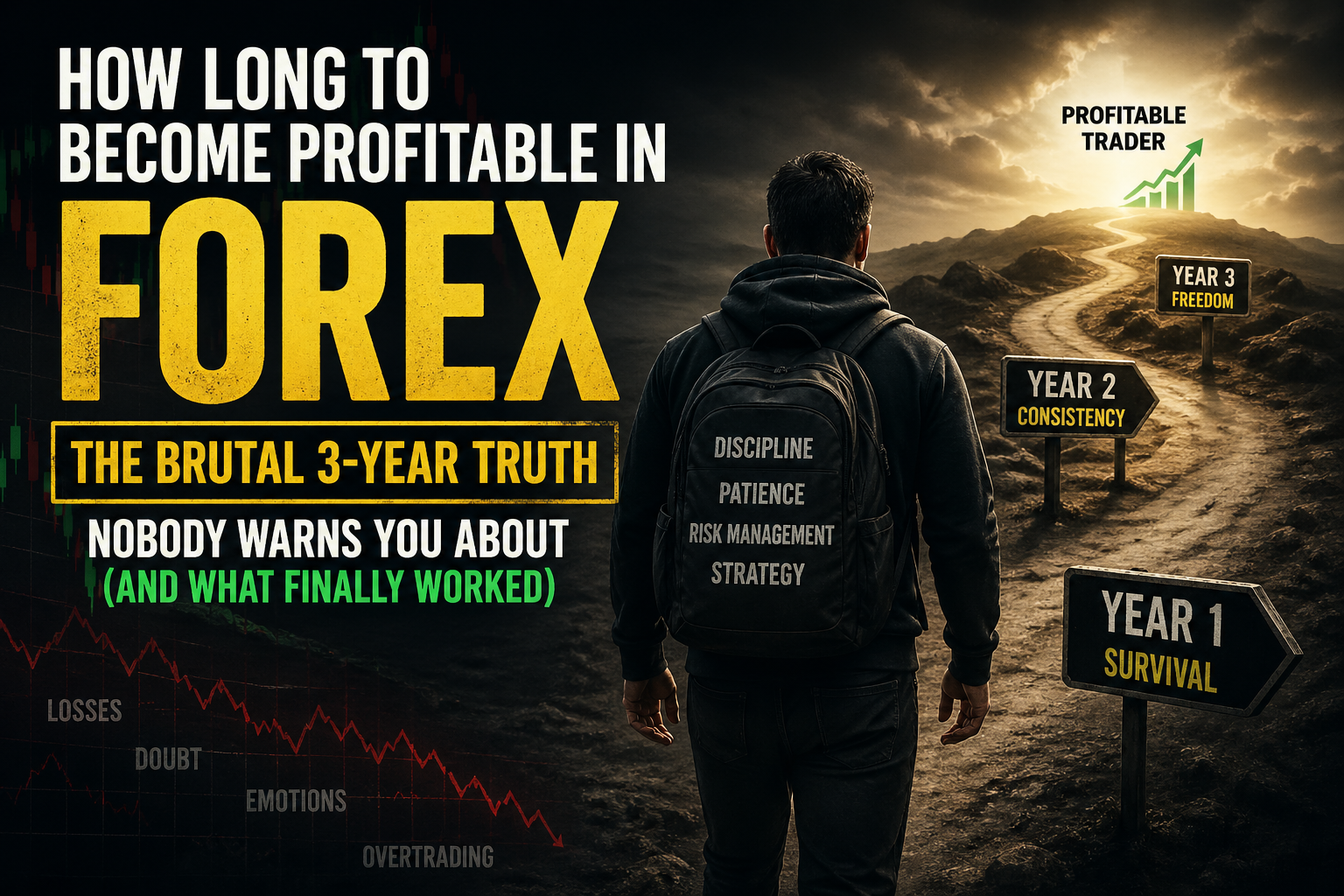
How long to become profitable in forex: The Brutal 3-Year Truth Nobody Warns You About (And What Finally Worked)
Introduction: The Forex Dream vs. The Forex Reality
Let me be completely honest with you.
When I first stumbled into forex trading, I was 24 years old, sitting in a tiny apartment, watching YouTube videos of traders flipping laptops open at the beach and pulling in thousands of dollars before lunch. I was hooked. I mean, really hooked- the kind of hooked where you start cancelling plans with friends because you’d rather watch candlestick patterns on a Saturday night.
I thought I’d be profitable within three months. Maybe six if I was unlucky. I had a degree, I was reasonably smart, and I figured how hard could this really be?
Three years, five blown accounts, and more sleepless nights than I care to admit later, I finally crossed into consistent profitability. And the journey completely shattered every expectation I walked in with.
This post is not a motivational speech. It’s not a sales pitch. It’s the raw, honest, sometimes embarrassing truth about how long it takes to become profitable in forex, what derailed me at every stage, and the specific things that ultimately turned everything around. If you’re just starting out, or you’ve been grinding for months with nothing to show for it, I wrote this for you.

How Long Does It Really Take to Become Profitable in Forex?
Let’s tackle the big question head-on, because it’s the one everyone types into Google at 2 a.m.
The answer? It depends but if you want a realistic number, think 1 to 3 years of dedicated, structured effort. According to Daily Price Action, even experienced traders can take close to a decade to “get it right,” and that’s not an outlier, it’s more common than the trading community likes to admit.
It takes about three years of trading before someone can become a consistently profitable forex trader. One must absorb lots of fundamental and technical research and experience before achieving a level of competency. Time, effort, and discipline are necessary to reach this level.
Traders who are the most committed and use their available time well can expect to see steady profits within six to twelve months. For those learning forex from scratch around a full-time job, a longer time frame of anything between one to five years is more realistic.
For me personally? It was 36 months. And even after month 36, I wasn’t printing money — I was simply no longer consistently losing it. True, steady profitability came around the four-year mark once I had a system I trusted and the emotional discipline to follow it.
Why Most Forex Traders Underestimate the Timeline
Here’s what nobody tells you at the beginning: forex profitability is not about intelligence. It’s not even primarily about strategy. It’s about the gradual, often painful development of a complete skillset that includes:
- Technical analysis – reading charts, patterns, support and resistance
- Fundamental analysis – understanding how economic data moves currency pairs
- Risk management – knowing exactly how much to risk on every single trade
- Trading psychology – managing fear, greed, revenge trading, and overconfidence
- System consistency – executing a plan the same way every single time, regardless of emotion
Becoming consistently profitable demands developing emotional discipline, risk management skills, and the psychological resilience to handle both wins and losses without letting emotions drive your decisions.
Most beginners focus almost entirely on strategy finding “the holy grail indicator” or the “best setup.” I was guilty of this myself. I spent months jumping from one strategy to another, convinced that profitability was just one more YouTube tutorial away.
It wasn’t.
My Personal Forex Profitability Timeline Year by Year
I want to walk you through my exact experience because I think it maps closely to what a lot of traders go through. If you’re in year one or two and feeling hopeless, this section might save you from quitting too soon.
Year One – The Honeymoon Phase (And the First Wipeout)
Year one was a rollercoaster. I opened my first live account with $500 after spending about two months on a demo. I thought I was ready. I wasn’t even close.
The first three months were actually decent. Beginner’s luck is real I hit a few good trades on EUR/USD and GBP/USD, doubled my money briefly, and started telling people I was “a forex trader.” That was a mistake.
Overconfidence crept in quickly. After some successful trades, it’s easy to feel overly confident. Winning can make you feel invincible and lead you to ignore your plan or jump back into trading without thinking.
By month five, I had blown that $500 account entirely. I doubled my position sizes when I should have been protecting capital. I held losing trades hoping they’d “come back.” They didn’t.
Key lessons from year one:
- Demo trading does not prepare you for the emotional weight of live trading
- Early profits can be more dangerous than early losses they create false confidence
- The forex market does not care about your feelings, your rent, or your expectations
- Breaking even at the end of year one is genuinely a win, as most currency traders who can at least break even after one year of trading will often become profitable traders in the years that follow.
Year Two – The Dark Valley
Year two was the hardest. I call it the dark valley because it’s where most traders quit and honestly, I almost did too.
I funded two more accounts. I blew both of them. Not because I didn’t know what I was doing technically, but because I was trading emotionally. Every loss triggered a desperate need to “get it back,” which is the textbook definition of revenge trading.
Revenge trading is when you want to quickly trade again after a loss to make up for it. I was doing this almost every session. A bad trade in the morning would set the emotional tone for my entire day. I’d overtrade, undersize my winners, let my losers run, and then spend the evening staring at my trading journal wondering what went wrong.
What actually went wrong? I had no real system. I had a collection of setups I sort of understood, a vague idea of risk management, and zero psychological structure.
What changed in year two (eventually):
- I started keeping a proper trading journal – noting not just outcomes but emotions before and during every trade
- I cut my position sizes drastically and accepted that small consistent gains were the goal, not home runs
- I stopped trading during high-impact news events that I didn’t understand
- I started learning about trading psychology – books like Mark Douglas’s Trading in the Zone genuinely shifted my thinking
Year Three The Turning Point
Year three is when things finally started to click. Not because I found some magic indicator or paid for an expensive course, but because I had finally accumulated enough screen time to recognize patterns in my own behavior and I had a system I was willing to commit to.
The more time you spend studying your charts each day and journaling your observations, the sooner you’ll achieve consistent profits.
I also made one of the best decisions of my trading career in year three: I started using a structured, rules-based approach and stopped improvising. Every trade had defined entry criteria, a pre-set stop loss, and a target. I was no longer “feeling” the market I was executing a plan.
By the end of year three, I had my first green quarter. Not massive returns but consistent, repeatable profits over three months. That felt better than anything I’d experienced in the previous two years combined.

The 5 Biggest Mistakes That Delayed My Forex Profitability
Looking back with clear eyes, these five mistakes cost me the most time and money on my journey to forex profitability.
Mistake #1 – Jumping Into Live Trading Too Fast
I spent barely two months on demo before going live. That was nowhere near enough. Unless you educate yourself, to start trading with live funds is disastrous. There’s a myriad of trading educators littered across the internet some knowledgeable, some not so.
A demo account isn’t just for practicing entries and exits. It’s for developing your process learning how to analyze, plan, execute, and review without the emotional pressure of real money on the line. I skipped this phase and paid dearly for it.
What I recommend instead:
- Spend at least 3–6 months on demo, aiming for at least 100 structured trades
- Track every single trade in a journal setup, entry, exit, emotion, outcome
- Only go live when you’re profitable on demo for at least two consecutive months
Mistake #2 – Overtrading and Chasing the Market
Overtrading, also known as churning, is excessive buying and selling in the market a mistake often seen among shorter-term traders. Overtrading is generally committed by those who have no trading plan.
I was guilty of this constantly in my first two years. I felt like I needed to be in a trade to be “doing something.” I’d force setups that weren’t there, jump in on impulse, and then wonder why my win rate was terrible.
The irony is that trading less was one of the biggest improvements to my profitability. Quality over quantity is not a cliché in trading it is an absolute truth.
Mistake #3 – Ignoring Risk Management
This is the one that blew my accounts. Not bad strategy but bad risk management.
I was risking 10%, 15%, even 20% of my account on single trades. One string of losses which happens to every trader and the account is gone. Many beginners focus only on potential profits and forget to plan for losses, leaving themselves exposed when the market moves unexpectedly.
The rule that saved me? Never risk more than 1–2% of your account on any single trade. It sounds boring. It is boring. It also keeps you in the game long enough to actually learn.
Mistake #4 Strategy-Hopping
Every time I hit a losing streak, I abandoned my strategy and went looking for a new one. This is one of the most destructive patterns a forex trader can fall into because you never give any single approach enough time to prove itself.
You have to be extremely systematic with a lot of discipline which took the longest for me. The market is always changing, therefore it’s only normal to change your plan but you need to learn to spot a good trend first.
Every strategy has losing periods. Every. Single. One. The question is whether your edge holds up over a large sample size not whether it works on every trade. I needed to understand statistics before I could understand strategy.
Mistake #5 – Neglecting Trading Psychology
I saved this for last because it’s the one most beginners dismiss as “soft” and it’s almost certainly the hardest part of becoming profitable.
When faced with the prospect of losing money or making a profit, we are all subject to powerful emotions such as fear and greed that can influence our actions. Unfortunately, in forex trading, making decisions based on emotions will soon lead you on a downward spiral of failure.
My emotional reactions to trades were sabotaging me far more than any technical shortcoming. Fear made me cut winners too early. Greed made me hold losers too long. Frustration made me overtrade after a bad session.
Until I addressed the psychological side through journaling, meditation, strict pre-trade routines, and genuine self-awareness I couldn’t sustain any edge I developed technically.
The Stages of Becoming a Profitable Forex Trader
Every trader who reaches profitability goes through recognizable stages. Understanding where you are in this journey can help you stay patient and focused.
| Stage | Timeframe (Approx.) | What’s Happening | Common Pitfall |
|---|---|---|---|
| Stage 1: Unconscious Incompetence | Months 1–3 | You don’t know what you don’t know. Early beginner’s luck possible. | Overconfidence, risking too much |
| Stage 2: Conscious Incompetence | Months 3–12 | You realize how much you don’t know. Losses mount. Frustration builds. | Quitting, revenge trading |
| Stage 3: Conscious Competence | Year 1–2 | You’re developing real skills but have to think hard about every decision. | Strategy-hopping, inconsistency |
| Stage 4: Unconscious Competence | Year 2–4 | Your process becomes second nature. Emotional control improves. | Complacency, over-scaling too fast |
| Stage 5: Consistent Profitability | Year 3+ | You have a genuine edge, manage risk well, and execute without emotion. | Overconfidence returning at scale |
This table is not a rigid prescription some people will take a year, others will take two years, and some will take three years. A few can take less than one year to be profitable. But in my experience, most traders who make it through to consistent profitability follow a path that looks roughly like this.
Key Factors That Determine How Fast You Become Profitable in Forex
Your timeline to forex profitability isn’t random. Several controllable factors dramatically influence how quickly or slowly you develop a real edge.
Time Commitment and Screen Time
The amount of time you commit to Forex has a direct impact on the amount of time it will take you to become profitable. All else being equal, the trader who commits four hours per day to studying the markets is going to develop faster than the trader who only devotes one hour per day.
This isn’t just about watching charts. It’s about deliberate practice studying setups, reviewing your trades, backtesting your strategy, and reading about market dynamics. The traders I know who progressed fastest treated this like a second job, not a hobby.
Quality of Education and Mentorship
Many new traders learn the craft as an apprentice, from a trader who is already successful. If someone is willing to impart their experience, it tends to speed up the learning curve.
I wasted years learning from the wrong sources flashy Instagram traders with rented Lamborghinis and no verifiable track record. When I finally found structured, credible education backed by real, transparent results, my progress accelerated significantly.
This is also why tools like VTM Automated System can be genuinely valuable not as a shortcut to avoid learning, but as a structured framework that gives newer traders a disciplined, tested approach while they develop their own skills. Having a rules-based system to lean on during the emotionally turbulent early years is something I genuinely wish I’d had from day one.
Capital Size
This one is often overlooked but matters more than most traders realize. The time it takes to become profitable in Forex trading varies depending on factors such as the amount invested, the trading strategy used, and the ability to analyze market trends.
Trading with $200 is fundamentally different from trading with $5,000 not because the charts look different, but because the psychological pressure is different. Under-capitalized traders often feel compelled to use excessive leverage to make “meaningful” money, which dramatically increases their risk of blowing an account.
Start with enough capital that you can trade proper position sizes with 1–2% risk per trade. If that’s not possible yet, spend more time on demo and save until you can.
Risk Management Framework
I cannot stress this enough. Every conversation about forex profitability timelines should center on risk management because it is the single factor that keeps you alive long enough to develop your skills.
Key risk management principles that transformed my trading:
- 1–2% max risk per trade – this is non-negotiable
- Risk-to-reward ratio of at least 1:2 – meaning you target twice what you risk
- No martingale strategies – doubling down on losers is a fast route to a blown account
- Stop losses on every single trade, set before entry – the key is to set defined protective stop-loss levels and not deviate. You make this decision prior to pulling the trigger; therefore, you’re not as emotionally charged as you will often be during a trade.
Trading Psychology and Emotional Discipline
Success requires more than technical knowledge. While anyone can master the mechanics of currency trading through self-study and practice, becoming consistently profitable demands developing emotional discipline, risk management skills, and the psychological resilience to handle both wins and losses.
The traders who reach profitability fastest are not always the most technically gifted. They’re often the most emotionally disciplined. They follow their system on bad days as faithfully as on good days. They don’t make exceptions for “gut feelings.” They treat a loss as data, not as a personal failure.
Building this kind of discipline takes time. But it can be accelerated through:
- Daily journaling – tracking not just trades but emotional states
- Pre-trade checklists – forcing yourself to slow down before every entry
- Regular review of past trades – identifying patterns in both winning and losing behavior
- Meditation or mindfulness practices – building general emotional regulation capacity
What Nobody Tells You About the Forex Profitability Journey
Beyond the technical and psychological factors, there are some brutal truths about forex trading that most courses and gurus conveniently leave out.
Most Forex Traders Never Become Consistently Profitable
This is not meant to discourage you, it’s meant to prepare you. Forex trading can be challenging and requires a lot of hard work, discipline, and dedication. Therefore, it is essential to educate yourself and develop a strong understanding of the market before jumping in.
Across the industry, broker disclosures routinely show that 70–80% of retail traders lose money. The traders who beat those odds are not lucky, they’re the ones who took the process seriously enough to do what most people won’t: study patiently, manage risk obsessively, and keep going through the inevitable difficult periods.
Profitable Doesn’t Mean Rich (At Least Not Yet)
When I finally hit consistent monthly profits, it was not transformational money. It was proof of concept. It was the foundation. The transition from “consistently profitable with a small account” to “earning a meaningful income from trading” requires scaling capital and that brings its own set of psychological and technical challenges.
A consistently profitable Forex trader isn’t confined merely to trading terminals and technical analysis; a professional trader is also an avid consumer of global economic and financial developments.
The lifestyle you see promoted on social media is the exception, not the rule and even for those traders who do reach that level, it typically took many years of grinding through exactly the kind of journey I’ve described here.
The Market Will Test You Personally, Not Just Technically
This was the most surprising realization of my forex journey. The market has an almost uncanny ability to find your exact psychological weak point and exploit it.
Are you someone who hates being wrong? You’ll hold losing trades far too long, hoping they’ll come back.
Are you naturally impatient? You’ll take profits too early and miss the bulk of the move.
Do you have a scarcity mindset around money? You’ll overtrade because you feel like you need to be making money every single session.
Your personal psychology shows up in your trading results more clearly than almost any other area of life. Working on yourself genuinely, seriously is not optional in this game. It’s central to profitability.
How to Speed Up Your Path to Forex Profitability
While there are no shortcuts, there are definitely smarter and dumber ways to approach this journey. Here’s what actually worked for me — and what I’ve seen work for others.
Master One Pair, One Timeframe First
Stop trying to trade every pair and every timeframe. When I narrowed my focus to EUR/USD on the 4-hour chart for six straight months, my results improved dramatically. Focus on consistent profitability before chasing extraordinary returns. The traders who build lasting wealth in forex prioritize steady, compound growth over spectacular gains, treating trading as a serious business rather than a get-rich-quick scheme.
Backtest Ruthlessly Before Trading Live
Before I put real money on any strategy, I now backtest it over at least 200 historical trades. Backtesting tells you:
- What the win rate actually is
- What the drawdown looks like
- Whether the edge holds across different market conditions
- How long the losing streaks typically last (so you don’t panic and abandon a valid strategy)
This step alone would have saved me years of unnecessary trial and error.
Use a Structured Trading System
One of the most underrated accelerators of forex profitability is trading within a structured, rules-based system rather than making discretionary decisions based on what “feels right” in the moment.
This is exactly what attracted me to the VTM Automated System. It removes the emotional component from trade execution and enforces a consistent, tested approach. For traders who struggle with discipline or consistency, having that kind of framework is genuinely valuable, it’s not a crutch, it’s a scaffold that supports you while you build real skills.
Find a Community and Accountability Partner
Trading alone is isolating and slow. Finding a community of serious traders not Instagram hype merchants but people doing the actual work accelerates your development in ways that solo study can’t match. You get exposure to different perspectives, you get called out when you’re making avoidable mistakes, and you stay accountable to your goals.
Trade Like a Business, Not a Gambler
The mindset shift that finally made everything click for me was treating my trading like a business with real metrics, KPIs, and performance reviews. Every month I reviewed:
- Win rate
- Average risk-to-reward
- Maximum drawdown
- Number of trades
- Emotional rating per trade
This data-driven approach stripped out the emotional narrative I was telling myself about my trading and showed me the actual numbers. Numbers don’t lie and they don’t have egos.
Forex Profitability Benchmarks Where Should You Be?
Here’s a realistic set of benchmarks for where you should be at each stage of your development, based on my experience and the broader trading community.
| Period | Realistic Goal | Key Focus |
|---|---|---|
| Months 1–3 | Understanding basics, demo trading only | Education, chart reading, basic risk management |
| Months 3–6 | Consistent demo profitability, journal established | Refining strategy, emotional awareness |
| Months 6–12 | Break-even or small live profits | Consistency, position sizing, avoiding overtrading |
| Year 1–2 | Consistently break-even; occasional profitable months | Psychology, patience, full system development |
| Year 2–3 | Sustainable profitability with growing account | Risk management mastery, scaling discipline |
| Year 3+ | Consistent monthly profits, potential income replacement | Optimization, scaling, diversification |
This isn’t a guarantee it’s a realistic roadmap. Your individual timeline will vary based on the factors discussed earlier, particularly time commitment, quality of education, and psychological development.
The Role of Automated and Algorithmic Tools in Forex Profitability
One conversation that’s increasingly important in the modern forex landscape is the role of automated trading systems and algorithmic tools. And I want to be honest here, because this is a space full of both genuine opportunity and significant hype.
During my journey, I resisted automation for a long time because I believed I needed to “learn to trade manually first.” That’s not wrong understanding the fundamentals before delegating to any system is important. But I also came to recognize that the right automated tools, used correctly, can support your trading in meaningful ways.
A well-designed system like the VTM Automated System can help traders in several key areas:
- Removing emotional bias – executing trades based on pre-set rules rather than feelings
- Consistency – applying the same criteria every time, without fatigue or distraction
- Risk management enforcement – never risking more than defined parameters, even during drawdown
- Freeing up time – allowing you to learn and develop while having a structured approach running in the background
The key is understanding that automation supports your trading journey, it doesn’t replace the education, the skill development, or the psychological work. Think of it as a co-pilot, not an autopilot.
Frequently Asked Questions About Forex Profitability
Can I become profitable in forex in 3 months?
It’s possible but unlikely for most traders. On average, it can take several months to several years of consistent learning and practice to become consistently profitable in Forex trading. Three months of focused, disciplined practice can absolutely establish a solid foundation but genuine, sustained profitability in that timeframe would be exceptional. Focus on break-even at 3 months and build from there.
Is forex trading profitable for beginners?
Not initially and that’s completely normal. Forex trading has a steep learning curve. The first year of trading currencies should be all about learning how to trade. There are important lessons to learn when it comes to approaching markets, executing trades, and monitoring risk. Achieving break-even at the end of year one can be a victory.
How much money do I need to start forex trading profitably?
There’s no single answer, but starting with less than $1,000 makes proper risk management very difficult without using extreme leverage. Many experienced traders recommend starting with at least $2,000–$5,000 to allow proper position sizing at 1–2% risk per trade.
Do most forex traders fail?
Yes, the majority of retail forex traders lose money, particularly in their first few years. But this does not mean forex is impossible to profit from. It means that approaching it seriously, with proper education, risk management, and patience, is genuinely what separates the minority who succeed from the majority who don’t.
What is the fastest way to become profitable in forex?
The fastest path to forex profitability combines: quality education from credible sources, intensive demo practice, strict risk management from day one, a rules-based strategy applied consistently, and serious attention to trading psychology. There are no genuine shortcuts — but there are smarter approaches that reduce unnecessary trial and error.
How do I know when I’m ready to scale my forex trading?
Scale only when you have at least 3–6 months of consistent profitability on your current position size, your win rate and risk-to-reward ratios are stable across different market conditions, and you can genuinely say your emotional reaction to individual trades does not drive your decisions. Scaling too early is one of the most common ways profitable traders regress.
Conclusion:
If I could go back and give myself one piece of advice before I started trading, it would be this: treat the first two years as tuition, not as an income source.
The market is going to take money from you while you learn. That’s not a failure that’s the price of education. Every blown account, every painful loss, every sleepless night reviewing bad trades is part of building the skillset that eventually produces real, consistent profits.
Time and patience are your greatest allies in this journey. The path from beginner to successful trader typically spans months to years, not weeks, and those who approach forex with realistic expectations and a commitment to continuous learning have the best chance of long-term success.
The traders who quit at month six, month twelve, or even month eighteen often quit right before things start clicking. I’ve seen it happen to people who were this close to turning the corner.
Don’t be that person.
Invest in your education. Build your system. Master your emotions. Manage your risk obsessively. And use every tool available to you including structured resources like the VTM Automated System – to build a sustainable, repeatable trading business.
The journey is longer than you think. But for those who see it through? It’s absolutely worth it.
Disclaimer: Forex trading involves significant risk and is not suitable for all investors. Past performance is not indicative of future results. Always trade responsibly and only risk capital you can afford to lose.
Do-Follow External Links: