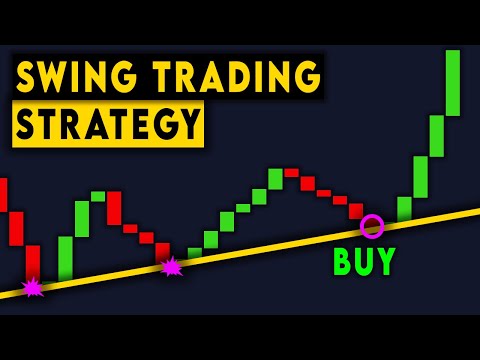
Most people who want to trade forex imagine themselves glued to screens at 2 a.m., watching candles flicker while adrenaline courses through their veins. They picture the chaos of day trading, rapid decisions, lightning-fast executions, and an almost superhuman ability to process information in milliseconds.
Here’s the thing, that doesn’t have to be your reality.
There is a smarter, calmer, and arguably more profitable way to participate in the world’s largest financial market. It’s called swing trading forex, and it might just be the most beginner-friendly strategy that most new traders completely overlook.
Right now, as you read this, experienced traders are quietly holding positions for days or weeks at a time, reviewing their charts for just 30–60 minutes each day, and walking away with returns that beat out many frantic day traders. They’re not burning out. They’re not watching every pip. And they’re building wealth steadily, one well-placed trade at a time.
If you’re new to forex and wondering whether you can actually make this work especially without quitting your job or abandoning your life, this guide is exactly what you need. We’re going to break down everything from what swing trading actually is, to the best strategies for beginners, the tools you’ll need, the mistakes you must avoid, and exactly how to get started.

The forex market processes over $7.5 trillion in daily volume. There is no shortage of opportunity. The only question is: are you ready to approach it the right way?
1. What Is Swing Trading Forex? (And Why It’s Perfect for Beginners)
At its most basic level, swing trading forex is a trading style where you hold positions in currency pairs for anywhere from a few days to a few weeks, aiming to profit from medium-term price “swings”, the natural up-and-down movements that happen within larger trends.
Unlike day traders who open and close every position within a single session, swing traders are patient. They identify a directional opportunity, enter with a plan, and then step back, letting the trade develop over time.
Think of it this way: if the forex market is a river, a day trader is someone desperately fighting the current second by second. A swing trader, on the other hand, spots the general flow of the river, jumps in at the right moment, and rides the current to a predetermined destination.
Why Is Swing Trading Ideal for Beginners?
Here are the key reasons why this trading style is genuinely beginner-friendly:
- Less screen time required. You don’t need to monitor markets throughout the day. Most swing traders spend 30–60 minutes on analysis and trade management daily, making it compatible with a full-time job or other commitments.
- More time for decision-making. Because you’re working on higher timeframes (typically the 4-hour and daily charts), you have hours — sometimes a full day — to analyze a setup before pulling the trigger. There’s no frantic clicking.
- Reduced emotional stress. Day trading is notoriously stressful. The rapid back-and-forth of prices plays havoc with emotions. Swing trading’s slower pace allows you to think more clearly and trade more rationally.
- Better risk-to-reward potential. Since you’re targeting larger moves over multiple days, you can often aim for risk-to-reward ratios of 1:2, 1:3, or even better. That means even if you’re wrong 40% of the time, you can still be profitable overall.
- Smaller account requirements. You don’t need to be a high-frequency trader or have institutional capital. Many beginners start swing trading forex with as little as $500–$1,000, though having $2,000–$5,000 provides more flexibility.
The core goal of swing trading is beautifully simple: buy low, sell high (in an uptrend) or sell high, buy low (in a downtrend). The strategy is about identifying where a currency pair is likely headed over the next few days, entering at a favorable price, and exiting at your target.
2. Swing Trading vs. Day Trading vs. Scalping: The Real Differences
Before going deeper, it’s important you understand how swing trading stacks up against other popular trading styles. Many beginners stumble simply because they pick a style that doesn’t match their lifestyle or personality.
| Feature | Scalping | Day Trading | Swing Trading |
|---|---|---|---|
| Trade Duration | Seconds to minutes | Hours (within one day) | Days to weeks |
| Time Commitment | 4–8+ hours/day of intense focus | 4–8 hours/day | 30–60 minutes/day |
| Stress Level | Very High | High | Moderate |
| Best Timeframes | 1-min, 5-min charts | 15-min, 1-hour charts | 4-hour, Daily charts |
| Number of Trades/Month | Hundreds | Dozens | 5–15 |
| Profit Per Trade | Very small (pips) | Small to medium | Medium to large |
| Overnight Risk | None | None | Yes |
| Beginner Friendly? | ❌ No | ❌ No | ✅ Yes |
| Full-Time Job Compatible? | ❌ No | ❌ No | ✅ Yes |
So Which Is Best?
If you have a full-time job, family obligations, or simply don’t want to stare at charts all day — swing trading wins, hands down. The reduced time commitment doesn’t mean reduced opportunity. In fact, many experienced traders argue that the higher timeframes used in swing trading produce cleaner, more reliable signals than the noise-filled lower timeframes.
3. How the Forex Market Works: What Every Beginner Must Understand First
Before you ever place a trade, you need to understand the environment you’re trading in. The forex (foreign exchange) market is where global currencies are bought and sold. It’s the world’s largest and most liquid financial market, operating 24 hours a day, five days a week.
The Basics You Need to Know
Currency Pairs: Forex is always traded in pairs. When you buy EUR/USD, for example, you’re simultaneously buying the Euro and selling the U.S. Dollar. Every pair has a base currency (EUR) and a quote currency (USD). The price tells you how many units of the quote currency you need to buy one unit of the base.
Pips: A pip is the standard unit for measuring how much a currency pair moves. For most pairs, a pip is the fourth decimal place (0.0001). So if EUR/USD moves from 1.1000 to 1.1050, that’s a 50-pip move.
Lots: Forex is traded in “lots.” A standard lot is 100,000 units of currency. Most brokers offer mini lots (10,000 units) and micro lots (1,000 units) that are much more suitable for beginners.
Leverage: Leverage allows you to control a large position with a small amount of capital. A 1:100 leverage means $1,000 in your account controls $100,000 worth of currency. This amplifies both profits AND losses, which is why risk management (covered later) is absolutely critical.
Spread: The spread is the difference between the buy (ask) price and the sell (bid) price. This is how most brokers make their money. Tighter spreads mean lower trading costs.
The Four Major Trading Sessions
The forex market operates through four overlapping trading sessions:
- Sydney Session — Opens Sunday 10 PM GMT, generally the quietest session.
- Tokyo Session — Opens Monday 12 AM GMT, best for JPY pairs.
- London Session — Opens Monday 8 AM GMT, one of the most active sessions.
- New York Session — Opens Monday 1 PM GMT, another high-activity session.
For swing traders, the exact session matters less than it does for day traders, since you’re working on higher timeframes. However, knowing when major economic events are released can save you from entering a trade right before a volatility spike.
4. The 9 Best Swing Trading Forex Strategies for Beginners
Now we get to the heart of it the actual strategies. As a beginner, you don’t need to master all of these immediately. The goal is to start with one or two that resonate with your thinking style, master them on a demo account, and then apply them to real money.
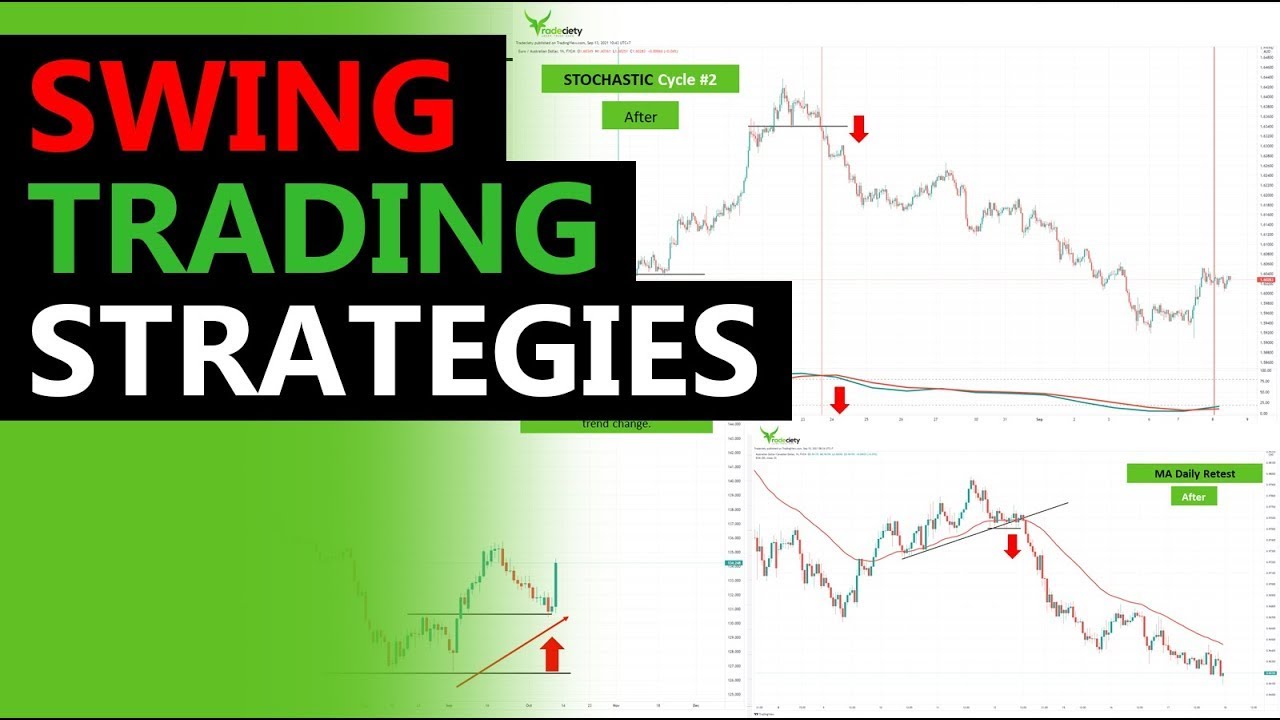
Strategy 1: Trend Following (The Foundation of All Swing Trading)
Trend following is, without question, the single most beginner-friendly swing trading strategy available. The concept is elegantly simple: the trend is your friend, trade in the direction of the market’s dominant move.
How it works:
- Identify whether a currency pair is in an uptrend (making higher highs and higher lows) or a downtrend (making lower highs and lower lows).
- Wait for a pullback, a temporary move against the main trend.
- Enter the trade when the pullback shows signs of exhaustion and the trend is resuming.
- Set your stop loss below the most recent swing low (in an uptrend) or above the most recent swing high (in a downtrend).
- Set your target at the next significant level of resistance (uptrend) or support (downtrend).
Example: EUR/USD has been making higher highs and higher lows for several weeks. It pulls back to a key support zone and forms a bullish candlestick pattern. You enter long (buy), place your stop below the swing low, and target the previous high.
Why it works for beginners: You’re not trying to predict reversals you’re following what the market is already doing. The probability of the trend continuing is almost always higher than the probability of it reversing.
Strategy 2: Support and Resistance Trading
Every experienced forex trader understands that price has memory. Levels where price has previously reversed called support (below price) and resistance (above price) tend to act as barriers again in the future.
How it works:
- Identify key horizontal support and resistance levels on the daily or 4-hour chart.
- Buying at support: When price approaches a strong support zone during an uptrend, look for bullish reversal signals (like a pin bar or engulfing candle) to enter long.
- Selling at resistance: When price approaches a strong resistance zone during a downtrend, look for bearish reversal signals to enter short.
- Stop loss goes just beyond the level (e.g., below support for a long trade).
- Target is the next major level in the direction of your trade.
Pro tip: The more times a level has been tested and held, the more significant it is. Also, when support breaks, it often becomes resistance, and vice versa this is called a “role reversal” and is a powerful concept to internalize.
Strategy 3: Breakout Trading
Price doesn’t trend forever. Periods of consolidation where price is stuck between support and resistance in a tight range inevitably give way to breakouts in one direction. Capturing these breakouts is a powerful swing trading approach.
How it works:
- Identify a consolidation zone where price has been ranging (moving sideways) for multiple days or weeks.
- Wait for a strong candle to close above resistance (bullish breakout) or below support (bearish breakout). A close is important, don’t jump in on a wick.
- Enter in the direction of the breakout on the next candle.
- Stop loss goes just inside the consolidation zone.
- Target is typically the width of the consolidation range, projected in the direction of the breakout.
Why this works: Consolidation zones represent a “compression” of energy in the market. When price finally breaks out, it often does so with force, giving swing traders a clean, directional move to ride.
Strategy 4: Moving Average Crossover
Moving averages smooth out price data and help identify the overall direction of the trend. The crossover strategy uses two moving averages — one faster and one slower and trades when they cross.
Common settings for swing trading:
- 50 EMA (Exponential Moving Average) and 200 EMA on the daily chart.
- When the 50 EMA crosses above the 200 EMA → Golden Cross → bullish signal.
- When the 50 EMA crosses below the 200 EMA → Death Cross → bearish signal.
How to trade it:
- Wait for the crossover to confirm.
- On the 4-hour chart, look for a pullback toward the faster moving average.
- Enter in the direction of the crossover when the pullback shows signs of ending.
- Use the most recent swing low/high for your stop loss.
This strategy works particularly well when combined with support/resistance confirmation. Moving averages alone can produce false signals in ranging markets, so context always matters.
Strategy 5: Fibonacci Retracement Entries
The Fibonacci retracement tool is one of the most elegant tools in a swing trader’s arsenal. Based on the famous mathematical sequence, key retracement levels (38.2%, 50%, 61.8%) often act as precise entry zones within a trending move.
How it works:
- Identify a clear swing high and swing low in a trending market.
- Draw the Fibonacci retracement from the swing low to the swing high (in an uptrend) or from the swing high to the swing low (in a downtrend).
- Wait for price to pull back into a key Fibonacci zone, typically the 50% or 61.8% level.
- Look for a candlestick reversal signal at the Fibonacci level as a trigger to enter.
- Stop loss goes just beyond the next Fibonacci level.
- Target is the previous swing high (or low in a downtrend).
Why traders love this strategy: It provides extremely precise entry points with tight stop losses, which means better risk-to-reward ratios. The 61.8% level (often called the “golden ratio”) is particularly powerful.
Strategy 6: Price Action with Candlestick Patterns
Price action trading means making decisions based purely on what price is doing no fancy indicators, just raw candlestick data. It’s arguably the most versatile and enduring form of market analysis.
Key candlestick patterns every swing trader must know:
- Pin Bar (Hammer/Shooting Star): A candle with a very long wick and small body. Shows that price was rejected from a level — a strong reversal signal when found at key support/resistance.
- Engulfing Candle: When a large candle completely “engulfs” the previous candle. A bullish engulfing (green candle covers previous red) signals buyers taking control. A bearish engulfing (red covers green) signals sellers taking control.
- Inside Bar: A candle whose entire range sits within the previous candle’s range. Represents indecision and often precedes a breakout.
- Doji: A candle where open and close are almost the same, indicating a battle between buyers and sellers. Often signals a reversal when found at key levels.
How to use them: Never trade a candlestick pattern in isolation. Always look for these patterns at key levels — at support, resistance, trend lines, or Fibonacci zones. A pin bar appearing in the middle of nowhere is far less powerful than one forming right at the 61.8% Fibonacci level and a major support zone.
Strategy 7: Trendline Bounce Strategy
A trend line connects a series of higher lows in an uptrend or lower highs in a downtrend. When price returns to test a valid trend line, it often bounces, providing a swing trading entry opportunity.
How it works:
- Draw a trend line connecting at least three swing lows (uptrend) or swing highs (downtrend). Two points create a line — three points confirm it.
- Wait for price to pull back to the trend line.
- Look for a bullish reversal signal on the 4-hour chart at the trend line touch.
- Enter with your stop just below the trend line (with some buffer).
- Target the previous swing high in the uptrend.
Key rule: A valid trend line must have at least three confirmed touches with clear price reactions. Two-point trend lines are speculative; three-point trend lines are significant.
Strategy 8: Break of Structure (Smart Money Concepts)
This is a more advanced but increasingly popular approach, especially among younger traders. It’s based on the idea that institutional traders (banks and hedge funds) move markets and leave footprints in the form of structural breaks.
Core concepts:
- A Break of Structure (BOS) occurs when price breaks through the most recent swing high (bullish) or swing low (bearish), signaling trend continuation.
- A Change of Character (CHoCH) is when price breaks a key level in the opposite direction — signaling a potential trend reversal.
- After a structural break, price often returns to retrace before continuing. This retracement zone is your entry point.
Why this matters: By understanding where institutional orders are placed (at liquidity zones, fair value gaps, and structural levels), you align your trades with the most powerful forces in the market — the big money.
Strategy 9: Multi-Timeframe Analysis
This isn’t a standalone strategy, it’s a framework that dramatically improves every strategy you use. The concept is simple: use a higher timeframe to determine the overall direction (bias) and a lower timeframe to pinpoint your entry.
The Three-Timeframe Approach:
| Timeframe | Purpose |
|---|---|
| Weekly Chart | Overall trend direction (big picture bias) |
| Daily Chart | Identify key levels, patterns, and setups |
| 4-Hour Chart | Time your entry with precision |
Example: On the weekly EUR/USD chart, you see a clear uptrend. On the daily chart, price has pulled back to a major support zone and formed a pin bar. On the 4-hour chart, price is beginning to show bullish momentum. You enter long with the trend, with a high-probability setup confirmed across three timeframes.
Why this is so powerful: It filters out noise and false signals. When a setup aligns across multiple timeframes, the probability of success increases significantly.
5. Best Currency Pairs for Swing Trading Beginners
Not all currency pairs are created equal. As a beginner, you want pairs that are:
- Liquid — heavily traded, meaning your orders fill cleanly and spreads are tight.
- Trending — prone to clear directional moves rather than choppy, sideways action.
- Predictable — influenced by well-understood economic factors.
Here are the best pairs for beginner swing traders:
| Currency Pair | Nickname | Why It’s Good for Beginners |
|---|---|---|
| EUR/USD | “The Fiber” | Most traded pair in the world; tight spreads, clean trends |
| GBP/USD | “The Cable” | High volatility, good for capturing large swings |
| USD/JPY | “The Gopher” | Excellent for trend-following; reacts clearly to risk sentiment |
| AUD/USD | “The Aussie” | Tied to commodity prices; clear trends |
| USD/CHF | “The Swissie” | Inversely correlated to EUR/USD; clean price action |
| EUR/GBP | — | Less volatile; good for conservative entries |
Start with one or two pairs. One of the biggest mistakes beginners make is trying to trade too many pairs at once. Master EUR/USD first. Once you’re consistently profitable there, consider adding one or two more.
6. Essential Technical Indicators for Forex Swing Traders
Indicators are tools, not crystal balls. The best traders use a small set of carefully chosen indicators to confirm what they’re already seeing in price action not to replace critical thinking.
Here are the most valuable indicators for swing trading forex:
- Moving Averages (50 EMA, 200 EMA): Help identify trend direction and act as dynamic support/resistance levels. The 200 EMA is particularly respected as a key dividing line between bullish and bearish market conditions.
- Relative Strength Index (RSI): An oscillator that measures momentum on a scale from 0 to 100. Readings above 70 suggest overbought conditions; readings below 30 suggest oversold conditions. Useful for confirming exhaustion at swing points, especially when divergence occurs between RSI and price.
- MACD (Moving Average Convergence Divergence): Shows the relationship between two moving averages of price. Crossovers of the MACD line above the signal line are bullish; below is bearish. The histogram shows momentum strength.
- Bollinger Bands: A volatility indicator consisting of a 20-period moving average with two standard deviation bands above and below. When price touches the lower band in an uptrend, it can signal a buying opportunity. Useful for identifying when a market is overextended.
- ATR (Average True Range): Measures market volatility. Crucially important for swing traders when setting stop losses placing your stop at a distance of 1–2 ATRs from your entry ensures your stop won’t be hit by normal market “noise.”
- Fibonacci Retracement Tool: Not technically an indicator (it’s a drawing tool), but indispensable for identifying high-probability entry zones within trends.
The cardinal rule: Never use more than three indicators at once. Indicator overload leads to paralysis and contradictory signals. Keep it clean.
7. Risk Management: The Rule That Separates Profitable Traders from Losers
Here is the most important section of this entire guide. Many traders skip it because it’s not as exciting as strategies. That is a catastrophic mistake.

You will lose trades. This is a guarantee, not a possibility. Even the best traders in the world are wrong 30–40% of the time. The difference between those who succeed and those who blow their accounts isn’t how often they’re right — it’s how well they manage their losses.
The Golden Rules of Risk Management
1. The 1–2% Rule Never risk more than 1–2% of your total account balance on a single trade. If you have a $2,000 account, your maximum loss on any single trade should be $20–$40. This keeps you in the game long enough to learn and compound your gains.
2. Always Use a Stop Loss A stop loss is an automatic order that closes your trade if price moves against you beyond a certain point. Never, ever trade without one. The stop loss is your insurance policy. Set it before you enter the trade, not after.
Place your stop loss based on market structure — just below a swing low (for long trades) or above a swing high (for short trades), not at an arbitrary pip distance.
3. Target a Minimum 1:2 Risk-to-Reward Ratio For every $1 you risk, you should be targeting at least $2 in reward. Ideally, swing traders aim for 1:3. At this ratio, you only need to be right 34% of the time to break even — and right 50% of the time to be genuinely profitable.
4. Calculate Your Position Size (Not Guess It) Use a position size calculator (available free online and built into most platforms). Input your account size, risk percentage, entry price, and stop loss price — the calculator will tell you exactly how many lots to trade.
5. Never Move Your Stop Loss Against You If the trade moves in your favor, you can trail your stop loss to lock in profits. But never move it further away from price to “give the trade more room” when it’s going against you. That’s how accounts get wiped out.
6. Beware of Leverage Leverage is a double-edged sword. It amplifies gains, but it equally amplifies losses. As a beginner, stick to low leverage — 1:10 or lower — until you have a proven, profitable track record. The promise of quick riches through high leverage is one of the most dangerous traps in forex.
Position Sizing Formula
Position Size = (Account Balance × Risk %) ÷ (Stop Loss in Pips × Pip Value)
For example: $2,000 account, 1% risk, 50-pip stop on EUR/USD (mini lot pip value ≈ $1):
- Risk amount = $2,000 × 1% = $20
- Position size = $20 ÷ (50 pips × $1) = 0.4 mini lots
8. How to Build Your Swing Trading Plan Step-by-Step
A trading plan is your business plan. Without it, you’re gambling. With it, you’re executing a repeatable, improvable process. Every serious swing trader operates from a written plan.
Here’s how to build yours:
Step 1: Define Your Trading Goals
- What is your monthly return target (be realistic — 2–5% per month is excellent)?
- What is your maximum acceptable monthly drawdown (loss)?
- How many trades per week/month are you targeting?
Step 2: Choose Your Instruments and Timeframes
- Which 1–3 currency pairs will you trade?
- What will be your primary analysis timeframe (daily) and your entry timeframe (4-hour)?
Step 3: Define Your Strategy
- Which of the 9 strategies outlined above will you use?
- What are your exact entry criteria? (e.g., “I will only enter long trades when: price is above the 50 EMA, price pulls back to a support zone, and a pin bar forms.”)
- What are your exit criteria? (target profit level and stop loss placement rules)
Step 4: Set Your Risk Parameters
- Maximum risk per trade: 1–2%
- Maximum number of simultaneous open trades: 2–3 for beginners
- Daily/weekly loss limit: If you lose X%, stop trading for the day/week and review
Step 5: Maintain a Trading Journal Record every trade you take:
- Date and time
- Currency pair and direction
- Entry price, stop loss, and target
- Rationale for the trade
- Outcome (profit or loss in pips and dollars)
- Lessons learned
Reviewing your journal weekly is how you identify patterns in your behavior both profitable ones to repeat and detrimental ones to eliminate. Traders who journal improve dramatically faster than those who don’t.
Step 6: Practice on a Demo Account First Every reputable broker offers a free demo account with virtual money. Spend at least 2–3 months trading your plan on a demo before risking real capital. The goal isn’t just to be profitable in demo it’s to build habits and discipline that will transfer to live trading.
9. 7 Costly Mistakes Beginners Make in Swing Trading Forex
This section could save you thousands of dollars. These aren’t hypothetical pitfalls — they’re the actual reasons most beginners fail. Read them carefully.
Mistake 1: Overtrading
More trades do not equal more profits. In fact, in swing trading, the opposite is often true. Because you’re working on higher timeframes with quality setups, you might only get 5–10 good trade setups per month per pair. The compulsion to always be “in a trade” leads beginners to take mediocre setups, which leads to unnecessary losses.
The fix: Only trade setups that meet all your predefined criteria. If a setup doesn’t check every box, it doesn’t exist. Boredom is not a valid reason to enter a trade.
Mistake 2: Trading Without a Stop Loss
It sounds unbelievable, but many beginners trade without stop losses, reasoning that they’ll “watch the trade” and close it manually if it goes wrong. The market doesn’t care about your intentions. A sudden news event can move price hundreds of pips in seconds, wiping out an unprotected account in moments.
The fix: Every trade, without exception, must have a stop loss set at the time of entry. No stop loss = no trade.
Mistake 3: Using Excessive Leverage
Leverage is the number one reason why most beginner forex accounts blow up. The temptation to control $100,000 worth of currency with $1,000 is powerful. But the same leverage that could make you 50% in a week can wipe your entire account in a single bad trade.
The fix: As a beginner, use leverage of 1:5 to 1:10 maximum. Strict position sizing (1–2% risk per trade) is your protection.
Mistake 4: Ignoring the Higher Timeframe Trend
Many beginners see a beautiful bullish setup on the 4-hour chart, enter long, and then watch their trade immediately reverse because they didn’t check the daily chart, which was clearly in a downtrend. Trading against the higher timeframe trend significantly lowers your probability of success.
The fix: Always establish your directional bias on the daily or weekly chart before looking for entries on the 4-hour chart. Trade with the big picture, not against it.
Mistake 5: Moving Stop Losses to Avoid a Loss
When a trade goes against them, beginners often move their stop loss further away to “give it more room.” This is one of the most psychologically destructive habits in trading. It transforms a controlled, small loss into a devastating, account-damaging one.
The fix: Accept that losses are part of the game. A small, controlled loss that you planned for is a business expense. A giant loss from a moved stop is a disaster. If your stop is hit, the trade was wrong move on.
Mistake 6: Chasing Trades After Missing the Entry
You see a perfect setup. You hesitate. Price shoots off without you. In a panic, you chase the trade and enter far from the ideal entry point — usually right before a retracement. This almost always ends badly.
The fix: If you miss the entry, let it go. There will always be another trade. Accept that you’ll miss setups — it’s unavoidable. What’s avoidable is the damage done by chasing.
Mistake 7: Ignoring Fundamental Analysis Completely
Technical analysis is powerful, but the forex market is also driven by macroeconomic forces — interest rates, inflation data, central bank decisions, and geopolitical events. Many beginners trade purely on technicals and are blindsided by major news events that violently invalidate their setups.
The fix: Keep a forex economic calendar bookmarked (Forex Factory is excellent and free). Before entering any trade, check whether major news events for that currency pair are scheduled within the next 24–48 hours. If an NFP (Non-Farm Payrolls) report or central bank meeting is coming, consider waiting until after the event to enter or avoid holding trades through it.
10. The Trader’s Mindset: Psychology Is Everything
You can know every strategy in this guide inside and out and still fail if your mindset isn’t right. Trading psychology is the hidden variable that determines whether a technically competent trader succeeds or implodes.
Here are the key psychological principles that professional swing traders live by:
- Patience is the ultimate edge. In swing trading, you might wait 3–4 days for a single setup to fully develop. Impatient traders take premature entries. Patient traders wait for confirmation and enter with far greater confidence.
- Process over outcome. You cannot control whether any given trade wins or loses. What you can control is whether you followed your plan. Judge yourself on your process, not on individual outcomes. A well-executed losing trade is a success; a poorly executed winning trade is a problem waiting to grow.
- Detach from the money. The moment you think of trades in terms of “rent money” or “what I could buy with these profits,” emotions take over. Think in percentages and risk units, not dollars.
- Losses are tuition fees. Every losing trade teaches you something, provided you’re journaling and reviewing. The traders who blow up are not the ones who lose — it’s the ones who refuse to analyze why they lost and keep repeating the same mistakes.
- Discipline beats intelligence. The forex market doesn’t reward the smartest people it rewards the most disciplined. Consistently following a simple, sound plan beats occasionally applying a complex one brilliantly.
- Avoid FOMO (Fear of Missing Out). Seeing a currency pair shoot up without you is one of the most uncomfortable feelings in trading. But chasing that move in a panic is almost always how you end up buying the top. Miss the trade. Gracefully.
11. How to Choose the Right Forex Broker for Swing Trading
Your broker is your gateway to the market. A bad broker can cost you money even when your trades are correct through excessive spreads, slippage, or unreliable execution.
Here’s what to look for:
- Regulation: Only trade with brokers regulated by reputable authorities — the FCA (UK), ASIC (Australia), CySEC (EU), or CFTC/NFA (US). Regulation means your funds are protected and the broker is held to strict operational standards.
- Spreads and Commissions: For swing trading, spreads matter less than for day trading (since you’re holding trades longer), but still aim for brokers with tight spreads on major pairs — ideally under 1 pip on EUR/USD.
- Platform: MetaTrader 4 (MT4) and MetaTrader 5 (MT5) are the industry standards and are available with most brokers. TradingView is increasingly popular for analysis. Ensure your broker’s platform is stable and feature-rich.
- Demo Account: Any serious broker will offer a free, unlimited demo account. If they don’t — walk away.
- Customer Support: Especially important as a beginner. Test the support before you deposit — send a question and see how quickly and helpfully they respond.
- Minimum Deposit: Many good regulated brokers allow you to start with as little as $100–$200, though $1,000+ is recommended for proper risk management.
- Swap/Rollover Fees: Since swing traders hold positions overnight, “swap” fees (the cost of rolling a position over to the next day) apply. Check these fees for the pairs you plan to trade — they can vary significantly between brokers.
12. Frequently Asked Questions
Q: How much money do I need to start swing trading forex? You can technically start with as little as $100–$200 with some brokers, but $500–$1,000 is more practical. For comfortable risk management with 1% risk per trade, having $2,000–$5,000 gives you the most flexibility. Never trade with money you can’t afford to lose.
Q: How long does it take to become profitable at swing trading forex? There’s no honest one-size-fits-all answer. Most traders who commit seriously to learning and journaling see meaningful improvement within 6–12 months of consistent practice. The demo phase (2–3 months minimum) is not optional it’s the foundation of everything.
Q: Is swing trading forex better than day trading? For most beginners, yes significantly. It requires less screen time, allows more thoughtful decision-making, has lower transaction costs (fewer trades), and is compatible with a full-time job. Day trading requires more experience, faster reflexes, and a much greater emotional tolerance for rapid losses.
Q: Can I swing trade forex with a full-time job? Absolutely. This is one of the primary advantages of swing trading. You can do your analysis in the evening (after the London/New York close), set your entry orders and stop losses, and let the trades run while you work. Most setups only need 30–60 minutes of attention per day.
Q: What timeframe is best for swing trading forex? The daily chart is the gold standard for analysis it’s less noisy, produces more reliable signals, and is widely respected by professional traders. The 4-hour chart is excellent for timing entries once you’ve established your directional bias on the daily. Avoid anything below the 1-hour chart for swing trading setups.
Q: Which is the best currency pair to start swing trading? EUR/USD is universally recommended for beginners. It’s the most traded pair in the world, has the tightest spreads, and produces clean, identifiable trends and patterns. Master it before adding other pairs.
Q: Do I need to understand fundamental analysis for swing trading? You don’t need to be an economist, but basic awareness is important. Know when major economic events (central bank rate decisions, NFP reports, CPI inflation data) are scheduled for the currencies you trade. Use a free economic calendar (like Forex Factory) to avoid being blindsided.
Q: What is a realistic return for a beginner swing trader? Realistic and sustainable targets for a developing trader are 2–5% per month. Anyone promising you 20–30% monthly returns is either misleading you or about to experience a catastrophic drawdown. Consistency and capital preservation first, performance follows naturally from that foundation.
Q: Should I use a trading signal service? As a beginner, using signals can be educational if you understand why the trade is being taken. But relying on signals as a substitute for learning is dangerous you’ll never develop your own analytical skills, and when the signal service fails (as they all eventually do), you’ll have no framework to fall back on.
Q: Is swing trading forex risky? All trading involves risk, and forex is no exception. However, swing trading with proper risk management (1–2% risk per trade, stop losses always in place, low leverage) makes the risk manageable and predictable. The real danger isn’t the strategy, it’s the trader who ignores risk management.
Conclusion:
Let’s take a step back and look at the big picture.
The forex market is the largest financial market on Earth. It runs around the clock, five days a week. It doesn’t care about your background, your education, or where you’re from. It rewards preparation, discipline, and emotional control and punishes impulsiveness, greed, and overconfidence.
Swing trading forex, when done correctly, offers beginners a genuinely accessible path into this market. It doesn’t demand that you quit your job. It doesn’t require you to have a finance degree or a six-figure starting account. What it does require is a commitment to learning, the patience to develop your skills properly, and the discipline to follow a plan even when your emotions push you elsewhere.
You now have the foundation:
- You understand what swing trading is and why it’s ideal for beginners.
- You know 9 proven strategies, from simple trend following to more advanced Smart Money Concepts.
- You understand how to analyze currency pairs, select the right indicators, and read multiple timeframes.
- You know the risk management rules that will protect your capital through the inevitable losing stretches.
- You’re aware of the most common mistakes — and how to avoid them.
What happens next is up to you.
Open a demo account. Pick one or two strategies. Study the charts every day. Journal every trade you take, whether it wins or loses. Be patient with yourself, this is a skill that compounds over time, just like your trading account eventually will.
The traders who fail are not the ones who are the least intelligent, they’re the ones who gave up before they found their edge. The ones who succeed are, more often than not, the ones who showed up consistently, stayed disciplined, and never stopped learning.
That can be you. The market isn’t going anywhere. The question is whether you’re going to approach it like a gambler chasing quick wins — or like a professional building a sustainable edge.
Start right. Start smart. And may the market move in your favor.
Disclaimer: This article is for educational purposes only and does not constitute financial advice. Trading forex involves significant risk and may not be suitable for all investors. Past performance is not indicative of future results. Always do your own research and consult a licensed financial professional before making investment decisions.