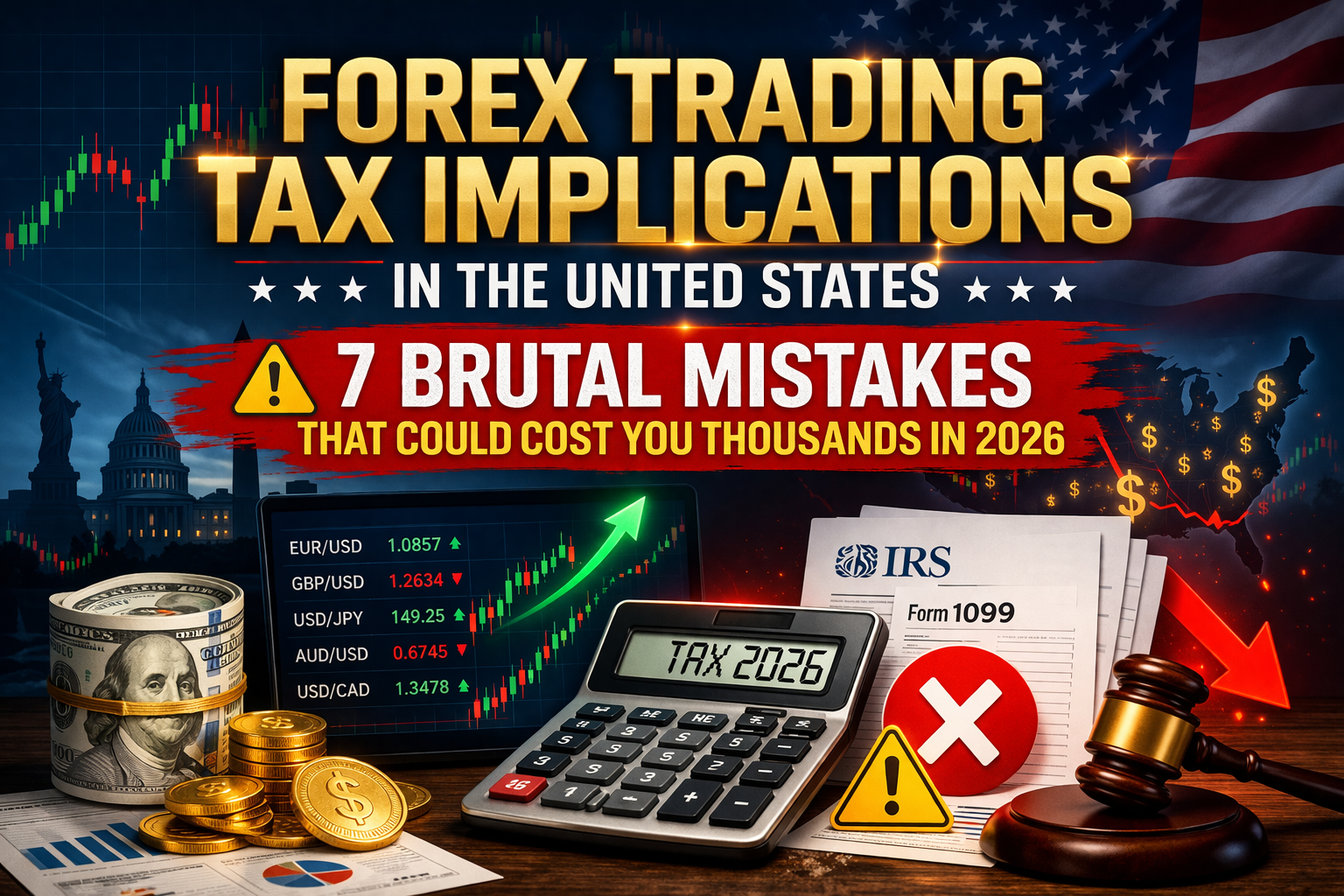
Introduction: The Tax Conversation Most Forex Traders Are Desperately Avoiding
When I first started trading forex, the last thing on my mind was taxes. I was glued to candlestick charts, obsessing over support and resistance levels, and watching pip movements like a hawk at 2 AM. Taxes? That felt like a problem for a future, more successful version of me.
Then the future arrived and it arrived with an IRS notice.
Nobody likes talking about taxes. It’s one of those topics that sends even seasoned traders into a spiral of avoidance, half-hearted Google searches, and frantic calls to accountants in April. But here’s the thing: ignoring the forex trading tax implications in the United States isn’t just irresponsible, it’s expensive. Potentially, very expensive.
The forex market is the largest financial market in the world, with over $7.5 trillion traded daily. It attracts ambitious people from all walks of life, weekend warriors, career changers, stay-at-home professionals, and full-time traders. And if you’re a U.S. citizen or resident, every single dollar of profit you pull from the market is on Uncle Sam’s radar, whether you withdraw it from your brokerage account or not.
This guide is different from the bland, bullet-pointed tax overviews you’ve probably skimmed before. This is a deep, honest, experience-informed walkthrough of everything you need to know about forex trading tax implications in the United States, written the way a knowledgeable friend would explain it to you over coffee. We’re going to cover the IRS’s two main tax frameworks for forex traders, the deductions you’re probably leaving on the table, the catastrophic mistakes traders make, and the practical steps you can take right now to keep more of your trading profits where they belong in your pocket.

Whether you’re a casual trader, an active day trader, or you’re running a systematic strategy with tools like VTM Automated System to maximize your edge in the markets, this post applies directly to you. Let’s get into it.
What Are the Forex Trading Tax Implications in the United States? The Big Picture
Before we dive into the granular details, let’s establish one non-negotiable truth: yes, forex trading profits are taxable in the United States.
There is a surprisingly common myth floating around trading communities especially among newer traders that your profits are only taxable once you withdraw them from your brokerage account. This is completely false. The IRS taxes your realized gains, meaning the moment you close a profitable position, that income exists for tax purposes regardless of whether you ever move it out of your trading account.
Another myth? That offshore brokers somehow protect you from U.S. tax obligations. Also false. The IRS requires U.S. citizens and residents to report their worldwide income, which includes profits from any forex broker, domestic or foreign.
The complexity, however, lies in how your forex profits are taxed. And that’s where most traders get confused, make costly decisions, or miss out on significant savings. The IRS has two primary tax treatment frameworks for forex traders, and they operate under very different rules.
The IRS Framework — Two Paths, One Decision
The Internal Revenue Code offers forex traders two main classification buckets:
- Section 988 — Ordinary Income Treatment
- Section 1256 — Capital Gains Treatment (the 60/40 Rule)
Which one applies to you depends on what you trade, how you trade, and in some cases, what elections you make before the tax year begins. Let’s walk through each of these in serious detail.
Section 988 — The Default Forex Trading Tax Treatment You Might Not Want
If you’re a retail spot forex trader in the United States and you haven’t done anything special to change it, you are almost certainly operating under Section 988 of the Internal Revenue Code. This is the default classification for spot forex transactions, and it has major implications for how your profits and losses are treated.
What Is Section 988?
Section 988 treats your forex gains and losses as ordinary income or ordinary losses. In plain English, this means your trading profits are taxed at your regular marginal income tax rate, exactly the same rate that applies to your salary, freelance income, or any other ordinary earnings.
As of 2025, the ordinary income tax brackets in the United States range from 10% to 37%, depending on your total taxable income. So if you’re a successful trader earning significant profits, you could be handing over more than a third of your trading gains to the IRS.
Here’s what the 2025 federal ordinary income tax brackets look like:
| Tax Rate | Single Filers | Married Filing Jointly |
|---|---|---|
| 10% | Up to $11,925 | Up to $23,850 |
| 12% | $11,926 – $48,475 | $23,851 – $96,950 |
| 22% | $48,476 – $103,350 | $96,951 – $206,700 |
| 24% | $103,351 – $197,300 | $206,701 – $394,600 |
| 32% | $197,301 – $250,525 | $394,601 – $501,050 |
| 35% | $250,526 – $626,350 | $501,051 – $751,600 |
| 37% | Over $626,350 | Over $751,600 |
Source: IRS 2025 Tax Year Brackets (confirmed under the One Big Beautiful Bill Act, signed July 4, 2025)
The One Thing Section 988 Actually Gets Right — Unlimited Loss Deductions
Here’s where Section 988 earns its keep: if you have a bad year trading and plenty of traders do, you can deduct your forex losses in full against your other income. There’s no $3,000 annual limit like you’d face with capital loss deductions. If you lost $40,000 trading forex under Section 988, you can offset $40,000 from your wages, business income, or other ordinary income.
This is a genuinely meaningful benefit, especially for:
- Newer traders who are still building their edge and expect to have losing years
- Inconsistent traders whose results swing dramatically from month to month
- Traders who are transitioning and using forex to supplement income while developing their skills
The flip side, of course, is that when you’re profitable, you pay ordinary income rates and those rates can hurt.
Who Should Stay Under Section 988?
Section 988 makes the most sense if:
- You’re new to trading and expect losses in the near term
- Your income bracket is 12% or lower, making the ordinary income tax rate tolerable
- You want the maximum flexibility to write off losses against other income sources
- Your trading results are inconsistent and you can’t reliably predict profitability
Section 1256 and the 60/40 Rule — The Forex Tax Advantage Most Traders Don’t Use
Now here’s where things get interesting. Section 1256 of the Internal Revenue Code specifically Section 1256(g), provides a significantly more favorable tax treatment for certain forex contracts, particularly regulated currency futures and options.
What Is the Section 1256 60/40 Rule?
Under Section 1256, gains and losses are split into two buckets regardless of how long you held the position:
- 60% of your gains are taxed at the long-term capital gains rate (0%, 15%, or 20% depending on income)
- 40% of your gains are taxed at the short-term capital gains rate (which is the same as your ordinary income rate)
This is called the 60/40 rule, and it’s one of the most powerful tax advantages available to American forex traders. You don’t have to hold a position for a year to qualify for the lower long-term rate, the split happens automatically.
The 2025 long-term capital gains tax rates are:
| Tax Rate | Single Filers | Married Filing Jointly |
|---|---|---|
| 0% | Up to $48,350 | Up to $96,700 |
| 15% | $48,351 – $533,400 | $96,701 – $600,050 |
| 20% | Over $533,400 | Over $600,050 |
How Much Can the 60/40 Rule Actually Save You?
Let me put real numbers on this so you can feel the difference. Suppose you make $50,000 in forex profits in a year and you’re in the 37% ordinary income bracket.
Under Section 988:
- 100% taxed as ordinary income at 37%
- Tax owed: ~$18,500
Under Section 1256 (60/40 Rule):
- 60% ($30,000) taxed at 20% long-term capital gains rate = $6,000
- 40% ($20,000) taxed at 37% ordinary income rate = $7,400
- Total tax owed: ~$13,400
The difference? You save approximately $5,100 — just by understanding which section applies to your trades.
That’s not a small number. For high-income traders, the savings compound dramatically as profits grow.
Who Qualifies for Section 1256 Treatment?

This is important. Not all forex contracts automatically qualify for Section 1256. The contracts that do qualify by default include:
- Regulated futures contracts on currency pairs traded on CFTC-regulated U.S. exchanges
- Foreign currency contracts that meet the IRS definition under Section 1256(g)
- Certain exchange-traded options on currencies
Standard spot forex trades the kind most retail traders execute through platforms like MetaTrader 4 or 5 are not automatically Section 1256 contracts. They default to Section 988.
However, many retail spot forex traders can elect to have their trades treated under Section 1256 instead. This election must be made before the first day of the tax year, not retroactively and must be documented in your records.
Section 988 vs. Section 1256 — The Complete Forex Tax Comparison
Let’s stop and consolidate everything side by side so you can see the full picture clearly:
| Feature | Section 988 | Section 1256 |
|---|---|---|
| Default for | Spot Forex (retail) | Currency Futures & Options |
| Tax treatment | Ordinary income/loss | 60% long-term / 40% short-term |
| Max tax rate | 37% | ~31.8% blended (high earner) |
| Loss deduction | Unlimited against ordinary income | Capped at $3,000/year (carry forward) |
| Holding period required for long-term rate | N/A (not applicable) | None — 60/40 applies automatically |
| Election required | None (it’s the default) | Must elect before tax year begins |
| Best for | Traders with losses; lower income | Consistently profitable traders; high earners |
| Mark-to-Market | Not required | Required (open positions valued at year-end) |
| IRS Form Used | Schedule D / Form 8949 | Form 6781 |
This table should be your reference point every time you’re making a strategic decision about how to structure your trading year.
Trader Tax Status (TTS) — The Hidden Forex Tax Benefit That Changes Everything
Beyond Section 988 and Section 1256, there’s a third layer of tax treatment that most traders don’t even know exists: Trader Tax Status, often abbreviated as TTS.
What Is Trader Tax Status?
The IRS distinguishes between someone who invests in securities or currencies and someone who trades them as a business activity. If the IRS considers you a “trader in securities” meaning you are in the business of buying and selling for profit you may qualify for Trader Tax Status. This unlocks a range of tax benefits that ordinary investors simply cannot access.
How Do You Qualify for Trader Tax Status?
The IRS does not have a rigid numerical threshold for TTS, but courts and IRS guidance have established that traders must demonstrate:
- Substantial activity — Trading must be frequent and continuous, not just occasional
- Trading as a significant occupation — It should be your primary or substantial business activity, not a side hobby
- Intent to profit short-term — Your activity should be focused on short-term price movements, not long-term holding
General benchmarks that the IRS and tax courts have used to support TTS include:
- Making four or more trades per day on a consistent basis
- Engaging in trading activity on at least 75% of available trading days
- Holding positions for very short durations
What Are the Tax Benefits of Trader Tax Status?
Once you qualify for TTS, the benefits are significant:
- Deduct trading business expenses on Schedule C — This includes platform fees, data subscriptions, trading education, home office expenses, professional research tools, and more
- Access to the Section 475(f) Mark-to-Market election — This converts capital gains/losses to ordinary income/loss, eliminates wash sale rules for your trading positions, and allows unlimited loss deductions
- No wash sale restrictions on positions covered by the Mark-to-Market election
- Business structure advantages — If you operate through an S-Corp or LLC, you may have access to additional tax planning strategies
Forex Tax Deductions You’re Probably Leaving on the Table
This is where traders consistently lose money by simply not knowing what they’re entitled to deduct. Whether you’re under Trader Tax Status or just an active retail trader, there are legitimate deductions you should be tracking throughout the year.
H3: Deductible Expenses for Active Forex Traders
Here is a comprehensive breakdown of commonly deductible trading expenses:
Trading Infrastructure Costs:
- Trading platform subscription fees (MetaTrader, cTrader, NinjaTrader, etc.)
- VPS (Virtual Private Server) hosting costs for automated trading systems
- Charting software and technical analysis tools (TradingView, Bloomberg terminal access, etc.)
- Market data feeds and real-time quote subscriptions
- Internet service costs (proportional to trading use)
Education and Research:
- Trading courses, webinars, seminars, and coaching programs
- Books, magazines, and subscriptions to financial publications
- Conference attendance fees (travel may be deductible too)
- Research reports and market intelligence subscriptions
Professional Services:
- Accountant or CPA fees related to your trading business
- Legal fees for trading-related matters
- Financial advisory fees
Home Office:
- If you have a dedicated space in your home used exclusively for trading, a proportional portion of your rent/mortgage interest, utilities, and internet may be deductible but the rules here are strict. The space must be used regularly and exclusively for your trading business.
Equipment:
- Computers, monitors, keyboards, and other trading hardware (often depreciated over time under IRS rules)
- Desk, chair, and office furniture for your trading space
Important: Most of these deductions are specifically available to traders who qualify for Trader Tax Status and use Schedule C for reporting. Casual investors have far more limited deduction options under the 2% miscellaneous deduction rules.
How to File Forex Taxes in the United States — The Forms You Need to Know
Navigating IRS forms can feel like learning a foreign language. Here’s a practical breakdown of what you’ll need:
H3: Key IRS Forms for Forex Traders
Form 1040 / Schedule D: Used for reporting capital gains and losses. If you’re under Section 988 or are a casual investor, this is where your forex activity lives.
Form 8949: This is the detailed attachment to Schedule D where individual trades are listed. If your broker provides a 1099-B, those figures flow into Form 8949. If your broker doesn’t issue a 1099-B (common with offshore brokers), you’re responsible for tracking and reporting your own figures.
Form 6781 (Gains and Losses From Section 1256 Contracts and Straddles): This is the central form for anyone using Section 1256 treatment. You report total net gains or losses here, and any losses from Section 1256 then flow to Schedule D to be netted against other capital gains.
Schedule C (Profit or Loss from Business): If you qualify for Trader Tax Status, you report your trading business expenses on Schedule C and potentially your trading income here as well.
Form 4797 (Sales of Business Property): Used by traders who have made the Section 475(f) Mark-to-Market election, converting trading gains/losses to ordinary income or loss reported as business property.
FinCEN Form 114 (FBAR): If you use a foreign forex broker and the aggregate value of your foreign financial accounts exceeds $10,000 at any point during the year, you must file an FBAR (Foreign Bank Account Report). Failure to file carries severe civil and even criminal penalties.
FATCA (Foreign Account Tax Compliance Act) Form 8938: For U.S. taxpayers with foreign financial assets above certain thresholds ($50,000 for single filers, $100,000 for married filing jointly at year-end), Form 8938 is required in addition to the FBAR.
7 Brutal Forex Trading Tax Mistakes That Could Cost You Thousands
This section might be the most important one in this entire post. These are the mistakes I’ve seen traders make repeatedly some from personal experience, others from conversations with fellow traders who found out the hard way.
Mistake 1 — Not Reporting at All Because “My Broker Didn’t Send a Tax Form”
This is the single most dangerous mistake on the list. A shockingly common belief is that if your broker doesn’t send a 1099-B or equivalent tax document, you don’t have to report your income. Wrong. Completely, dangerously wrong. Especially with offshore brokers, the absence of a tax document doesn’t exempt you from IRS reporting obligations. The IRS expects you to self-report, and failure to do so is tax evasion — not a gray area.
Mistake 2 — Assuming Profits Are Only Taxable When Withdrawn
You’ve already read this above, but it bears repeating because it’s so common. Profits are taxable when realized not when withdrawn. The moment you close a position at a profit, that income exists in the eyes of the IRS.
Mistake 3 — Confusing Section 988 and Section 1256
Many traders file under the wrong section entirely, either costing themselves money in unnecessary taxes or making incorrect elections. The most common version is filing Section 1256 gains as ordinary income under Section 988, or vice versa. Understanding which section governs your specific trades is not optional — it’s foundational.
Mistake 4 — Missing the Deadline for a Section 1256 Election
If you’re a spot forex trader who wants to elect Section 1256 treatment to take advantage of the 60/40 rule, you must make that election before the first day of the tax year or before you place your first trade. You cannot wait to see if you’re profitable and then retroactively apply the election. Missing this deadline means being locked into Section 988 for the entire tax year.
Mistake 5 — Ignoring Mark-to-Market on Open Positions
Under Section 1256, your open positions must be “marked to market” at year-end meaning any unrealized gains or losses on open trades as of December 31st are treated as if those positions were closed on that day. Many traders don’t account for this, leading to unexpected tax liabilities on paper profits they haven’t actually realized in cash.
Mistake 6 — Poor Record-Keeping (Relying Only on Broker Statements)
Broker statements are a starting point, not a complete record. The IRS expects you to maintain your own detailed trade logs, including date, time, currency pair, entry price, exit price, profit/loss, and any related fees. A dedicated bank account for your trading activities, separate from your personal accounts also makes record-keeping vastly cleaner and looks far better in the event of an audit.
Mistake 7 — Forgetting to File FBAR When Using a Foreign Broker
If you’re trading through a non-U.S. broker (which is common given the regulatory restrictions on U.S. forex brokers), and your account balance exceeds $10,000 at any point during the year, you are legally required to file an FBAR. The penalties for non-filing are severe up to $10,000 per non-willful violation and significantly higher for willful violations.
Forex Tax Planning Strategies — How to Legally Minimize Your Forex Tax Burden
Now that we’ve covered what you owe and what to avoid, let’s talk about legitimate strategies to reduce your tax liability.
Strategy 1 — Choose the Right Tax Section for Your Trading Profile
If you’re consistently profitable and in a high income bracket, electing Section 1256 treatment can save you thousands annually through the 60/40 rule. If you’re a newer trader expecting losses, staying under Section 988 gives you the unlimited loss deduction benefit. The decision should be made with a clear-eyed look at your expected trading results and income bracket.
Strategy 2 — Maximize Your Deductions
Don’t leave money on the table. Every legitimate trading-related expense your charting software, trading education, VPS server, home office, internet bill, accounting fees should be tracked and deducted. If you’re running a systematic, automated trading strategy (as many smart traders do with tools like VTM Automated System), your automation infrastructure, including VPS costs and software licenses, is potentially deductible.
Strategy 3 — Consider Trader Tax Status If You Qualify
If you trade with sufficient frequency and regularity, pursuing formal Trader Tax Status opens up Schedule C deductions and potentially the Section 475(f) election. Work with a tax professional who specializes in trader taxation to assess whether you qualify.
Strategy 4 — Year-End Tax Loss Harvesting
For traders under capital gains treatment, strategically realizing losses before December 31st can offset gains elsewhere in your portfolio, reducing your overall taxable income. Be aware that Section 1256 contracts are marked to market at year-end anyway but for positions outside that, timing your exits can matter.
Strategy 5 — Keep Meticulous Records All Year Long
Tax planning doesn’t happen in April it happens all year. Using dedicated trading journals, software tools, or export reports from your platform to maintain a running record of your trades makes filing accurate returns far easier and ensures you’re capturing every deductible expense.
Strategy 6 — Work with a Tax Professional Who Knows Trading
This can’t be overstated. A generalist CPA who doesn’t understand forex trading, Section 988, or the nuances of Mark-to-Market elections can actually make your tax situation worse. Seek out a tax professional or a firm that specializes in trader taxation to ensure you’re making optimal decisions.
Forex Trading Tax Implications for International Traders in the U.S.
If you’re a non-U.S. citizen living and trading in the United States, or a U.S. citizen trading through international brokers, there are additional dimensions to the forex trading tax implications in the United States that deserve attention.
FBAR and FATCA Obligations
As discussed above, using foreign brokers creates additional reporting obligations. The FBAR (FinCEN Form 114) and FATCA (Form 8938) requirements are separate from your income tax return and carry independent penalties for non-compliance.
Tax Treaties
The United States has tax treaties with dozens of countries. If you’re a U.S. citizen living abroad and trading forex, you may be subject to tax obligations in both countries on the same income. Tax treaties may reduce or eliminate double taxation, but navigating these rules requires professional guidance.
Exchange Rate Calculations
All forex income and losses must be reported to the IRS in U.S. dollars. If you’re trading in non-USD accounts or receiving foreign currency income, you must convert those figures to USD using the IRS-approved exchange rates for the relevant tax year. Getting this wrong can lead to significant inaccuracies in your tax return.
Using Automated Trading Systems and Their Tax Implications
The rise of algorithmic and automated forex trading has added a new dimension to tax reporting. If you’re running automated systems, copy-trading setups, or using tools like VTM Automated System to execute trades systematically, the same tax rules apply but record-keeping becomes even more critical.
When a system executes dozens or hundreds of trades per month automatically, you cannot manually track each one. You’ll need:
- Platform-level trade reports (most modern platforms allow CSV or Excel exports of your full trade history)
- Third-party tax software that integrates with your broker or accepts trade data imports
- Clearly documented system parameters and logs in case the IRS ever questions the nature or frequency of your trading activity
Automated trading can also strengthen your case for Trader Tax Status, since high-frequency systematic execution clearly demonstrates substantial and continuous trading activity.
Section 988 vs. Section 1256 — A Practical Decision Framework
At this point, you have all the information. But the question I get asked most often is still: “Which one should I choose?”
Here is a simple decision framework:
Choose Section 988 (or stay with default) if:
- You’re new to trading and expect losses in your first year or two
- Your total income puts you in the 12% or lower bracket
- You want the safety net of unlimited loss deductions against ordinary income
- Your results are highly variable from year to year
Elect Section 1256 if:
- You have a track record of consistent profitability
- Your income bracket is 22% or higher
- You trade regulated futures or currency options (it may apply automatically)
- You can reliably make the election before the tax year begins
- The math shows meaningful savings at your income level (refer to the $50,000 example above — a $5,100 annual saving is nothing to dismiss)
Consider Trader Tax Status if:
- Trading is your primary or substantial occupation
- You trade at high frequency with clear regularity
- You have significant business expenses to deduct
- You want access to the Section 475(f) Mark-to-Market election
Frequently Asked Questions About Forex Trading Tax Implications in the United States
Is forex trading taxable in the United States?
Yes, absolutely. All U.S. citizens and residents must report forex trading profits to the IRS. This applies regardless of whether you use a domestic or foreign broker, and whether or not you withdraw your profits from your account.
How do I report forex trading income on my tax return?
Depending on your tax treatment, you’ll report using different forms. Section 988 traders typically use Schedule D and Form 8949. Section 1256 traders use Form 6781. Traders with Trader Tax Status who qualify under Section 475(f) use Form 4797 and Schedule C.
What is the 60/40 rule for forex taxes?
Under Section 1256, 60% of your forex gains are taxed at the lower long-term capital gains rate and 40% at the short-term (ordinary income) rate — regardless of how long you held the position. This blended rate is typically lower than paying ordinary income rates on 100% of your gains.
Can I deduct forex trading losses?
Yes. Under Section 988, forex losses can be deducted against other ordinary income with no annual cap. Under Section 1256, losses are subject to capital loss limitations ($3,000/year against ordinary income) but can be carried forward to future tax years.
Do I have to report small forex profits or losses?
Yes. The IRS requires full reporting of all trading gains and losses, no matter how small. Failing to report even minor gains can attract penalties.
Do I need to file an FBAR if I use a foreign forex broker?
If you use a foreign broker and the aggregate balance of all your foreign financial accounts exceeds $10,000 at any point during the tax year, you must file FinCEN Form 114 (FBAR) by April 15, with an automatic extension to October 15.
When should I make the Section 1256 election?
The Section 1256 election for spot forex must be made before the first day of the tax year or before placing your first trade of the year. It cannot be made retroactively once the year has begun and you’ve seen your results.
Does the wash sale rule apply to forex trading?
For spot forex transactions under Section 988, the wash sale rule generally does not apply. For traders using the Section 475(f) Mark-to-Market election, wash sale rules are also eliminated for positions covered by the election.
What records should I keep for forex tax purposes?
You should maintain detailed records including:
- Date of each trade
- Currency pair traded
- Entry and exit prices
- Lot sizes/position sizes
- Profit or loss per trade
- Any fees or commissions paid
- Exchange rates used for USD conversion (if applicable)
- Screenshots or platform confirmations
Should I hire a tax professional for forex taxes?
For most active traders, yes especially once your annual trading volume or profits become significant. A tax professional who specializes in trader taxation can help you choose the right section, identify deductions, avoid costly mistakes, and represent you in case of an IRS inquiry.
Conclusion: The Forex Trading Tax Conversation You Can No Longer Afford to Avoid
Here’s the bottom line: the forex trading tax implications in the United States are real, they are complex, and they are not going away. Every profitable trade you close without a clear tax strategy is a trade where you might be leaving hundreds or thousands of dollars in unnecessary taxes on the table. Or worse, building up a liability that blindsides you come April.
But here’s the good news: once you understand the system, it’s manageable. Choosing between Section 988 and Section 1256 isn’t rocket science it’s a spreadsheet calculation and a decision made with clear eyes. Keeping records throughout the year costs you minutes, not hours, when done consistently. Finding the right deductions isn’t cheating; it’s your legal right as a trader running what is, in many respects, a business.
If you’re serious about trading and I mean really serious, in it for the long game — then being serious about your tax obligations is part of the package. The most successful traders I know treat their tax strategy with the same discipline they bring to their entry and exit rules.
They also use every legitimate edge available to them. From automated strategies that maximize consistency (tools like VTM Automated System exist precisely for this reason) to smart tax elections that reduce their annual burden every advantage counts.
Don’t be the trader who spent months perfecting their strategy only to give a third of it back to the IRS unnecessarily. Understand the rules, make smart elections, keep clean records, and work with a professional who gets it.
The market rewards the prepared. So does tax season.
Disclaimer: This post is for educational and informational purposes only and does not constitute tax or legal advice. Tax laws are subject to change, and individual circumstances vary significantly. Please consult a qualified tax professional or CPA who specializes in trader taxation before making any tax-related decisions.
Related Resources:
- IRS Publication 550 — Investment Income and Expenses
- IRS Topic No. 429 — Traders in Securities
- VTM Automated Trading Strategy