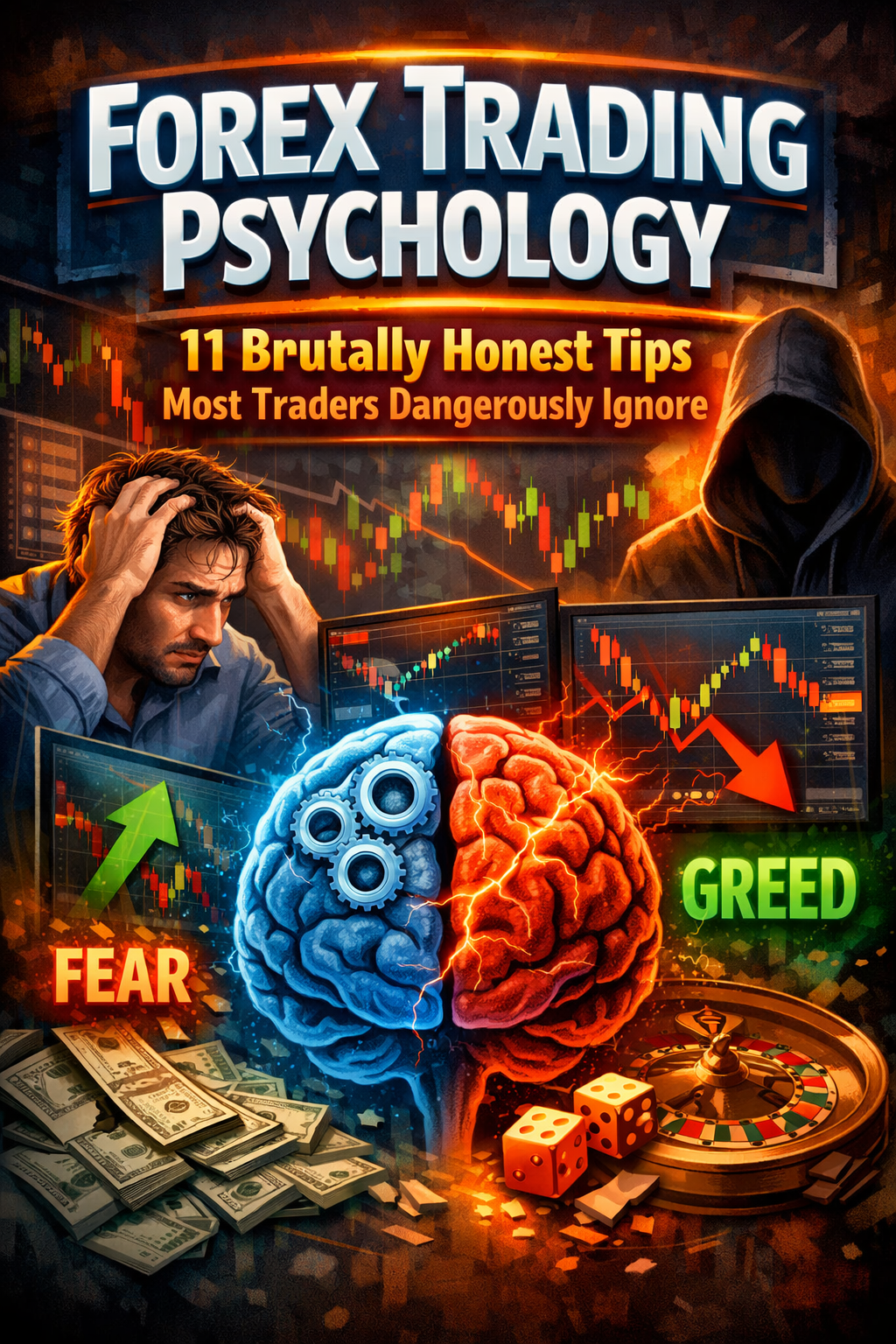
Introduction: The Real Reason Most Forex Traders Fail (And It’s Not What You Think)
Let’s get something uncomfortable out of the way right now.
You could have the most sophisticated trading strategy ever devised. You could know every candlestick pattern by heart, understand RSI divergences inside out, and read market structure like a seasoned analyst. And yet — if your psychology is broken, none of it matters. Not even a little.
Here’s a statistic that should stop you cold: between 70% and 89% of retail forex traders lose money, according to data from regulators like the FCA and ESMA. And the sobering truth that almost nobody in this industry wants to admit? Most of those traders had strategies that could have worked. They simply could not execute those strategies consistently because their emotions got in the way.
Think about that for a moment. The market didn’t beat them. They beat themselves.

This post is not going to sugarcoat things for you. It’s not going to sell you a dream. What it IS going to do is hand you 11 forex trading psychology tips that are honest, battle-tested, and powerful enough to completely change how you show up at your trading desk every single day. Whether you’re a complete beginner or a struggling intermediate trader who can’t seem to break through that ceiling, this guide is exactly what you’ve been missing.
The traders who thrive long-term are not necessarily the most brilliant analysts. They are the most disciplined. They are the most self-aware. They have cracked the code of their own mental wiring — and that’s the code we’re about to crack together.
Read every word. Your trading account will thank you.
What Is Forex Trading Psychology and Why Does It Matter?
Defining Forex Trading Psychology
Forex trading psychology refers to the entire landscape of mental and emotional factors that influence how you make decisions in the market. It covers your thoughts, your behavioral patterns, your subconscious biases, and the emotional responses that bubble up every time a position goes against you — or, perhaps even more dangerously, when it goes with you.
This is not abstract philosophy. It is a well-documented field rooted in behavioral finance, and it explains some of the most baffling things traders do: closing a winning trade too early out of fear, doubling down on a losing position out of stubbornness, or entering a random trade on a quiet Tuesday because boredom made sitting on the sidelines feel unbearable.
According to FOREX.com, a trader’s psychology is shaped by a combination of emotions, biases, personality traits, and external pressures — all of which can positively or negatively influence their trading outcomes. Successful traders are those who learn to recognize and manage these factors rather than being ruled by them.
Why Forex Trading Psychology Is Your Biggest Edge
Here’s the thing: the forex market is brutally efficient at punishing emotional decision-making. Unlike stocks, where a company’s underlying value can bail you out over time, the currency market has no such mercy. If your psychology is not sharp, the market will find that weakness and exploit it — repeatedly, and at scale.
As Mark Douglas, the legendary author of Trading in the Zone, famously stated: successful trading is 80% mental and 20% mechanics. You can have the best technical setup in the world, but if you can’t pull the trigger — or if you exit too early out of fear — your edge evaporates into thin air.
This is the reason why two traders using the exact same strategy can produce wildly different results. One trader follows the rules with calm, methodical discipline. The other second-guesses every entry, moves stop-losses during active trades, and revenge-trades after losses. Same strategy. Opposite outcomes. Pure psychology.
The 6 Dangerous Emotions Secretly Destroying Your Forex Trades
Before we get to the solutions, you need to clearly understand the enemy. These six emotional states are the most destructive forces in a retail trader’s psychological landscape — and every single one of them is more common than you’d like to admit.
1. Fear of Loss
Fear is perhaps the most universal emotion in forex trading. It shows up as hesitation before entering a trade you’ve fully analyzed, premature exits from profitable positions, and a paralysing reluctance to take a valid setup because “it might not work this time.” As AvaTrade notes, fear often manifests as preventing traders from executing their strategy effectively — leading to missed opportunities and poor decision-making that quietly erodes an account over time.
What makes fear especially insidious is that it masquerades as prudence. You tell yourself you’re being careful, being smart. But really, you’re letting emotional discomfort override a rational, well-tested plan.
2. Greed and Overconfidence
The flip side of fear is greed. After a string of winning trades, many traders start to feel invincible. They increase position sizes beyond their risk management rules, hold winning trades too long hoping for “just a little more,” or stop using stop-losses because “they always work out.”
FundedNext’s psychology guide points out that greed can drive vital choices in a negative direction — especially when it mutates into overconfidence. Overconfidence causes traders to open positions that far exceed their experience level, and it silences the inner voice that says “check your risk parameters.” The market has a brilliant way of humbling overconfident traders, usually at the worst possible moment.
3. Revenge Trading
This one is particularly dangerous because it feels so justified in the moment. You just lost three trades in a row. Your account is down. You’re frustrated, maybe even angry. So you open another trade — bigger this time, looser entry criteria, barely any analysis — just to “get back” what the market took from you.
This is revenge trading, and as Dukascopy’s trading psychology resource explains, it rarely ends well. You’re not trading the market anymore — you’re fighting it. And the market doesn’t care about your feelings. It will take your money just as efficiently whether you’re calm or seething.
4. Hope
Hope sounds harmless. In forex, it can be catastrophic. Hope is what keeps you in a losing trade well past your stop-loss. Hope is the internal monologue that says, “It’ll come back… it always comes back.” ForexTraders.com describes hope as one of the most damaging market emotions because it coddles traders into holding losing positions indefinitely, often leading to disastrous portfolio consequences.
A disciplined trader replaces hope with analysis. Instead of “I hope it comes back,” they ask “Does the setup still validate my original thesis?” If the answer is no — they exit. Full stop.
5. FOMO — Fear of Missing Out
You’re watching EUR/USD make an explosive move. You weren’t in it. Now it’s 100 pips in your direction — without you. The pain of missing out triggers an impulsive entry right at the top of the move, just as it’s about to reverse. You entered late out of FOMO, got trapped, and gave back capital you didn’t need to lose.
FOMO is one of the most common traps in forex trading psychology, and the antidote is developing unwavering trust in your process. There will always be another trade. Always.
6. Boredom and Overtrading
Quiet market sessions are a trader’s hidden enemy. When there’s nothing valid to trade, the boredom becomes unbearable — and boredom leads to forced trades. You start looking for setups that aren’t there. You lower your entry criteria “just this once.” You trade because you want to feel active, not because the market is offering you an opportunity.
Dukascopy’s research identifies overtrading as one of the most common psychological mistakes, fueled by adrenaline or the desperate urge to make back losses. Quality over quantity is not just a saying in trading — it is the difference between a growing account and a depleted one.
The Forex Trading Psychology Comparison Table: Emotional Trader vs. Disciplined Trader
This table is one of the most important things you’ll read today. Study it. Print it. Pin it above your trading desk.
| Scenario | Emotional Trader | Disciplined Trader (Psychology-First) |
|---|---|---|
| After a losing trade | Revenge-trades immediately to recover losses | Reviews the trade in journal, takes a break, waits for the next valid setup |
| When a trade goes against them | Moves stop-loss further hoping for reversal | Accepts the stop-loss hit as cost of doing business |
| During a winning streak | Increases position sizes dramatically, abandons risk rules | Maintains consistent position sizing regardless of recent performance |
| Missing a big market move | Chases the move, enters late out of FOMO | Accepts the missed opportunity, waits for the next clean entry |
| Before entering a trade | Enters on gut feeling or excitement | Checks checklist: setup valid, risk calculated, stop-loss placed |
| During slow market sessions | Overtrades out of boredom | Stays on the sidelines, reviews charts, studies, journals |
| After 5 consecutive losses | Doubles up to recover, enters emotional spiral | Reduces position size, re-evaluates strategy, protects capital |
| When strategy stops working | Abandons strategy, jumps to a new system** | Reviews data, refines system, stays patient through drawdown |
| Trade management | Exits early due to anxiety or holds too long due to greed | Uses pre-set take-profit and stop-loss orders consistently |
| Risk management | Risks 10–20% per trade when feeling confident | Always risks 1–2% per trade regardless of conviction level |
| Self-assessment | Blames market, broker, or news for losses | Takes full accountability, identifies personal patterns |
| Trading journal | Never journals, never reviews performance | Journals every trade: entry, exit, emotion, lesson |
The gap between these two traders is not intelligence. It is not access to information. It is psychology — pure and simple.
11 Brutally Honest Forex Trading Psychology Tips for Success
Now let’s get to the substance. These are not generic platitudes you’ve heard a hundred times. These are deep, practical, and honest forex trading psychology tips that will genuinely transform the way you operate in the market.
Tip 1: Accept That Losses Are Not Failures — They Are the Cost of Doing Business
This is perhaps the single most important mindset shift you can make. Every professional trader loses trades. Every single one. The difference is that professionals understand that a loss is not a failure of intelligence or analysis — it is simply the cost of operating in a probabilistic environment.
Your job as a forex trader is not to be right on every trade. Your job is to execute your strategy consistently so that your statistical edge plays out over a large sample of trades. If your strategy wins 55% of the time with a 1:2 risk-to-reward ratio, you need to take every valid setup to let that edge express itself. Skipping trades out of fear, or deviating from risk rules out of hope, is what truly destroys an account.
How to implement this:
- Define acceptable loss per trade BEFORE you place it (1–2% of capital is the gold standard)
- After a losing trade, ask: “Did I follow my plan perfectly?” If yes, the loss was acceptable regardless of outcome
- Stop measuring success by whether a trade won or lost — measure it by whether you executed your plan correctly
- Remind yourself regularly: even the best strategies in the world lose roughly 40-50% of trades
When you genuinely internalize this, fear largely dissolves. You stop needing to be right. You start needing to be consistent. And consistency is what builds accounts.
Tip 2: Build a Non-Negotiable Trading Plan and Follow It Religiously
A trading plan is your psychological firewall. It is the document that stands between you and every impulsive, emotion-driven decision you would otherwise make in the heat of the moment.

According to FOREX.com’s trading psychology guide, the best way to ensure your strategy is uninfluenced by emotions and biases is to build a plan and stick to it. When you define your rules in advance — entry criteria, exit criteria, position sizing, daily loss limits — you remove the need to make those decisions under emotional pressure. The decision has already been made for you, by a calmer, more rational version of yourself.
Your trading plan should include:
- Clear entry criteria: Specific conditions that must be met before you enter any trade (not vague rules like “looks bullish”)
- Exit strategy: Where your stop-loss goes, where your take-profit goes — decided before entry
- Risk per trade: A fixed percentage (1–2%) of total capital, non-negotiable
- Daily/weekly loss limit: A hard stop that ends your trading session if reached (e.g., 3% daily loss limit)
- Valid trading sessions: When you will and won’t trade, and which pairs you’ll focus on
- Journaling protocol: When and how you’ll document each trade
The plan only works if you treat it as law. BabyPips emphasizes that goals focused on process rather than profits — like “I will not take impulse trades” — are specific, measurable, and entirely within your control. These are the kinds of commitments that compound into better performance over time.
Tip 3: Master Your Emotional Triggers Before They Master You
Self-awareness is a trading superpower. You need to know, with precision, what triggers your worst trading behavior. Is it the feeling of being “owed” a win after a losing streak? Is it the excitement of a news event? Is it the anxiety of watching an open position for too long?
Everyone has different triggers. The key is identifying yours through honest reflection and then building pre-emptive defenses.
Practical steps to master emotional triggers:
- Before each session: Check in with your emotional state. Rate your stress or agitation on a scale of 1–10. If you’re above a 7, either take reduced position sizes or sit out entirely
- During a session: If you feel your heart rate rising or notice you’re refreshing charts obsessively, step away for 10–15 minutes
- After a loss: Give yourself a mandatory cooling-off period before you can enter the next trade. Even 30 minutes can break the revenge-trading impulse
- Identify your personal “tells”: The specific thoughts and feelings that precede your worst trades. Write them down. Know them intimately
As Dukascopy’s forex psychology resource puts it, mastering trading psychology doesn’t mean never feeling fear or greed — it means knowing what to do when those emotions show up. The better you understand your internal patterns, the more clarity you bring to the market.
Tip 4: Keep a Detailed Trading Journal — Your Most Underused Tool
If there is one single habit that separates consistently profitable traders from the rest, it is journaling. Not just trade outcomes — but the entire psychological context of each trade.
Your trading journal should capture:
- The setup: What did you see in the chart? What was your thesis?
- The entry: What conditions triggered your entry?
- Your emotional state: Were you calm? Anxious? Overconfident?
- Trade management: Did you stick to your original stop-loss and take-profit, or did you adjust?
- The outcome: Win or loss, by how many pips?
- The lesson: What can you take from this trade, regardless of outcome?
Over time, your journal becomes a goldmine of personal insight. You will start seeing patterns — specific pairs where you consistently underperform, times of day when your decision-making deteriorates, emotional states that reliably precede bad trades. This data is more valuable to your development than any indicator or strategy.
BabyPips’ trading psychology section notes that trade journaling or deliberate practice will make you a consistently profitable trader faster than simply hunting for good setups. The self-knowledge it builds is irreplaceable.
Tip 5: Implement Ironclad Risk Management — It’s Not Just Financial, It’s Psychological
Risk management and forex trading psychology are inseparable. Here’s why: when you risk too much per trade, every small adverse move feels like a crisis. Your nervous system goes into fight-or-flight mode. You start making emotionally-driven micro-adjustments to your positions. You can’t think clearly because the financial stakes feel overwhelming.
But when you risk only 1–2% of your account per trade, a string of losses becomes manageable — and more importantly, it becomes emotionally manageable. As the NY City Servers forex psychology guide explains, when you risk 1–2% per trade, a loss doesn’t trigger panic. You can absorb 10 consecutive losses and still have 80–90% of your account intact. That’s enough runway to recover without emotional desperation.
The risk management essentials:
- Never risk more than 1–2% of total capital on a single trade
- Always place stop-losses before entering the trade — not after, not “when it gets really bad”
- Use proper position sizing formulas: (Account size × Risk %) ÷ (Stop-loss in pips × Pip value) = Lot size
- Set a daily loss limit (e.g., 3–5% of account) and stop trading when you hit it — no exceptions
- Maintain a minimum 1:2 risk-to-reward ratio on most trades
- Never use leverage that makes your position size unreasonable relative to your stop-loss distance
Proper risk management is your psychological safety net. It allows you to trade with confidence knowing that no single trade can devastate you.
Tip 6: Develop a Pre-Trade Routine to Shift Into the Right Mindset
Elite athletes don’t walk onto the field in a random mental state. They have warm-up routines, visualization practices, and mental preparation rituals that prime their minds for peak performance. Serious traders should be no different.
A pre-trade routine signals to your brain that it’s time to shift into calm, analytical mode — out of the reactive, emotional mode that dominates everyday life.
A sample pre-trade routine:
- 5–10 minutes of mindfulness or deep breathing: This genuinely works. Dukascopy’s guide notes that even five minutes of focused breathing before a session can stop impulsive trades in their tracks
- Review your trading plan: Read your entry criteria, risk rules, and daily loss limit before you open a single chart
- Check your emotional state: Honest self-assessment — are you in the right headspace today?
- Mark key levels: Identify your key support, resistance, and potential setups on clean charts before any price action happens
- Set your alerts: Price alerts mean you don’t have to stare at charts all day, which reduces emotional wear
- Define your session goals: Not “make $500 today” — but “execute my plan on 2–3 quality setups and journal every trade”
This routine may seem simple, but the consistency of it builds enormous psychological discipline over time.
Tip 7: Stop Chasing the Market — Patience Is Your Most Profitable Virtue
Patience is arguably the most financially valuable psychological skill a forex trader can possess. The market will always be there. There will always be another setup. There will always be another entry. The traders who try to force their way into every move, who can’t bear the discomfort of waiting, are the ones who accumulate unnecessary losses in suboptimal trades.
Exclusive Markets’ trading psychology guide emphasizes that discipline is the backbone of successful forex trading — it provides a solid foundation for making sound decisions and managing risks effectively. And discipline, at its core, is largely about the discipline to do nothing when nothing valid is presenting itself.
How to cultivate trading patience:
- Define your “A+ setups” — the highest-quality configurations that meet all your criteria — and only take those
- Set a maximum trades-per-session rule. Many professional traders limit themselves to 2–3 trades per session. This forces selectivity
- Walk away from the screen when there’s nothing valid. You are not obligated to be in the market at all times
- Remember: flat is a position. Being in cash while waiting for a high-probability setup is a perfectly valid trade decision
- Reframe boredom as discipline: Every time you resist a suboptimal trade out of patience, you’ve made a profitable decision even without placing an order
Tip 8: Manage Cognitive Biases That Are Silently Wrecking Your Analysis
Beyond raw emotions, there are specific cognitive biases — systematic errors in thinking — that most traders never even know they have. These biases operate below conscious awareness, quietly distorting your perception of the market.
The most dangerous trading biases and how to counter them:
- Confirmation Bias: You’ve decided EUR/USD is going up. Now you only see the bullish signals and dismiss the bearish ones. Counter: Actively seek out the best argument against your trade before entering it
- Anchoring Bias: You entered a trade at 1.0850 and now you can’t accept a move away from that level. You’ve anchored to your entry price rather than what the chart is actually showing. Counter: Periodically ask yourself: “If I weren’t in this trade, what would I think of the current price action?”
- Hindsight Bias: “I knew that trade was going to work!” or “I knew that trade was going to fail!” After the fact, everything seems obvious. But this bias prevents honest learning. Counter: Write your analysis BEFORE the trade plays out. Judge yourself against what you thought before, not after
- Recency Bias: After 3 consecutive losses, you start believing your strategy is broken. After 3 wins, you start believing you’re invincible. Both are distortions caused by over-weighting recent events. Counter: Evaluate your strategy on statistically significant sample sizes — minimum 50–100 trades, not 3–5
- Loss Aversion: Research shows humans feel the pain of a loss roughly twice as intensely as the pleasure of an equivalent gain. This causes traders to hold losses too long and cut winners too short. Counter: Mechanical take-profit and stop-loss orders that execute regardless of how you feel
FOREX.com’s trading psychology guide highlights that biases affect even experienced traders, and that awareness of them is the first step toward managing their impact.
Tip 9: Use Demo Trading Strategically to Build Psychological Habits
Many traders dismiss demo trading as pointless because “it doesn’t feel real.” But when used deliberately and seriously, demo trading is one of the most powerful psychological training tools available.
The purpose of a demo account isn’t just to test a strategy — it’s to practice executing your psychology. Can you follow your trading plan consistently when no real money is at stake? If you can’t, you definitely won’t be able to when real money enters the equation.
How to make demo trading psychologically valuable:
- Trade a demo account exactly as you would a live account — same lot sizes relative to account size, same rules, same journaling
- Try to generate the same emotional responses: Look at the numbers as real. Treat each trade as if it counts
- Build your pre-trade routine on demo before applying it live
- Only graduate to live trading once you’ve shown consistent profitability AND consistent rule-following over at least 50–100 demo trades
- Return to demo if you hit a rough patch live — use it to recalibrate your psychology without additional financial damage
Tip 10: Build a Support System and Never Trade in Isolation
Trading is an intensely solitary activity, and that isolation can amplify psychological problems dramatically. When you have no one to be accountable to, bad habits sneak in unchecked. When you have no one to discuss trades with, cognitive biases go unchallenged.

How to build a healthy trading support system:
- Join a reputable trading community where members share analysis, accountability, and psychological support — not just signals
- Find an accountability partner: A fellow trader who agrees to review your journal weekly and call out patterns you might be rationalizing
- Follow traders you respect on social media — not for signals, but for mindset insights and professional perspective
- Consider a trading mentor who can see your blind spots from the outside
- Be careful about toxic trading communities that glorify risk-taking, glorify wins without discussing losses, or promote unrealistic return expectations. These environments will damage your psychology, not improve it
Fusion Markets’ forex psychology guide notes that successful traders share common traits including discipline, patience, adaptability, and a willingness to accept losses as part of the process — and surrounding yourself with others who embody these traits accelerates your own development enormously.
Tip 11: Treat Forex Trading Like a Professional Business, Not a Gambling Casino
This is the psychological reframe that ties everything together. The traders who struggle most with forex psychology are the ones who unconsciously treat the market like a casino — a place where you bet, get lucky, and cash out. The traders who succeed are the ones who approach trading with the mindset of a business owner.
A business owner:
- Plans ahead: Has a business plan (trading plan), knows their costs (risk per trade), and understands their margins (risk-to-reward ratios)
- Tracks performance: Keeps detailed records (trading journal) and reviews them regularly to identify trends
- Manages cash flow: Never puts all capital at risk on one venture (proper position sizing)
- Stays detached from individual outcomes: A business owner doesn’t emotionally collapse because one product didn’t sell this week — they focus on the long-term trend
- Continuously invests in education: A business owner never stops learning — neither should a trader
- Accepts operating costs: Just as a business has expenses, a trader has losing trades. They’re baked into the model
Admiral Markets’ research on why forex traders fail confirms that experienced traders have realistic expectations — they understand that there will be good periods and bad periods, just like any business. This realistic mindset relieves psychological pressure and allows for clearer decision-making.
How Automated Systems Help You Win the Forex Trading Psychology Battle
Here’s a truth that many trading psychology resources won’t tell you: even with perfect psychological discipline, trade-by-trade manual execution remains emotionally demanding. There will always be moments of doubt, fear, and hesitation, especially during high-volatility events.
This is where automated trading systems — when built on sound, thoroughly backtested strategies — can dramatically reduce the psychological burden of trading. Automation removes the most dangerous variable from your trades: you, in the moment, under emotional pressure.
Automated systems execute trades based on predefined rules without hesitation, without fear, and without greed. They don’t revenge-trade after a loss. They don’t chase FOMO entries. They don’t overtrade because it’s a slow Wednesday afternoon.
If you’re looking for a professionally designed automated trading solution that removes psychological friction from your trading, explore the VTM Automated Strategy at vtmstrategy.com — a system built around disciplined, rule-based execution that removes the need for you to make real-time emotional decisions on every trade. Automation doesn’t replace the need for trading psychology — you still need it to develop, oversee, and refine your system. But it removes the most vulnerable point of failure: the moment of execution.
This is especially valuable for traders who have a solid strategy but consistently sabotage it with emotional execution. Sometimes the best thing you can do for your psychology is remove yourself from the equation at the precise moment when emotions are strongest.
Building Your Forex Trader’s Mental Blueprint
Now that you have the eleven core forex trading psychology tips, let’s talk about how to pull them together into a cohesive mental blueprint — a personal system for psychological excellence that you apply every single day.
Daily Psychological Habits for Serious Forex Traders
Morning (Pre-Trading):
- 5–10 minute mindfulness or breathing exercise
- Read through your trading plan and rules
- Honest emotional check-in: stress level, focus level, energy level
- Mark key levels and identify potential setups before markets move
- Set price alerts to avoid screen-staring
During Trading:
- Trade only when setups meet ALL your defined criteria — not most, not some
- Once a stop-loss is placed, do not move it wider — ever
- If you feel emotional: step away. No trade is worth breaking your psychology
- Maximum 2–3 trades per session. Quality only
- If you hit your daily loss limit: close the platform. Done
Post-Trading:
- Journal every trade within 24 hours: setup, emotion, execution, outcome, lesson
- Rate your psychological performance today, not just financial
- Identify one thing you did well and one thing to improve
- Disconnect from charts and let the market breathe
Weekly:
- Full journal review: look for patterns in your best and worst trades
- Strategy review: is your edge still intact based on recent data?
- Psychological assessment: which emotional patterns showed up this week?
The Long Game: Understanding That Psychology Is a Skill, Not a State
One final thing to understand: good trading psychology is not something you achieve once and then have forever. It is an ongoing practice. The market will keep testing you, keep finding new ways to trigger your emotional responses, keep throwing curveballs that your current mental framework isn’t equipped for.
The traders who stay consistently profitable are not those who have eliminated all emotion — they are the ones who have built sustainable systems for managing emotion, recovering quickly from psychological lapses, and continuously developing their self-awareness.
As Fusion Markets eloquently puts it: in the dynamic world of forex trading, success is not solely determined by market knowledge or technical prowess but by the ability to master one’s own trading psychology. Everyone faces the same challenges in the markets. Only those who can overcome the psychological barriers in trading end up succeeding over the long-term.
You now have the roadmap. The work — daily, consistent, honest work — is yours to do.
FAQ: Forex Trading Psychology Tips
Q1: What is forex trading psychology?
Forex trading psychology refers to the mental, emotional, and behavioral factors that influence a trader’s decisions in the foreign exchange market. It covers emotional responses like fear and greed, cognitive biases like confirmation bias and anchoring, and behavioral patterns like revenge trading and overtrading. Mastering forex trading psychology is considered by many experts to be more important than technical knowledge for achieving consistent profitability.
Q2: Why do most forex traders fail psychologically?
Most forex traders fail because they allow emotions — particularly fear, greed, hope, and frustration — to override their trading plan and strategy. They lack the psychological discipline to execute consistently. Studies suggest that between 70–89% of retail forex traders lose money, and while poor strategies play a role, psychological failures are the primary cause for traders who have a workable edge.
Q3: How do I stop revenge trading in forex?
Revenge trading is stopped through structural safeguards rather than willpower alone. Implement a mandatory cooling-off period after any losing trade (at minimum 30 minutes, ideally the rest of the session). Set a daily loss limit that automatically ends your trading day. Keep a trading journal that helps you identify the emotional state that precedes revenge trades. Over time, recognition of the trigger alone can interrupt the pattern before it manifests.
Q4: How important is a trading journal for forex trading psychology?
A trading journal is arguably the single most important tool for developing forex trading psychology. It allows you to identify patterns in your emotional responses, track your rule-following consistency, and build genuine self-knowledge over time. Without a journal, you are trading blind from a psychological standpoint — making the same mistakes repeatedly without the data needed to recognize them.
Q5: Can automated trading systems help with trading psychology?
Yes, significantly. Automated systems execute trades based on pre-defined rules without emotional interference. They don’t hesitate, revenge-trade, or make impulsive decisions. For traders who have a solid strategy but struggle with emotional execution, automation can be a game-changer. Tools like the VTM Automated Strategy are specifically designed to bring the consistency of rule-based execution to your trading.
Q6: How long does it take to master forex trading psychology?
There is no fixed timeline — it varies significantly by individual. Most traders require at minimum 6–12 months of consistent, journal-reviewed practice to develop meaningful psychological discipline. Some traders require 2–3 years to fully internalize the habits of disciplined trading. The key accelerator is deliberate practice: journaling, review, honest self-assessment, and active implementation of psychological strategies rather than passive reading about them.
Q7: What is the 1% risk rule in forex trading psychology?
The 1% risk rule is the principle of never risking more than 1% (some traders use 2%) of your total trading capital on any single trade. This rule is as much psychological as it is financial — by keeping individual trade risk small, it prevents the emotional overwhelm that comes with large position sizes, allowing traders to think clearly and execute their strategy without panic.
Q8: How do I deal with fear in forex trading?
Dealing with trading fear requires a multi-pronged approach:
(1) Reduce position sizes until fear is manageable — trade sizes that allow you to sleep comfortably overnight;
(2) Use a demo account to build experience with setups before committing real capital;
(3) Reframe losses as a normal cost of trading rather than failures;
(4) Build confidence through consistent journaling that shows you your strategy has an edge over time.
Conclusion: Your Forex Trading Psychology Is Your Greatest Asset — Don’t Waste It
Here is the uncomfortable truth that most people in this industry dance around: if you don’t address your trading psychology, no indicator, no strategy, no signal service, and no amount of technical knowledge will ever make you a consistently profitable forex trader. The market will keep finding the cracks in your psychological armor and extracting capital through them until there’s nothing left.
But here’s the empowering flip side of that truth: your psychology is completely within your control. Unlike the market — which you cannot predict with certainty — your mind is something you can actually work on, improve, and master. Every single tip in this guide is actionable. Every single habit is buildable. And every single psychological transformation starts with one decision: the decision to take your mental game as seriously as you take your charts.
The 11 forex trading psychology tips we’ve covered today — from accepting losses as a cost of business, to building an ironclad trading plan, to keeping a detailed journal, to treating forex like a professional business — are not complicated. But they require commitment. They require honesty. And they require consistency that most traders simply aren’t willing to apply.
You’re still reading this. That already puts you in a different category.
Now go apply it. Start with one tip today. Then add another next week. Build your mental blueprint one brick at a time. And if you want to remove the emotional burden of trade-by-trade execution while you develop your psychological foundations, explore VTM Automated Strategy at vtmstrategy.com — professional, rule-based trading systems built to execute your edge without emotional interference.
The traders who succeed in forex don’t just have good strategies. They have good minds. Build yours.
Disclaimer: This article is for educational purposes only and does not constitute financial advice. Forex trading involves significant risk of loss. Always trade with capital you can afford to lose and consider seeking advice from a licensed financial professional.