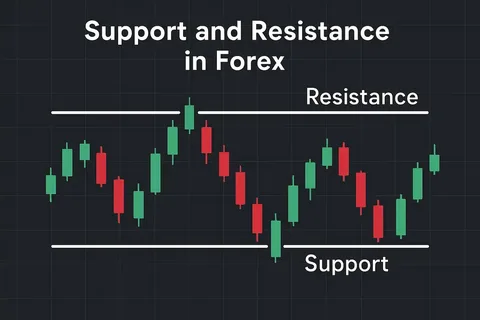
Support and Resistance Forex: 9 Powerful Trading Secrets Most Traders Regret Ignoring
Forex trading often feels complicated when beginners first encounter the markets. Charts move quickly, indicators flash signals, and countless strategies promise profits. Yet experienced traders often rely on one of the simplest but most powerful concepts in technical analysis.

Support and resistance forex trading.
Despite the emergence of AI tools, algorithmic trading systems, and advanced market indicators, forex support and resistance remains one of the most reliable ways to understand market behavior.
Why?
Because financial markets are driven by human psychology. Traders repeatedly react to certain price levels where buying or selling pressure becomes strong.
When you understand these levels, you can anticipate market movements rather than chase them.
In this guide you will learn:
• What support and resistance really mean
• How professional traders identify key levels
• How to trade forex using support and resistance levels
• The best support and resistance forex trading strategy 2026
• Advanced support and resistance strategy for profitable forex trading
If you master this concept, you will never look at charts the same way again.
Understanding Support and Resistance Forex
Before applying any forex trading strategy, you must understand what support and resistance actually represent in the market.
Support Level
A support level is a price area where buying pressure becomes strong enough to stop the price from falling further.
When price reaches support:
• Buyers enter the market
• Sellers begin closing trades
• Price often rebounds upward
Think of support as a floor that price struggles to break below.
Resistance Level
A resistance level is the opposite.
It is a price area where selling pressure prevents the price from rising further.
At resistance:
• Sellers dominate
• Buyers hesitate
• Price often reverses downward
Resistance acts like a ceiling that price struggles to break above.
According to the educational resources at
https://www.babypips.com/learn/forex/support-and-resistance
these levels represent psychological price barriers created by collective trader behavior.
This explains why support and resistance appear repeatedly across all markets and timeframes.
Why Support and Resistance Trading Works in Forex
Many beginners assume successful trading requires complicated indicators.
In reality, the support and resistance trading strategy works because it aligns with fundamental market mechanics.
Key Reasons It Works
- Institutional traders watch these levels
- Liquidity accumulates around these zones
- Stop losses cluster near these prices
- Market psychology repeats itself
Large institutions like banks and hedge funds often execute orders at these levels because they offer liquidity.
For example:
• Buy orders accumulate near support
• Sell orders accumulate near resistance
When these orders trigger, price reacts strongly.
Support and Resistance Forex Levels Explained
Support and resistance can appear in different forms.
Understanding them helps you trade with higher accuracy.
Horizontal Support and Resistance
These are the most common.
They appear when price repeatedly bounces from the same level.
Example:
If EUR/USD repeatedly reverses around 1.1000, that becomes a key level.
Dynamic Support and Resistance
Dynamic levels move with price.
Examples include:
• Moving averages
• Trendlines
• Channels
These act as floating support or resistance.
Psychological Price Levels
Round numbers often become strong levels.
Examples include:
• 1.2000
• 1.3000
• 2000 on Gold
Traders naturally place orders around these levels.
More insights about price level psychology can be found on
https://www.investopedia.com/articles/trading/06/supportresistance.asp
Support and Resistance Trading Strategy for Forex Beginners
Beginners often complicate trading.

The truth is that support and resistance trading strategy for forex beginners can be surprisingly simple.
Step 1: Identify Major Levels
Open a chart and look for areas where price repeatedly reacts.
Mark zones where:
• Price bounced upward
• Price reversed downward
• Price consolidated
These areas become your support or resistance.
Step 2: Wait for Price Reaction
Do not trade immediately.
Wait for confirmation such as:
• Rejection candles
• Pin bars
• Engulfing patterns
Step 3: Enter the Trade
Buy near support.
Sell near resistance.
Step 4: Place Stop Loss
Always protect capital.
Place stop loss:
• Below support for buys
• Above resistance for sells
Step 5: Take Profit
Target the next key level.
How to Trade Forex Using Support and Resistance Levels
Once you understand the basics, you can apply several trading approaches.
Strategy 1: Bounce Trading
This is the most common.
Buy when price bounces from support.
Sell when price rejects resistance.
Best used in ranging markets.
Strategy 2: Breakout Trading
Sometimes price breaks through a level.
This often leads to strong trends.
Example:
Resistance breaks
→ turns into support
→ price continues upward
This concept is known as role reversal.
Strategy 3: False Breakouts
Professional traders often look for fake breakouts.
Example:
Price breaks resistance
Then quickly returns below.
This traps buyers and triggers strong selling pressure.
Best Support and Resistance Forex Trading Strategy 2026
Markets evolve, but certain trading principles remain timeless.
One of the best support and resistance forex trading strategy 2026 combines three elements.
1 Support and Resistance Zones
Always mark key price levels first.
2 Market Structure
Observe:
• Higher highs
• Higher lows
• Lower highs
• Lower lows
This reveals trend direction.
3 Confirmation Indicators
Add simple indicators like:
• RSI
• Moving averages
• Volume
The combination significantly improves accuracy.
Advanced Support and Resistance Strategy for Profitable Forex Trading
Professional traders rarely rely on a single method.
Advanced strategies combine support and resistance with market structure.
Liquidity Sweeps
Institutions often push price beyond levels to trigger stop losses.
This creates liquidity.
After liquidity is collected, price reverses.
Supply and Demand Zones
These are refined support and resistance zones where institutions entered large positions.
Multi Timeframe Analysis
Professionals analyze multiple charts.
Example:
H4 chart shows support
M15 chart shows entry pattern
This increases precision.
Support and Resistance Trading vs Indicator Based Trading
| Trading Method | Advantages | Disadvantages |
|---|---|---|
| Support and resistance trading | Clear market structure | Requires patience |
| Indicator based trading | Easy signals | Can lag |
| Hybrid approach | Higher probability trades | Slightly complex |
Most experienced traders combine both methods.
The Role of Automation in Support and Resistance Forex Trading
Manual trading requires discipline and constant chart monitoring.
This is why many traders now rely on automated systems.
Platforms like VTM Automated System simplify execution by using algorithmic strategies designed to identify high probability setups while maintaining strict risk management.
Automation does not replace trading knowledge, but it helps eliminate emotional decisions.
For traders who struggle with consistency, this approach can dramatically improve results.
Common Support and Resistance Trading Mistakes
Many traders fail because they misuse these levels.
Avoid these mistakes.
Drawing Too Many Levels
This creates confusion.
Focus only on major levels.
Ignoring Market Context
Support may break in strong trends.
Always analyze trend direction.
Entering Too Early
Wait for confirmation.
Patience improves win rate.
Ignoring Risk Management
Even perfect setups can fail.
Always protect capital.
Support and Resistance Forex Tips From Professional Traders

Experienced traders follow strict principles.
Key Tips
• Focus on higher timeframes first
• Trade fewer but higher quality setups
• Use support and resistance zones instead of single lines
• Combine with market structure
• Practice on demo before risking capital
Consistency matters more than frequency.
Why Support and Resistance Trading Will Remain Relevant Until 2030
Despite technological advancements, these levels will remain relevant.
Reasons include:
• Human psychology will always influence markets
• Institutional trading relies on liquidity zones
• Price action remains universal across assets
Whether trading forex, crypto, or stocks, support and resistance trading will remain foundational.
Summary
The support and resistance forex trading strategy remains one of the most widely used methods for analyzing the foreign exchange market. Despite the rise of complex indicators and automated trading tools, many professional traders still rely on forex support and resistance because these levels reveal how the market behaves around key price zones.
At its core, support and resistance represent areas where price repeatedly reacts due to strong buying or selling pressure. Support is the price level where buying demand becomes strong enough to stop the market from falling further. When price approaches support, buyers tend to enter the market, causing the price to bounce upward. Resistance, on the other hand, is the level where selling pressure prevents the price from rising higher. At resistance levels, sellers often dominate and push the market downward.
Understanding support and resistance trading helps traders identify potential entry and exit points. Instead of randomly placing trades, traders can analyze price charts to locate areas where the market has historically reversed or consolidated. These areas often become key decision zones for future price movements.
For beginners learning how to trade forex using support and resistance levels, the process starts with identifying major price zones on a chart. Traders usually look for areas where price has bounced multiple times. These levels are then used to plan trades. A common approach is to buy near support and sell near resistance, especially in ranging markets. However, traders must also watch for breakouts, which occur when price moves strongly beyond a support or resistance level and starts a new trend.
The support and resistance trading strategy for forex beginners is popular because it is relatively easy to understand. Instead of relying on many technical indicators, traders focus on the natural movement of price. When combined with simple confirmation signals like candlestick patterns or momentum indicators, the strategy can become highly effective.
In modern trading environments, the best support and resistance forex trading strategy 2026 often combines traditional price level analysis with additional tools such as market structure, trend analysis, and technical indicators. Traders may also analyze multiple timeframes to identify stronger levels. For example, a support level identified on a daily chart can provide a more reliable trading signal than one seen on a lower timeframe.
Advanced traders often go further by applying an advanced support and resistance strategy for profitable forex trading. These methods include concepts such as liquidity sweeps, supply and demand zones, and institutional order flow. These techniques help traders understand how large financial institutions influence price movements around key levels.
Another important aspect of modern trading is automation. Many traders now use automated systems that help execute strategies with greater consistency and discipline. These systems can analyze price movements and identify potential support and resistance setups without emotional interference.
In conclusion, the support and resistance forex trading strategy remains a foundational method for understanding price behavior in the forex market. Whether used by beginners or experienced traders, these levels provide valuable insights into market psychology, potential reversals, and breakout opportunities. By combining proper risk management, confirmation signals, and consistent practice, traders can use support and resistance to develop a structured and reliable forex trading strategy.
execution and consistency.
FAQ on Support and Resistance Forex Trading Strategy
1. What is support and resistance in forex trading?
Support and resistance in forex trading refer to price levels where the market tends to stop and reverse. Support is where buying pressure prevents price from falling further, while resistance is where selling pressure prevents price from rising.
2. Why is support and resistance important in forex trading?
Support and resistance help traders identify potential entry and exit points. They also reveal areas where the market may reverse, consolidate, or break out.
3. How do beginners identify support and resistance forex levels?
Beginners can identify support and resistance by looking for areas where price repeatedly reverses or consolidates on the chart.
4. What timeframe works best for support and resistance trading?
Higher timeframes such as the 4-hour and daily charts usually provide stronger support and resistance levels than lower timeframes.
5. How accurate is the support and resistance trading strategy?
Support and resistance trading can be highly accurate when combined with proper confirmation signals and risk management.
6. What is the best support and resistance forex trading strategy?
The best strategy combines support and resistance levels, market structure, and confirmation indicators like RSI or moving averages.
7. Can support and resistance work in all markets?
Yes. Support and resistance trading works in forex, stocks, commodities, and cryptocurrencies because it reflects market psychology.
8. What is a support level in forex?
A support level is a price zone where buyers enter the market strongly enough to prevent price from falling further.
9. What is a resistance level in forex?
A resistance level is a price zone where sellers enter the market strongly enough to prevent price from rising higher.
10. How do professional traders use support and resistance?
Professional traders use support and resistance to identify liquidity zones where institutions are likely to enter or exit trades.
11. How do you draw support and resistance correctly?
Support and resistance should be drawn as zones rather than exact lines, focusing on areas where price reacted multiple times.
12. What are dynamic support and resistance levels?
Dynamic levels move with price and include indicators like moving averages, trendlines, and price channels.
13. What is a breakout in support and resistance trading?
A breakout occurs when price moves beyond a support or resistance level with strong momentum.
14. What is a false breakout in forex?
A false breakout happens when price temporarily breaks a level and quickly returns inside the range, trapping traders.
15. Why do support levels sometimes break?
Support levels break when selling pressure becomes stronger than buying pressure.
16. Why do resistance levels sometimes break?
Resistance breaks when buying pressure overwhelms sellers in the market.
17. What happens when resistance becomes support?
When resistance breaks, it often turns into support. This concept is known as role reversal.
18. What happens when support becomes resistance?
When support breaks downward, it often becomes resistance in future price movements.
19. How do you trade forex using support and resistance levels?
You can buy near support levels and sell near resistance levels, ideally with confirmation signals.
20. What indicators work best with support and resistance?
Common indicators include:
• RSI
• Moving averages
• MACD
• Volume indicators
21. Can support and resistance predict market trends?
Support and resistance alone cannot predict trends but can help identify trend continuation or reversal zones.
22. Is support and resistance trading suitable for beginners?
Yes. It is one of the easiest and most effective forex trading strategies for beginners.
23. What is the difference between support and demand?
Support is a technical level where price reacts, while demand zones represent institutional buying areas.
24. What is the difference between resistance and supply?
Resistance is a price level where selling pressure appears, while supply zones represent institutional selling activity.
25. How many times should price touch a level to confirm support or resistance?
Generally, two or more touches indicate a strong support or resistance level.
26. What is the best way to confirm support and resistance trades?
Confirmation can come from:
• Candlestick patterns
• Momentum indicators
• Volume analysis
27. What is a support and resistance zone?
A support or resistance zone is a price range where the market repeatedly reacts.
28. Do support and resistance work in scalping?
Yes. Scalpers frequently use short-term support and resistance levels for quick trades.
29. What is the role of psychology in support and resistance trading?
Support and resistance levels exist because traders remember previous price levels and react to them.
30. Why do round numbers act as support and resistance?
Round numbers attract large volumes of orders because traders naturally place buy and sell orders around them.
31. How do institutional traders use support and resistance?
Institutions use these levels to enter large trades where liquidity is highest.
32. What is liquidity in support and resistance trading?
Liquidity refers to areas where many buy and sell orders exist, often near major support and resistance levels.
33. Can support and resistance help reduce trading risk?
Yes. They allow traders to place logical stop-loss orders and control risk more effectively.
34. What is the best forex pair for support and resistance trading?
Major pairs like EUR/USD, GBP/USD, and USD/JPY often respect support and resistance levels well.
35. How often should traders update support and resistance levels?
Levels should be reviewed whenever significant market structure changes occur.
36. Do news events affect support and resistance levels?
Yes. Major economic news can cause price to break through support or resistance levels quickly.
37. What is a retest in support and resistance trading?
A retest occurs when price breaks a level and returns to test it again before continuing in the breakout direction.
38. Is support and resistance trading profitable?
Yes, when used with proper discipline, risk management, and confirmation signals.
39. Can automated systems trade support and resistance?
Yes. Some automated trading systems are designed to detect and trade around these levels.
40. Why do many traders fail using support and resistance?
Many traders fail because they ignore confirmation signals or trade too frequently.
41. Should support and resistance be drawn on every timeframe?
It is best to identify levels on higher timeframes first, then refine entries on lower timeframes.
42. How do trendlines relate to support and resistance?
Trendlines can act as dynamic support or resistance levels in trending markets.
43. What is the difference between support resistance and pivot points?
Pivot points are calculated mathematical levels, while support and resistance are based on historical price behavior.
44. What is price rejection in support and resistance trading?
Price rejection occurs when the market strongly reacts to a level, forming long candle wicks.
45. Can support and resistance be used with automated trading strategies?
Yes. Many algorithmic trading systems incorporate these levels to identify high probability trades.
46. What is the biggest mistake beginners make with support and resistance?
The biggest mistake is drawing too many levels and creating confusion on the chart.
47. How do you know if a support level is strong?
A strong support level usually has multiple touches and significant price reactions.
48. What makes a resistance level strong?
Resistance becomes stronger when price repeatedly fails to break above it.
49. Is support and resistance trading still relevant in 2026 and beyond?
Yes. Because markets are driven by human behavior, support and resistance will remain relevant for many years.
50. What is the fastest way to master support and resistance forex trading?
The fastest way is consistent chart practice, backtesting strategies, and using structured trading systems that reduce emotional decisions.