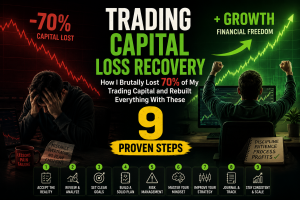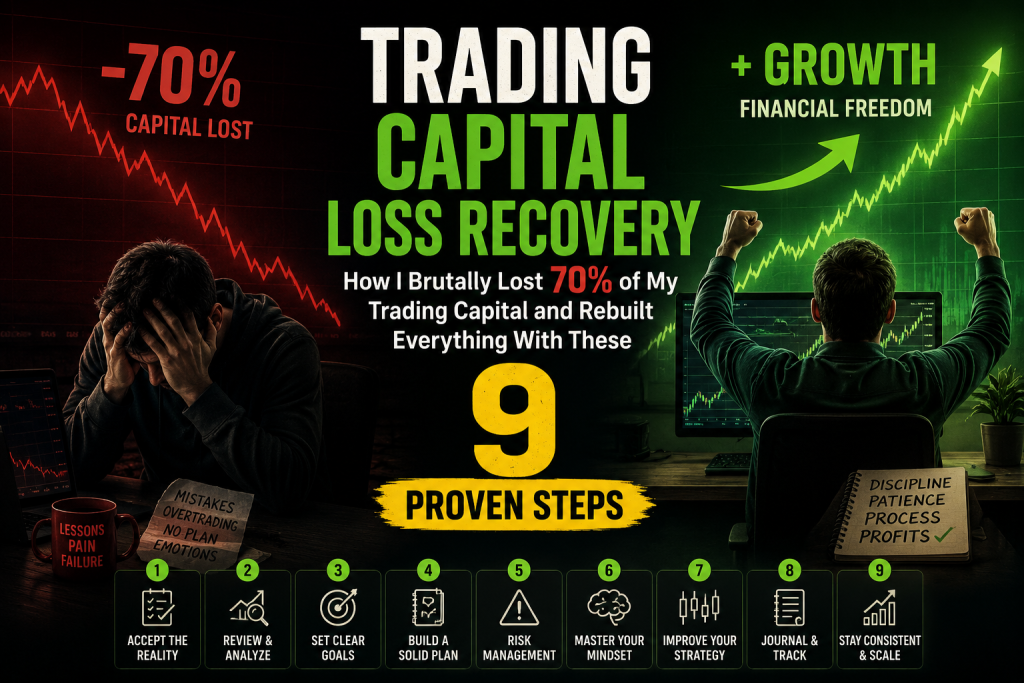
Trading Capital Loss Recovery: How I Brutally Lost 70% of My Trading Capital and Rebuilt Everything With These 9 Proven Steps
Introduction:
I still remember the exact morning it happened.
It was a Tuesday, just past 9 AM, and I was staring at my screen watching my account balance do something I had always told myself would never happen to me. In the span of three weeks – three catastrophically undisciplined, emotionally charged, revenge-fueled weeks – I had wiped out 70% of my trading capital.
Not a small loss. Not a bad month. Seventy percent. Gone.
If you’ve ever sat in that chair, with that hollow, sick feeling settling in your chest as you refresh your portfolio page hoping the numbers will somehow be different this time, you already know what I mean. You don’t need me to describe it. What you need is what I desperately searched for and couldn’t find back then: an honest, step-by-step account of what recovery actually looks like. Not the motivational poster version. The real one.
This post is that account.
I’m not writing this from a place of theory. I’m writing it from scar tissue. From over 2,000 hours of journal entries, backtest reviews, position-sizing spreadsheets, and many, many quiet nights staring at equity curves. If you’ve experienced a catastrophic drawdown, or if you’re in one right now, I want you to read every word of this. Because the truth is trading capital loss recovery is possibleForex Trading Psychology: 7 Fatal Mistakes That Destroy 90% of Traders (Avoid These Now). But only if you stop doing what most traders do after blowing up: going back in bigger, faster, and angrier.
Let’s talk about what actually works.
What Is a Trading Drawdown – And Why 70% Is a Different Beast?

Before we get into the recovery steps, it’s important that we frame exactly what we’re dealing with. A drawdown is simply the peak-to-trough decline in your account equity, how much you’ve lost from your highest point before recovering.
The math of recovery is asymmetric and unforgiving. A 50% drawdown requires a 100% gain to recover, which is why limiting losses through position sizing and stop-losses is the single most important risk management discipline.
Think about that for a second. A 70% drawdown the kind I experienced, means you need to grow your remaining capital by 233% just to get back to where you started. That’s not a mountain. That’s Everest. Without oxygen. In a blizzard.
Here’s a table that makes this painfully clear:
The Brutal Math of Trading Drawdown Recovery
| Drawdown Suffered | Capital Remaining | Return Required to Break Even |
|---|---|---|
| 10% | 90% | 11.1% |
| 20% | 80% | 25% |
| 30% | 70% | 42.9% |
| 40% | 60% | 66.7% |
| 50% | 50% | 100% |
| 60% | 40% | 150% |
| 70% | 30% | 233% |
| 80% | 20% | 400% |
| 90% | 10% | 900% |
This asymmetry is why capital preservation matters more than profit maximization. Every additional percentage point of drawdown makes recovery disproportionately harder. And here is the psychological trap: the deeper you fall, the more desperate you feel. That desperation pushes you to increase size, skip your rules, and take trades you would never touch on a normal day. Which creates more drawdown. Which creates more desperation. The spiral feeds itself.
I lived that spiral. And it nearly ended my trading career before it had really begun.
How I Lost 70% of My Trading Capital: The Honest Truth
I’m going to tell you what happened, because understanding the cause of a trading capital loss is the first step toward genuine recovery. Pride has no place in this story.
Here’s what actually happened to me:
- I stopped following my trading plan. I had a strategy that was working. Modestly, but working. Then I had three consecutive losing trades and decided — with all the wisdom of a sleep-deprived, frustrated ego — that my system was “broken.”
- I revenge traded. I doubled my position size trying to “make it back” quickly. After a massive loss, it’s tempting to chase big wins to recover quickly. But that mindset is what usually caused the damage in the first place. I learned this lesson the hard way.
- I ignored risk management entirely. I removed stop-losses. I held losing positions overnight. I told myself stories about why the trade would “come back.”
- I traded emotionally. Fear and greed took turns driving my decisions. I was no longer trading a strategy I was trading my feelings.
- I lacked a structured system. My biggest mistake wasn’t a bad trade. It was the absence of a rules-based, automated approach to position sizing and risk control. If I’d had something like the VTM Automated System guiding my execution, entire chapters of that disaster would have been different.
A 2021 Journal of Behavioral Finance study found discretionary overrides reduced returns by 4.7% annually among 1,200 retail traders. The fix: The strategy does not need to change. Your discipline does.
That last sentence hit me like cold water when I first read it. My strategy wasn’t broken. I was.
The 3 Types of Drawdown You Need to Correctly Diagnose First
One of the most underrated and overlooked aspects of trading capital loss recovery is correctly identifying what type of drawdown you’re actually in. Getting this wrong means applying the wrong fix — and potentially making things much, much worse.
Misdiagnosing the type of drawdown you are experiencing is one of the most common and costly mistakes traders make. Each type has a different root cause and demands a different response.
Here are the three types:
Type 1: Strategy Drawdown
This occurs when your trading system itself has a flaw. The market has changed, your edge has eroded, and no amount of discipline can fix execution if the underlying logic is broken. If your backtested win rate was 60% but you’re now consistently hitting 30% over 50+ trades, your strategy may be the problem.
The fix: Go back to the drawing board. Backtest, paper trade, and verify your edge before risking real capital again.
Type 2: Execution Drawdown
This is when the strategy is fine but you are not following it. You’re overriding signals. Moving stop-losses. Sizing on emotion. Taking trades outside your playbook.
The fix: This is a discipline problem, not a strategy problem. Journal every trade. Get an accountability partner. Consider automating your execution entirely to remove the human override from the equation. Tools like the VTM Automated System exist precisely for this reason.
Type 3: Market Regime Drawdown
Sometimes your strategy is sound AND your execution is disciplined — but the market has shifted in a way that temporarily invalidates your edge. Mean-reversion strategies bleed in trending markets. Momentum strategies get chopped in sideways ranges.
The fix: Recognize the regime change. Sit on the sidelines, reduce size dramatically, or deploy a complementary strategy suited to current conditions.
When I lost 70% of my capital, I was experiencing all three simultaneously. That’s how devastating it got. And that’s why accurate diagnosis is the foundation of any real recovery plan.
Step 1: Stop Trading Immediately and Sit in the Silence
I know this sounds counterintuitive. Your instinct after a major loss is to get back in there and win it back. But this is the single worst thing you can do.
The first step in any recovery is to stop trading and assess. Continuing to trade while in a drawdown without understanding its cause compounds losses in over 70% of cases, according to behavioral finance research.
When I finally forced myself to close my platform and step away, it felt like admitting defeat. It wasn’t. It was the first intelligent decision I’d made in weeks.
Take at least five to seven trading days completely offline. Use this time to:
- Print out every losing trade from the past 30-90 days
- Identify the single biggest mistake that appears repeatedly
- Ask yourself honestly: Was this a strategy failure, an execution failure, or a regime mismatch?
- Journal your emotional state during each of those trades
The silence is uncomfortable. But clarity lives in that discomfort.
Step 2: Conduct a Brutal, Ego-Free Trade Audit
One of the first steps in recovering from a trading slump is to reflect on what is not working and make necessary changes. Taking the time to assess your trading strategies and identifying mistakes is essential. By doing so, you can gain valuable insights into what went wrong and make adjustments accordingly.
This is not a comfortable process. You’re going to look at trades you’re not proud of. You’re going to see patterns that embarrass you. Do it anyway.
Here’s a simple framework for your trade audit:
- Entry Quality: Was the trade setup aligned with your system criteria? Be brutally honest was this an A+ setup or a C-grade impulsive entry?
- Stop-Loss Discipline: Did you place a stop-loss at entry? Did you move it mid-trade?
- Position Size: Was your sizing consistent with your risk rules, or did you size up out of greed or desperation?
- Exit Quality: Did you exit based on your rules, or based on fear or hope?
- Emotional State: What was your mood when you took this trade? Were you trading to recover losses?
Focus on process, not outcome evaluate whether trades followed your plan rather than obsessing over results. Emotional control during drawdowns is just as important as technical strategy.
What you’re looking for is patterns. Most traders who blow up don’t have ten different problems. They have one or two problems that repeat. Find yours. Name them. Write them on a sticky note on your monitor if you have to.
Step 3: Drastically Reduce Your Position Sizing
This is non-negotiable. If you go back into the market at your old position sizes after a 70% drawdown, you are gambling, not trading.

If your normal risk per trade is 2% of your account, cutting to 1% means a continued losing streak does half the damage. You are buying time and preserving capital while you work through the remaining recovery steps. Multiple studies in behavioral economics confirm that people make better probability assessments when the stakes are lower, even when the underlying decisions are identical.
For me, this meant going from risking 2-3% per trade down to risking 0.5% per trade. Yes, it felt almost pointless. Yes, the gains were tiny. But here’s what that “tiny” sized trading gave me that I desperately needed:
- Emotional distance from the outcome of each individual trade
- Proof of concept that my system still worked
- Confidence rebuilt on actual results, not hope
The key principle is that you earn back your full size. You return to normal sizing only after demonstrating consistent profitability at the reduced level over a minimum of 20 to 30 trades. This guardrail prevents premature escalation, one of the most common causes of a double drawdown.
I cannot emphasize the “double drawdown” danger enough. I know traders who recovered 30% of their losses, then went back to full size too soon and blew up again. Don’t be that person.
Step 4: Return to Paper Trading or Simulation First
Take a step back, and trade in a demo account for a few days. If you have been losing, you will likely save yourself money. Since it’s not real money, you can strategize your trade plan in this demo account until you feel that you can be back in the game. After a few winning days in the demo account, start trading with real money, but use small position sizes.
I know what you’re thinking. “Paper trading is for beginners. My problem is psychology, not skill.”
Here’s why you’re wrong about that.
Paper trading after a blowup isn’t about learning how to trade. It’s about resetting your nervous system. When real money is on the line and you’ve just suffered a catastrophic loss, your amygdala — the brain’s threat-detection center is in overdrive. An amygdala hijack is a stress response where the survival system overrides the planner. In plain English: risk management leaves the room and revenge trading starts acting confident.
Simulation trading gives you a safe environment to execute your strategy correctly and start rebuilding the neural pathways of disciplined trading. Once you’re hitting clean, rule-based entries and exits in simulation for two consistent weeks, you can move back to live trading at reduced size.
Step 5: Build or Rebuild a Rules-Based Trading System (This Is the One That Changed Everything)
This is the step that most post-blowup articles gloss over, and it’s the one that made the most difference in my own recovery.
The root cause of my 70% drawdown wasn’t bad luck. It wasn’t even bad analysis. It was the absence of a non-negotiable, rules-based system that removed my emotional decision-making from the equation.
Here’s what a proper rules-based trading framework should define:
- Entry criteria: Exact conditions that must be met before a trade is taken (not “it looks good to me”)
- Stop-loss placement: A specific, pre-defined level — not adjusted after entry
- Position sizing formula: Based on a fixed percentage of current account equity
- Take-profit targets: Defined risk-to-reward ratios, not gut feelings
- Maximum daily loss limit: The point at which you close the platform and stop for the day
- Maximum drawdown limit: The account level at which you go to minimum size or pause entirely
A drawdown ladder is a predefined sequence of de-risking actions as drawdown deepens: cut position sizing, restrict setups, reduce session time, or stop live trading. It protects both capital and psychological state.
After my recovery, I became a strong advocate for automated or semi-automated systems specifically because they enforce these rules even when your emotions are screaming at you to break them. The VTM Automated System was something I wish I’d had earlier. It’s built around exactly the kind of disciplined, rules-based execution framework that prevents the kind of catastrophic drawdown I experienced. If you’re serious about not going through what I went through, it’s worth exploring.
Step 6: Reframe Your Relationship With Losses Psychologically
Here’s something no trading course tells you: the market will never stop giving you losses. Even the best professional traders in the world lose on 40-50% of their trades. The difference between profitable traders and losing traders isn’t the absence of losses — it’s their relationship with losses.
Accept losses as part of the process — even profitable strategies experience them. Emotional control during drawdowns is just as important as technical strategy. Stay disciplined — avoid revenge trading or impulsive position size increases.
After my blowup, I went through something that resembled grief. There was denial (“the market manipulated that trade”), anger (“this system is garbage”), bargaining (“if I just make a few big trades I can get it all back”), and eventually — acceptance. Acceptance is where the real work begins.
Here are the psychological shifts that actually helped me rebuild:
- I stopped measuring my performance by P&L alone. My primary metric became process adherence: did I follow my rules, regardless of outcome?
- I started a trading journal with emotional annotations. Not just what I traded — but how I felt before, during, and after each trade.
- I found an accountability partner. Another trader who would review my journal weekly and call me out when I was rationalizing bad behavior.
- I accepted that recovery is measured in months, not days. The time needed to recover from drawdown varies. Recovery is not a race. Trying to “win it all back” in a single trade is tempting but dangerous. Instead, think of recovery as a structured process where you rebuild both your account and your confidence in tandem.
Step 7: Apply the Drawdown Ladder – A Systematic De-Risking Protocol
One of the most practical tools I implemented during my recovery was something I now call the Drawdown Ladder a pre-defined sequence of de-risking actions triggered at specific account thresholds. Here’s how it works in practice:
Sample Drawdown Ladder Framework
| Account Equity Level | Action Required |
|---|---|
| Above starting equity | Normal position sizing (e.g., 1-2% risk per trade) |
| 5% below starting equity | Reduce to 0.75% risk per trade; A+ setups only |
| 10% below starting equity | Reduce to 0.5% risk per trade; max 2 trades per day |
| 15% below starting equity | Reduce to 0.25% risk per trade; 1 trade per day |
| 20% below starting equity | Stop live trading; return to simulation for minimum 10 days |
The $98,000 threshold is not random. It gives you a cushion above the termination line. At 0.5% risk per trade, you can absorb 16 consecutive losing trades before hitting the hard floor. Sixteen. In a row. That is a statistical near-impossibility with any tested strategy.
The beautiful thing about this framework is that it removes the decision-making entirely. You don’t have to feel like you should reduce your size. The system tells you to. Emotion becomes irrelevant.
For every 10 percent in drawdown in their account, the Turtle Traders cut their trading unit size dramatically. When markets turned around, this preventive behavior of reducing units increased the likelihood of a quick recovery, getting back to making big money again.
The legendary Turtle Traders — one of the most successful trading experiments in history — used a version of exactly this. It worked for them. It worked for me.
Step 8: Focus Obsessively on Small Wins and Consistency
After a traumatic financial loss, the human brain craves a big win. It wants the dramatic reversal – the trade that makes up for everything in one glorious moment. This craving will destroy you.
Focus on small wins — rebuilding gradually is more sustainable than chasing large gains. Patience and discipline are crucial; rushing to recover often worsens losses.
What I focused on during recovery was this: a clean week. Not a profitable month. Not getting back to breakeven. Just a clean week where I followed my rules on every single trade. Then another clean week. Then another.
The results surprised me. When I stopped chasing big gains and focused purely on process, the gains started showing up naturally. Not because the market magically rewarded my virtue but because disciplined, rules-based trading has genuine positive expectancy. And positive expectancy, compounded over hundreds of trades, generates consistent growth.
Here’s the practical framework I used for building back:
- Week 1-2: Paper trade or micro-size live trading (0.25% risk per trade). Goal: 100% rule adherence.
- Week 3-4: Increase to 0.5% risk per trade if first two weeks showed clean execution. Goal: Maintain discipline at slightly higher stakes.
- Month 2: Increase to 1% risk per trade after demonstrated consistency. Goal: Prove the system works at normal minimum size.
- Month 3+: Evaluate whether to scale further based on actual equity growth and sustained discipline.
The whole point is that you earn back your size through performance, not through hope or desperation.
Step 9: Protect Your Capital Structure Going Forward – The Non-Negotiable Rules
Recovering from a 70% trading capital loss once is painful. Doing it twice is career-ending. Here are the non-negotiable rules I put in place after my recovery rules I’ve kept every single day since:
- Never risk more than 1-2% of account equity on a single trade. This is the universal law of professional trading, and it exists for good reason.
- Define a maximum daily loss limit. Mine is 3% of account equity. When I hit it, the platform closes. No exceptions, no negotiations with myself.
- Define a maximum monthly drawdown. Mine is 10%. If I hit 10% in any calendar month, I move to simulation until the month resets.
- Never trade without a stop-loss in place. Not once. Not even when the trade “looks certain.”
- Never add to a losing position to average down. This is how small losses become catastrophic ones.
- Review your trading journal weekly. Not monthly. Weekly.
- Have someone else review your trades. Blind spots are called blind spots for a reason.
Do whatever you can to limit drawdowns while keeping the upside. Diversify, use stop-losses, restrain position sizes. Rebuild confidence gradually. Focus on process, not just outcomes.
The Role of Automated Systems in Preventing Future Blowups
If there’s one thing I could go back and tell my pre-blowup self, it would be this: your biggest enemy in trading is not the market. It’s the version of you that shows up after three losing trades in a row.
That version of you is irrational. That version of you revenge trades. That version of you removes stop-losses and doubles down and convinces itself that this time is different. No amount of knowledge or experience fully immunizes you against that version of yourself. The only real protection is a system that doesn’t give that version of you the keys.
That’s what drew me to the VTM Automated System. It’s built around the core principle that consistent, rules-based execution not heroic discretionary decisions — is the foundation of sustainable trading. The system manages entries, exits, and position sizing according to pre-defined parameters. It removes the emotion. It enforces the rules. And it gives traders the kind of structural discipline that’s genuinely hard to maintain manually, especially when things get difficult.
I’m not saying automation is for everyone. But after going through what I went through, I believe very strongly that every trader whether they use a system like VTM or build their own rigid rule set needs to find a way to constrain their worst impulses. The market will hand you opportunities every day. Your job is to still be in the game when they arrive.
What “Recovery” Actually Looks Like: Setting Realistic Expectations
Let me be honest with you about something that most recovery posts avoid saying: getting back to your previous account high after a 70% drawdown will take time. Real time. Possibly years.
If you suffer a 50% drawdown and earn a respectable 10% annually going forward, it takes over seven years to return to your high-water mark. Even at 20% annual returns, it takes 3.8 years. This is why veteran traders repeat the mantra: the first job of a trader is not to make money. It is to not lose money.
After my 70% loss, I made peace with the following:
- Recovery is not linear. There will be setbacks within the recovery.
- The goal is not to return to your previous equity peak as fast as possible. The goal is to become a better trader than the one who lost 70% in the first place.
- Your relationship with risk must fundamentally change. Not just your rules — your relationship.
- Small, consistent gains compound powerfully over time. A trader making 3-5% per month consistently, without blowups, will dramatically outperform one making 20% some months and losing 30% others.
Here is what my recovery timeline actually looked like (normalized to protect account specifics):
| Month | Account Recovery % | Key Milestone |
|---|---|---|
| 1 | -2% (further loss) | Stopped trading; began audit |
| 2 | +1.5% | Returned to micro-size live trading |
| 3 | +4.2% | Consistent rule adherence; increased to half-size |
| 4 | +3.8% | First profitable month at normal size |
| 5 | +5.1% | Implemented drawdown ladder framework |
| 6 | +6.4% | Two consecutive disciplined months |
| 12 | +38% | Recovered approximately 16% of original capital lost |
| 18 | +67% | Recovered approximately 29% of original capital lost |
| 24 | +112% | Returned to original pre-blowup equity level |
Two years. That’s how long it took. Two years of disciplined, boring, rule-following trading.
Was it worth it? Absolutely. Because the trader who came out at month 24 was not the same trader who blew up at month zero. That trader had been replaced by someone who actually understood risk. Someone who respected the market. Someone who could see the danger signs coming from miles away.
Frequently Asked Questions (FAQ) About Trading Capital Loss Recovery
Q1: How long does it realistically take to recover from a 70% trading drawdown?
Based on personal experience and the mathematics of compounding, a 70% drawdown recovery requires generating 233% returns on your remaining capital. At a consistent 10-20% annual return — which is already very good — this takes approximately 4-8 years. However, the timeline shortens significantly if you are disciplined, reduce costs, and trade with genuine positive expectancy. Most importantly, the focus should not be on speed of recovery, but on quality of recovery.
Q2: Should I add more capital to my account to speed up recovery?
This is a deeply personal decision, but in my experience, the answer is almost always no — until you have proven you can trade the remaining capital profitably and consistently. Adding fresh capital to an undisciplined account is like adding fuel to a fire. Fix the process first. Grow the account second.
Q3: Is revenge trading ever a good idea after a big loss?
Never. Emotional decisions — letting fear or frustration dictate actions — often compound losses. Recognizing what leads to drawdown is the first step. Only then can you begin to chart a course for recovery. Revenge trading is the single most reliable way to turn a bad situation into a catastrophic one.
Q4: What is the best position size to use during drawdown recovery?
The key principle is that you earn back your full size. You return to normal sizing only after demonstrating consistent profitability at the reduced level over a minimum of 20 to 30 trades. During recovery, start with 0.25-0.5% risk per trade and only scale up after demonstrated profitability at reduced size.
Q5: Can automated trading systems help prevent blowups?
Yes — significantly. Automated systems like the VTM Automated System enforce rules-based execution that removes the emotional override that causes most catastrophic losses. They’re not perfect, but they address the single biggest vulnerability most retail traders have: themselves.
Q6: What’s the most important psychological shift after a major trading loss?
Accepting that losses are a permanent and unavoidable feature of trading — not a sign of failure. The goal is not a loss-free equity curve. The goal is a managed, controlled equity curve where no single loss or losing streak can permanently damage your account or your ability to continue.
Q7: Should I quit trading after losing 70% of my capital?
Only you can answer that. But I’d ask you this: did you lose 70% because the market is rigged against you? Or did you lose 70% because of identifiable, fixable mistakes in your process, psychology, or risk management? If it’s the latter — and for most traders it is — then quitting isn’t the answer. Learning is.
Conclusion:
I want to close this the same way I wish someone had spoken to me in those dark days when I was staring at a 70% loss and wondering if I should ever trade again.
You are not the worst trade you ever made.
The loss is real. The math is brutal. The path back is long and requires more discipline than you’ve had to show before. But the traders who emerge from catastrophic drawdowns — the ones who do the work, reduce the size, fix the process, and rebuild — they become the traders who actually last. They become the traders who understand, at a bone-deep level, what risk really means. And that understanding is worth more than the capital they lost.
The market will be there tomorrow. The question is whether you’ll show up to it as the trader who learned — or the trader who repeated the same mistakes with less capital and more stubbornness.
I chose the former. It took two years. It was the best investment of my trading life.