
Introduction: Why ECN vs Market Maker Forex Brokers Still Confuses Traders
Every trader remembers their first forex broker decision. It usually starts with a simple question that quickly becomes overwhelming.
Should you choose an ECN forex broker or a market maker broker?
On paper, the differences seem obvious. One claims transparency, tight spreads, and direct market access. The other promises fixed spreads, simplicity, and easy entry for beginners.
But in real trading, the truth is far more uncomfortable.
Many traders lose money not because their strategy is bad, but because they misunderstood forex broker types. Execution delays, hidden costs, conflict of interest, slippage, and stop hunting are rarely explained clearly. Most articles skim the surface and move on.
This guide goes deeper.
By the end of this article, you will understand the ECN vs market maker forex brokers comparison, the real risks traders ignore, and how to choose the right broker for your trading style. Ignoring these truths can quietly drain your account, even if you are profitable on paper.
The forex market trades over $7.5 trillion daily according to the Bank for International Settlements (https://www.bis.org), making it the largest financial market in the world. Yet most retail traders never question how their orders actually get executed. This ignorance costs them thousands in hidden fees and missed opportunities.
What Are Forex Broker Types and Why They Matter More Than Your Strategy
Before comparing ECN vs market maker, you need to understand why broker type matters more than indicators or strategies.
A forex broker is not just a platform. It controls how your orders are executed, who takes the other side of your trade, and how prices are delivered to you. Think of it as the difference between buying directly from a manufacturer versus buying from a middleman who controls inventory and pricing.
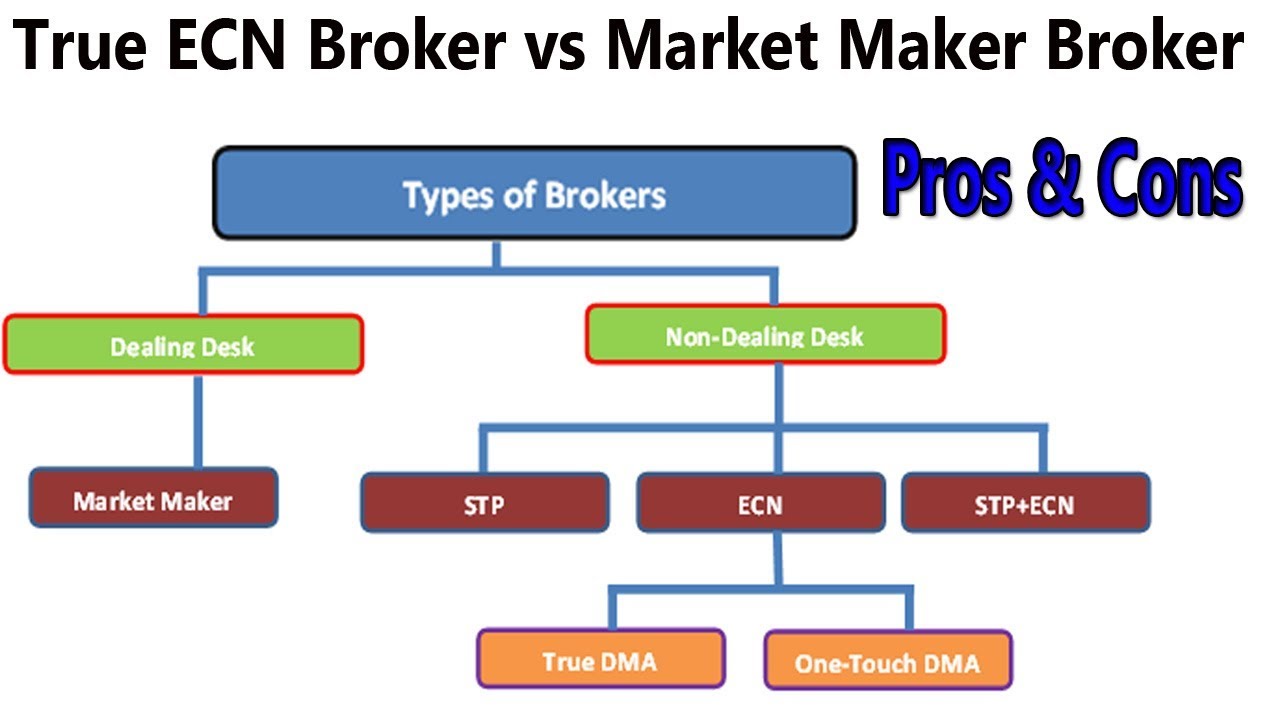
The main forex broker types include:
- Market Maker brokers (also called Dealing Desk brokers)
- ECN forex brokers (Electronic Communication Network)
- STP brokers (Straight Through Processing)
- Hybrid models combining features from multiple types
This article focuses on the two most misunderstood types, ECN and market maker brokers, because most retail traders fall into this decision trap. Understanding the distinction can mean the difference between consistent profitability and slow account erosion.
According to educational resources from Investopedia (https://www.investopedia.com/terms/f/forex-broker.asp), the broker model fundamentally changes your trading experience. Variables like spread costs, execution speed, and order rejection rates all stem from the broker type you choose.
What Is a Market Maker Broker: The Internal Marketplace Model
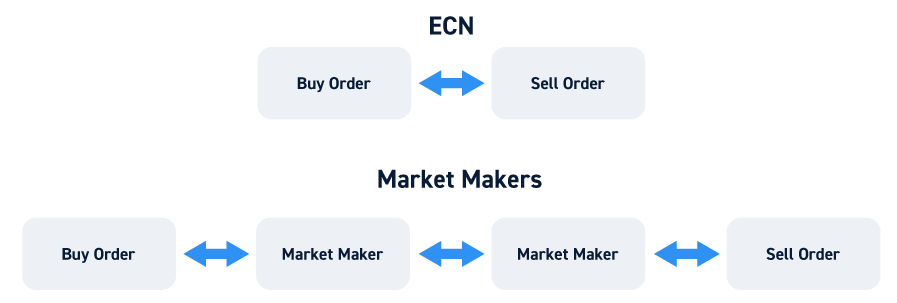
A market maker broker creates its own market. Instead of sending your trades directly to liquidity providers, the broker internally matches orders.
In simple terms, when you buy, the broker can sell to you. When you sell, the broker can buy from you.
How Market Maker Brokers Operate
Market maker brokers typically:
- Offer fixed or semi fixed spreads regardless of market conditions
- Control execution internally through a dealing desk
- Profit from spreads and potentially from client losses
- Allow small account sizes, sometimes as low as $10
- Provide instant execution in calm markets
- Act as the counterparty to your trades
This model is not automatically bad or unethical. Many beginners start with market maker brokers because they are easy to use, require less capital, and offer predictable spread costs during normal market hours.
Market makers serve an important function. They provide liquidity when natural buyers and sellers are not immediately available. Large institutional market makers like Citadel Securities play this role in equity markets (https://www.citadelsecurities.com).
However, the conflict of interest is real and structural.
When traders win consistently, market maker brokers may hedge those trades externally with liquidity providers. When traders lose, the broker keeps the loss internally as profit. This is perfectly legal but creates misaligned incentives.
The broker profits when you lose. This does not mean every market maker manipulates trades, but the temptation exists by design.
The Psychology Behind Market Maker Business Models
Market maker brokers operate on a simple statistical principle: most retail traders lose money.
Research consistently shows that 70% to 90% of retail forex traders lose money over time. The European Securities and Markets Authority (ESMA) publishes data showing these loss rates across regulated brokers (https://www.esma.europa.eu).
Market makers build their business model around this reality. If the majority of clients lose, the broker profits without needing to manipulate anything. They simply provide the platform and let trader psychology do the rest.
This structure creates risks that most traders never consider until they start winning consistently.
What Is an ECN Forex Broker: Direct Market Access Explained
An ECN forex broker connects traders directly to a network of liquidity providers. These include banks, institutions, hedge funds, and other traders participating in the interbank market.
ECN stands for Electronic Communication Network.
Think of it as a digital marketplace where all participants see real market prices and compete for the best execution. Your buy order might be matched with another trader’s sell order, or filled by a bank providing liquidity.
How ECN Forex Brokers Operate
An ECN forex broker typically:
- Offers variable spreads that reflect actual market conditions
- Charges commission per trade instead of marking up spreads
- Provides transparent pricing from multiple liquidity sources
- Matches orders in the open market without dealer intervention
- Removes direct conflict of interest between broker and trader
- Allows viewing of market depth in some cases
Unlike market makers, ECN brokers do not profit from client losses. Their income comes exclusively from commissions and trading volume. Whether you win or lose, the broker earns the same commission on your trade size.
This alignment of interests is why ECN brokers are often favored by professional traders, scalpers, algorithmic traders, and anyone serious about long term profitability.
The Technology Behind ECN Execution
ECN brokers use sophisticated technology to aggregate liquidity from multiple sources. When you place an order, the system searches for the best available price across all connected liquidity providers.
This process happens in milliseconds. The best ECN brokers invest heavily in server infrastructure and network connectivity to minimize latency. According to BabyPips educational resources (https://www.babypips.com/forexpedia/ecn-broker), true ECN execution provides the most transparent trading environment available to retail traders.
However, not all brokers claiming to be ECN actually are. Some use hybrid models or simply rebrand STP execution as ECN for marketing purposes. True ECN brokers provide access to interbank spreads and real market depth.
ECN vs Market Maker Forex Brokers Comparison Table
This table clearly shows the practical differences traders experience daily.
| Feature | ECN Forex Broker | Market Maker Broker |
|---|---|---|
| Order execution | Direct market execution | Internal execution |
| Spreads | Variable, usually lower | Fixed or wider |
| Commission | Yes, typically $3-$7 per lot | Often no |
| Conflict of interest | Very low | High |
| Slippage | Real market slippage | Often controlled |
| Stop hunting risk | Minimal | Higher |
| Suitable for scalping | Yes | Often restricted |
| Suitable for news trading | Yes | Often restricted |
| Beginner friendly | Moderate | High |
| Minimum deposit | Usually higher ($100-$500) | Often lower ($10-$100) |
| Spread during volatility | Widens naturally | May stay fixed but requotes |
| Market depth visibility | Sometimes available | Rarely available |
| Execution speed | Typically faster | Can be delayed during volatility |
This table alone explains why traders experience wildly different results using the same strategy on different brokers. A scalping system that works beautifully on an ECN broker might fail completely on a market maker platform due to execution restrictions and spread markup.
7 Shocking Truths Traders Ignore About ECN vs Market Maker
1. Market Maker Brokers Can Trade Against You (And It’s Legal)
This is the most uncomfortable truth that most beginner traders refuse to accept.
Many traders believe all forex brokers simply connect them to “the market” and earn small fees. This is dangerously naive.
A market maker broker can legally take the opposite side of your trade. This creates a built in conflict of interest where your loss becomes their gain.
When you lose, the broker can win. When you win too consistently, execution quality may mysteriously change.
This does not mean every market maker is dishonest or manipulative. Many operate ethically within regulatory guidelines. But the incentive structure is fundamentally misaligned.
It is like playing poker where the house takes a percentage of every pot, but also plays hands against you. Even if the house plays fairly, the conflict exists.
Professional traders avoid brokers where interests clash. They understand that over thousands of trades, even subtle execution biases compound into significant profit differences.
The Financial Conduct Authority (FCA) in the UK recognizes this conflict and requires brokers to disclose their execution model (https://www.fca.org.uk). However, disclosure does not eliminate the conflict, it merely makes you aware of it.
2. ECN Forex Brokers Are Not Always Cheaper Despite Lower Spreads
Many traders assume ECN brokers are always cheaper because raw spreads are tight. This is only half the truth.
ECN brokers charge explicit commissions, typically between $3 and $7 per round turn lot. During high volatility events like NFP (Non-Farm Payroll) releases or central bank announcements, ECN spreads can widen dramatically to reflect true market conditions.
If you trade exclusively during news events or illiquid Asian session hours, your costs on an ECN broker can exceed what you would pay with fixed spreads on a market maker.
The real advantage of an ECN forex broker is not cost alone, it is transparency and execution quality.
You know exactly what you are paying. There are no hidden markups, no requotes during volatility, and no execution games. For traders who value predictability and fairness over fixed costs, this transparency is worth the commission structure.
Do the math for your specific trading style. A day trader making 20 trades daily will calculate costs differently than a swing trader making 5 trades monthly.
3. Fixed Spreads Can Be an Illusion That Costs You Money
Market maker brokers advertise fixed spreads as a major selling point. One pip spread on EUR/USD sounds attractive and predictable.
But during volatility, execution behavior tells a different story.
Instead of the spread widening like it naturally would in the real market, the market maker broker protects itself through execution control mechanisms:
- Requotes that force you to accept worse prices
- Order rejections during fast markets
- Execution delays that cause slippage
- “Price no longer valid” messages during news
In reality, you still pay the cost of volatility. It is just hidden in slippage, missed entries, and delayed fills instead of visible spread widening.
Many traders prefer the honest spread widening of ECN brokers over the execution manipulation disguised as fixed spreads. At least you know what you are getting.
4. Stop Hunting Is Mostly a Market Maker Problem (Here’s Why)
One of the most emotional and controversial topics in forex is stop loss hunting.
While the broader interbank market naturally seeks liquidity around key levels (this is normal market behavior), market maker brokers have complete visibility into client positions and stop loss locations.
This creates an environment where suspicious patterns emerge:
- Stops get hit by a single pip before price reverses
- Multiple traders report identical stop hunting experiences
- Price spikes occur only on the broker’s platform, not on others
ECN forex brokers route orders externally to the interbank market. They do not see your stop loss location. They cannot benefit from hitting your stops because they earn commissions regardless of whether you win or lose.
This structural difference dramatically reduces stop hunting risk. Your stops are processed in the actual market alongside institutional orders, not in an internal system where the broker profits from your loss.
According to research and trader reports documented on forums like ForexFactory (https://www.forexfactory.com), stop hunting complaints overwhelmingly come from market maker broker clients rather than ECN users.
5. Strategy Performance Depends More on Broker Type Than You Think
A strategy that works perfectly on an ECN broker can fail catastrophically on a market maker broker, even with identical settings and risk management.
Why does this happen?
- Delayed execution: Market makers may delay order processing by milliseconds or seconds, destroying scalping edge
- Different spread behavior: Fixed spreads create different profit targets and stop distances
- Slippage handling: How and when slippage occurs varies dramatically
- Trade restrictions: Many market makers ban scalping, news trading, or high frequency systems in their terms
This is why many traders think their strategy “stopped working” when in reality the broker environment changed. They switched brokers, or the broker changed execution policies, and suddenly a profitable system becomes unprofitable.
Backtesting on historical data cannot account for these broker-specific execution differences. You need forward testing in the actual execution environment.
If you develop a strategy on one broker type, understand it may not transfer to another without adjustment.
6. Beginners Are Often Placed in the Wrong Broker Type for Long-Term Success
Many beginners are funneled into market maker brokers because of aggressive marketing focused on:
- Low minimum deposits ($10 or $25)
- Simple platforms requiring no learning curve
- Fixed spreads that seem predictable
- No commissions to confuse them
While this helps entry and gets people trading quickly, it can slow long term growth and development.
As traders mature and develop consistent strategies, execution quality becomes exponentially more important than simplicity or low deposits. The costs of poor execution compound over time.
A trader might spend two years developing skills on a market maker platform, only to discover their profitable strategy gets restricted or execution degrades once they start winning. They are forced to switch brokers and restart, losing time and momentum.
Starting on an ECN broker with proper education might have a steeper learning curve initially, but it builds better habits and understanding from day one.
Understanding this transition early can save years of frustration and account churn.
7. Automation Exposes Broker Weaknesses Faster Than Manual Trading
Automated trading systems and Expert Advisors reveal broker behavior with brutal efficiency.
Manual traders might not notice a 0.5 second execution delay or 0.3 pip average slippage. These seem like minor inconveniences.
But automated systems running hundreds of trades monthly will expose these patterns immediately through performance metrics. The strategy that backtested with 65% win rate suddenly shows 52% live because of execution quality issues.
Market maker brokers often restrict or ban:
- Scalping systems with short holding times
- High frequency trading algorithms
- News trading EAs that trade volatility
- Grid or martingale systems
These restrictions exist because automated systems can exploit fixed spread inefficiencies or create risk for the broker when trading against clients.
This is where ECN forex brokers shine for automation.
Platforms like the VTM Automated System are designed to work best in transparent execution environments where trades are processed fairly and consistently. The system relies on precise execution, low latency, and absence of artificial restrictions.
Using automation on the wrong broker type can silently destroy performance before you realize what is happening. The strategy is not broken, the execution environment is incompatible.
You can learn more about how execution quality affects automated trading performance at https://vtmstrategy.com.
Is ECN Broker Better Than Market Maker? The Honest Answer
This is one of the most searched questions in forex, and the answer disappoints people looking for simple solutions.

The honest answer is: it depends entirely on the trader’s experience, capital, strategy, and goals.
ECN Forex Broker Is Better If You:
- Scalp or day trade with tight stop losses
- Use automated systems or Expert Advisors
- Trade news releases or high volatility events
- Value transparency over simplicity
- Plan long term growth and scaling
- Have sufficient capital for higher minimum deposits
- Understand commission structures
- Need fast execution speeds
Market Maker Broker Is Better If You:
- Are a complete beginner testing forex for the first time
- Trade small volumes with limited capital
- Prefer predictable fixed spread costs
- Want simple execution without complexity
- Trade infrequently (swing or position trading)
- Do not plan to scalp or use automation
Most successful traders eventually migrate from market maker to ECN as experience grows and capital increases. This progression is natural and healthy.
Starting with a market maker is not wrong if you understand the limitations and plan to transition when appropriate. The mistake is staying with an inappropriate broker type after outgrowing it.
Best ECN Forex Broker for Beginners: What to Look For
Beginners often fear ECN brokers because of commissions and variable spreads. The pricing seems more complicated than simple fixed spreads.
But the learning curve is absolutely worth it for those committed to serious trading.
A good ECN forex broker for beginners should offer:
- Clear commission structure: No hidden fees or surprise charges
- Stable execution: Consistent order processing without games
- Reasonable minimum deposit: $100-$500 range, not $10,000
- Educational support: Resources to understand ECN execution
- Demo account: Practice environment with realistic execution
- Regulation: FCA, ASIC, or other tier-one regulatory oversight
Learning in a transparent environment builds better trading habits from the beginning. You learn to calculate total trade costs (spread plus commission), understand real market behavior during volatility, and develop strategies that work in genuine market conditions.
When evaluating brokers, check regulatory databases like the FCA register (https://www.fca.org.uk/firms/financial-services-register) or ASIC’s professional registers (https://asic.gov.au) to verify licensing claims.
Execution Quality: The Silent Profit Killer Nobody Talks About
Most traders obsess over indicators, entry signals, and strategy optimization while completely ignoring execution quality.
This is backwards.
A one pip difference in average execution cost per trade compounds brutally over time. Consider a trader making 100 trades per month:
- 1 pip worse execution = 100 pips monthly loss = 1200 pips annually
- At $10 per pip, that is $12,000 per year lost to execution alone
Slippage, requotes, spread manipulation, and delayed fills slowly bleed accounts dry. A profitable strategy on paper becomes unprofitable in live trading purely from execution degradation.
According to educational research published by Investopedia (https://www.investopedia.com/articles/active-trading/101014/why-high-frequency-trading-has-become-problem.asp), execution quality plays a major role in long term trading profitability, especially for active strategies.
Likewise, trading education platforms like BabyPips (https://www.babypips.com/learn/forex/broker-speak) emphasize understanding broker models and execution before strategy optimization.
Think about it logically. Your strategy might have a genuine 2 pip edge per trade. If your broker takes 1.5 pips through poor execution, you are left with 0.5 pips. One small mistake or bit of slippage eliminates your entire edge.
This is why professional traders pay extreme attention to broker selection and execution monitoring. They understand infrastructure matters as much as strategy.
How VTM Automated System Fits Into This Decision
Automation exposes the truth about broker quality faster than anything else.
The VTM Automated System is designed to operate in environments where execution is clean, consistent, and transparent. This aligns naturally with ECN forex broker infrastructure rather than market maker execution.
Why does this matter for automation?
Automated systems cannot adapt to requotes, cannot negotiate during execution delays, and cannot tolerate stop hunting. They require:
- Precise order execution at expected prices
- Minimal latency between signal and fill
- No artificial restrictions on trading frequency
- Transparent pricing without hidden spread markups
Instead of fighting broker limitations and execution games, VTM focuses resources on strategy logic, risk control, and adaptive market behavior. The system assumes a fair execution environment.
Traders using automated systems quickly learn that broker quality determines whether automation scales successfully or fails mysteriously. You can have the best algorithm in the world, but it will underperform on a poor execution platform.
This is not unique to VTM. Any serious automated trading approach requires broker infrastructure that supports rather than hinders systematic execution.
Explore how execution quality affects automated trading performance and why ECN infrastructure matters for algorithmic systems at https://vtmstrategy.com.
Common Mistakes Traders Make When Choosing Forex Broker Types
Avoid these errors that cost traders thousands in unnecessary losses:
- Choosing based on deposit bonuses instead of execution quality and regulation
- Ignoring commission math and only comparing spreads
- Attempting to run automation on brokers with scalping restrictions
- Switching brokers too late after wasting years on inappropriate platforms
- Blaming strategy instead of investigating infrastructure problems
- Believing all ECN brokers are equal without verifying true execution model
- Accepting poor execution as normal instead of testing alternatives
- Not reading terms and conditions about trading restrictions
- Overlooking regulatory jurisdiction and protection differences
Avoiding these mistakes alone can improve results without changing your strategy whatsoever. Sometimes the problem is not your trading, it is your trading environment.
Regulation and Safety: Why Broker Type Matters Less Than Licensing
Regardless of whether you choose ECN or market maker, regulatory oversight matters more than execution model.
An unregulated ECN broker is more dangerous than a regulated market maker. Always prioritize:
- Tier-one regulation (FCA, ASIC, SEC, CFTC)
- Segregated client funds
- Negative balance protection
- Compensation schemes
- Transparent company ownership
Check regulatory status through official databases before depositing funds. The Financial Conduct Authority provides a public register at https://www.fca.org.uk/firms/financial-services-register where you can verify UK broker licenses.
Summary:
The ECN vs market maker debate is not about which broker type is good or bad in absolute terms. It is about alignment between your needs and the broker’s structure.
Your broker should support your trading style and goals, not quietly work against them through misaligned incentives or execution limitations.
Traders who understand this distinction early gain a structural edge that compounds over time. Those who ignore it often spend years tweaking strategies and adjusting indicators when the real problem was infrastructure all along.
Execution quality matters. Transparency matters. Broker type matters.
These factors determine whether your edge can be captured in live trading or gets eroded before it reaches your account balance.
Choose wisely. Do your research. Test execution quality on demo accounts before committing capital. Ask existing clients about their experience. Check regulatory databases.
Your broker is your business partner in trading. Choose partners whose interests align with yours.
Frequently Asked Questions
What is the main difference between ECN and market maker brokers?
The main difference is execution structure. ECN brokers route orders directly to the interbank market and earn commissions. Market makers execute internally and can take the opposite side of your trades, profiting from spreads and client losses.
Is ECN forex broker better than market maker?
For experienced traders, scalpers, and those using automation, ECN brokers are generally better due to transparency and execution quality. For absolute beginners with small capital, market makers can provide easier entry. Most traders transition to ECN as they develop skills.
Do market maker brokers manipulate prices?
Not all market maker brokers manipulate prices, but the conflict of interest exists by design since they profit when clients lose. Regulated market makers must follow rules, but the incentive structure creates potential for subtle execution biases.
Can beginners use ECN forex brokers successfully?
Yes, especially if they plan long term growth and are willing to learn proper cost calculation including commissions. Starting on ECN builds better habits despite a steeper initial learning curve.
Which broker type is best for automated trading?
ECN forex brokers are generally far better for automated systems and Expert Advisors because they provide consistent execution, no artificial restrictions, and transparent pricing that algorithms require.
How do I know if my broker is truly ECN?
True ECN brokers provide variable spreads, charge explicit commissions, and often allow you to see market depth. Verify through regulatory filings and test execution during high volatility to confirm spreads widen naturally rather than triggering requotes.
What is a hybrid or STP broker?
STP (Straight Through Processing) brokers route orders to liquidity providers without a dealing desk but may mark up spreads instead of charging commissions. Hybrid models combine features of different execution types.
Can I switch from market maker to ECN broker easily?
Yes, but your strategy may need adjustment since execution characteristics differ. Test thoroughly on demo before switching live capital to ensure your approach works in the new execution environment.