Introduction:
You’ve just opened your first forex trading account, deposited your hard-earned money, and you’re staring at a screen filled with colorful lines, candlesticks, and indicators that look like something from a NASA control room. Your heart races as you watch currency pairs moving up and down, knowing that fortunes are being made and lost with every tick.
Here’s the sobering truth that nobody wants to tell you: approximately 90% of new forex traders lose money within their first year, and the primary culprit isn’t lack of capital or bad luck, it’s the inability to properly read and interpret forex charts.
I’ve spent over a decade in the forex markets, and I’ve seen countless beginners make the same devastating mistakes when learning how to read forex charts. These aren’t small errors that cost you a few pips here and there. These are fundamental misunderstandings that can wipe out entire trading accounts before you even realize what went wrong.
But here’s the good news: every single one of these mistakes is completely avoidable once you understand what they are and how to prevent them. In this comprehensive guide, I’m going to walk you through the seven critical mistakes that destroy most new traders, and more importantly, I’ll show you exactly how to read forex charts for beginners in a way that actually gives you a fighting chance in the markets.
Whether you’re looking to master forex chart analysis, understand candlestick patterns, or simply learn how to analyze forex charts without losing your shirt, this guide will give you the foundation you need. By the time you finish reading, you’ll understand why most traders fail—and how you can be part of the successful 10% who actually make consistent profits.
Let’s dive into the mistakes that could be costing you thousands of dollars, and the solutions that could transform you from a struggling beginner into a confident chart reader.
Understanding Forex Charts: The Foundation Every Beginner Needs
Before we expose the critical mistakes that are destroying traders’ accounts, you need to understand what forex charts actually are and why they’re the single most important tool in your trading arsenal.

What Are Forex Charts and Why Do They Matter?
Forex charts are visual representations of price movements in currency pairs over specific time periods. Think of them as the financial equivalent of a medical monitor in an intensive care unit—they show you the vital signs of currency pairs in real-time, helping you make life-or-death decisions about your trades.
When you look at forex trading charts, you’re not just seeing random lines and patterns. You’re witnessing the collective psychology of millions of traders, banks, institutions, and governments all placing their bets on which direction they believe a currency will move. Every candlestick, every trend line, and every price level tells a story about supply and demand, fear and greed, optimism and panic.
The forex market trades over $7.5 trillion daily, according to recent Bank for International Settlements data, making it the largest and most liquid financial market in the world. Without the ability to read charts properly, you’re essentially trying to navigate this ocean of money while blindfolded.
The Three Main Types of Forex Charts
Understanding how to read forex charts starts with knowing the different chart types available to you:
1. Line Charts
Line charts are the simplest form of forex chart, connecting closing prices over a specified time period with a continuous line. While they’re easy to read, they omit crucial information like opening prices, highs, and lows—which is why experienced traders rarely use them for actual trading decisions.
2. Bar Charts (OHLC Charts)
Bar charts show four critical price points for each time period: Open, High, Low, and Close (OHLC). Each vertical bar represents a specific timeframe, with small horizontal lines indicating the opening price (left side) and closing price (right side). The top of the bar shows the highest price reached, while the bottom shows the lowest price.
3. Candlestick Charts
Candlestick charts are by far the most popular choice among professional traders, and for good reason. Originating from 18th-century Japanese rice traders, candlestick charts provide the same OHLC information as bar charts but in a much more visual and intuitive format.
Each candlestick has a “body” (the thick part) representing the range between opening and closing prices, and “wicks” or “shadows” (the thin lines) showing the high and low prices. Bullish candles (where the close is higher than the open) are typically colored green or white, while bearish candles (where the close is lower than the open) are colored red or black.
Time Frames: The Multiple Dimensions of Forex Charts
One aspect that confuses beginners is that the same currency pair can tell completely different stories depending on which timeframe you’re viewing. A pair might look bullish on a 5-minute chart while simultaneously appearing bearish on a daily chart.
Common timeframes include:
- M1 (1-minute) – Used primarily by scalpers
- M5 (5-minute) – Short-term trading and entry timing
- M15 (15-minute) – Intraday trading decisions
- M30 (30-minute) – Broader intraday context
- H1 (1-hour) – Day trading and swing trading
- H4 (4-hour) – Swing trading analysis
- D1 (Daily) – Position trading and major trend identification
- W1 (Weekly) – Long-term trend analysis
- MN (Monthly) – Ultra-long-term perspective
Professional traders typically analyze multiple timeframes simultaneously—a technique called “top-down analysis“—starting from higher timeframes to identify the overall trend, then zooming into lower timeframes for precise entry and exit points.
Now that you understand the basics, let’s examine the seven critical mistakes that destroy most beginners’ trading accounts when they’re learning how to read forex charts.
Mistake 1: Ignoring Multiple Timeframe Analysis in Forex Chart Reading
This is perhaps the single biggest mistake I see beginners make, and it’s absolutely devastating to their trading results. They find a setup that looks perfect on their chosen timeframe, pull the trigger on a trade, and then watch in horror as the price moves against them—completely unaware that they just traded against the dominant trend on higher timeframes.
Why This Mistake Destroys Traders
Imagine trying to swim across a river by only looking at the water immediately around you, without noticing the massive current pulling you downstream. That’s essentially what you’re doing when you trade based on a single timeframe without considering the bigger picture.
Here’s what happens in practice: A beginner sees a bullish candlestick pattern form on a 15-minute chart and excitedly enters a buy trade, dreaming of profits. What they don’t realize is that on the 4-hour and daily charts, the pair is in a strong downtrend, and that little bullish pattern is nothing more than a brief pause before the downtrend continues.
The result? Their trade gets demolished as the larger timeframe trend reasserts itself.
The Solution: Master Multiple Timeframe Analysis
Professional traders use what’s called “multiple timeframe analysis” (MTFA) to ensure they’re trading with—not against—the dominant market forces. Here’s the step-by-step process:
Step 1: Start with the Higher Timeframe (Daily or 4-Hour)
Your analysis should always begin with higher timeframes to identify the overall trend and major support/resistance levels. This is your “market context”, the big picture that tells you which direction the smart money is flowing.
Ask yourself:
- Is the daily chart in an uptrend, downtrend, or range?
- Where are the major support and resistance levels?
- Is the price approaching any significant zones?
Step 2: Move to the Medium Timeframe (1-Hour or 4-Hour)
This intermediate timeframe helps you refine your understanding and identify potential trading setups within the context of the higher timeframe trend.
Look for:
- Trend confirmation or divergence from the daily chart
- More precise support and resistance levels
- Potential reversal or continuation patterns forming
Step 3: Use Lower Timeframes for Entry Timing (5-Minute to 15-Minute)
Only after you’ve confirmed the higher timeframe context should you drop down to lower timeframes to fine-tune your entry. This is where you look for specific trigger patterns that signal the optimal moment to enter.
The Golden Rule of Multiple Timeframe Analysis:
Never take a trade on a lower timeframe that contradicts the trend on your higher timeframe. If the daily chart shows a downtrend, don’t take buy trades on the 15-minute chart, no matter how tempting they look.
Real-World Example
Let’s say you’re analyzing EUR/USD:
- Daily Chart: Strong uptrend, price recently pulled back to test support
- 4-Hour Chart: Price is forming a bullish reversal pattern at the support level
- 15-Minute Chart: A bullish engulfing candlestick pattern just formed
This alignment across timeframes gives you high-probability trade setup. You’re not fighting against the market—you’re flowing with it.
Contrast this with a beginner who only looks at the 15-minute chart, sees that bullish engulfing pattern, and buys without realizing the daily chart is in a massive downtrend. They’re setting themselves up for failure.
Mistake 2: Overloading Charts with Too Many Indicators
Walk into any beginner trader’s workspace, and you’ll likely see forex charts that look like a Christmas tree exploded—dozens of indicators in different colors, overlapping each other, creating a visual mess that’s more confusing than helpful.
I call this “indicator overload syndrome,” and it’s one of the fastest ways to destroy your trading account while simultaneously convincing yourself you’re doing “professional analysis.”
The Psychology Behind Indicator Addiction
Here’s why beginners fall into this trap: Indicators feel safe. They’re mathematical, calculated, “scientific.” When you add another indicator to your chart, you feel like you’re gaining an edge, getting closer to the “holy grail” of trading that will tell you exactly when to buy and sell.
The harsh reality? More indicators don’t equal better trading decisions. In fact, they often lead to “analysis paralysis”—a state where you have so much conflicting information that you either freeze and can’t make a decision, or you cherry-pick the indicators that support what you already want to believe.
The Problems with Indicator Overload
1. Conflicting Signals
When you have five different indicators on your chart, you’ll inevitably get conflicting signals. The MACD might be bullish while the RSI shows overbought conditions. The Stochastic Oscillator might signal a buy while the moving averages suggest selling. Which one do you follow?
2. Lagging Information
Most indicators are “lagging” they’re based on past price data and tell you what already happened, not what’s about to happen. By the time your indicators confirm a trend, the best entry opportunity has often already passed.
3. Missing Price Action
When your chart is cluttered with indicators, you can’t see the most important thing: raw price action. You miss critical support and resistance levels, candlestick patterns, and market structure that would give you better trading signals than any indicator.
The Solution: Embrace Simplicity and Learn to Read Candlestick Charts in Forex Trading
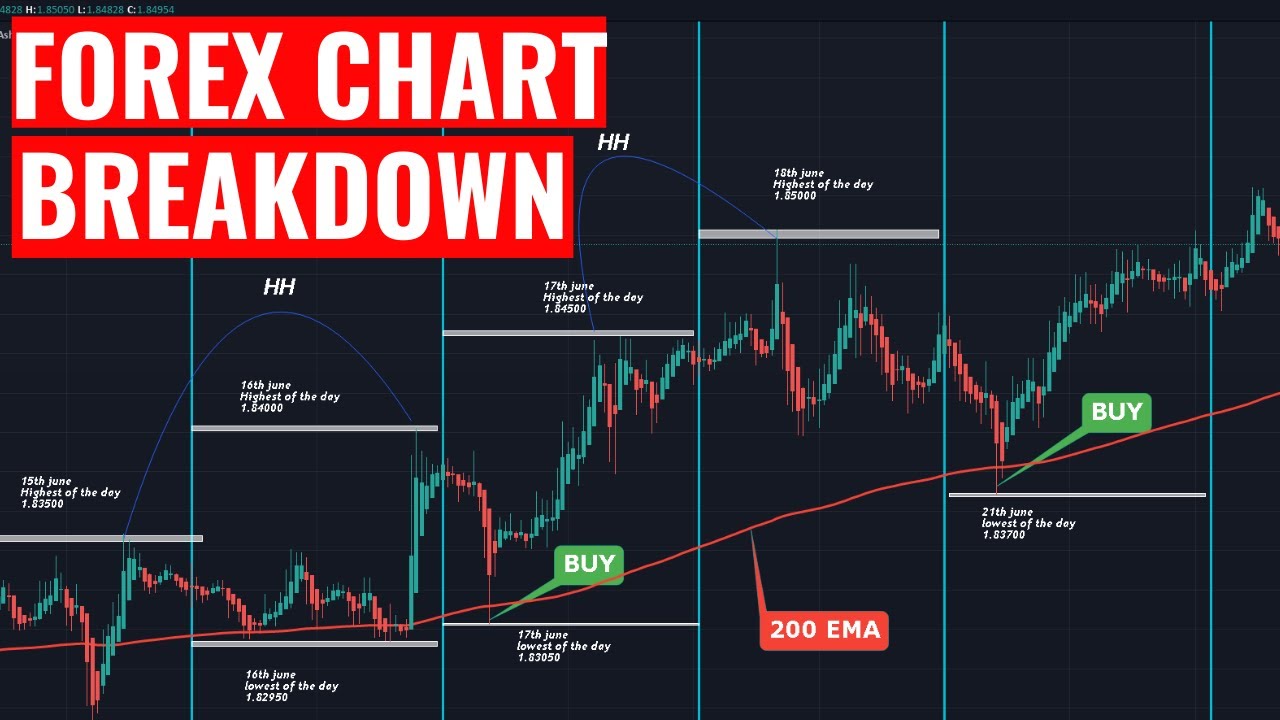
The most successful traders I know use incredibly simple chart setups. Many use nothing more than:
- Clean candlestick charts
- A few key support and resistance levels
- Perhaps one or two well-chosen indicators
Here’s how to simplify your approach to forex chart analysis:
Start with Naked Price Action
Remove all indicators from your chart and spend at least a month learning to read pure price action. Focus on:
- Candlestick patterns: Learn the major patterns like pin bars, engulfing patterns, doji candles, and hammers
- Support and resistance: Identify where price has historically reversed or consolidated
- Market structure: Recognize higher highs and higher lows (uptrend) or lower highs and lower lows (downtrend)
- Chart patterns: Study triangles, head and shoulders, double tops/bottoms, and flags
Add Maximum Two Indicators
If you must use indicators, limit yourself to two that serve different purposes:
- A trend-following indicator (like a 20 and 50 period moving average)
- A momentum indicator (like the RSI or MACD)
Make sure you understand exactly what each indicator measures and how it adds value to your analysis. If you can’t explain why an indicator is on your chart and how it improves your trading, remove it.
The 80/20 Rule for Forex Chart Analysis
Research shows that 80% of your trading results come from 20% of your analysis techniques. Focus on mastering the fundamentals—support and resistance, trend identification, and basic candlestick patterns—before adding complexity.
Recommended Minimalist Chart Setup
For beginners learning how to analyze forex charts, I recommend this simple setup:
- Candlestick chart (4-hour timeframe as your primary chart)
- Horizontal lines marking major support and resistance levels
- 20-period and 50-period Exponential Moving Averages (optional)
- RSI set to 14 periods (optional)
That’s it. This gives you everything you need to make informed trading decisions without the confusion and conflicting signals that come from indicator overload.
Mistake 3: Failing to Identify Key Support and Resistance Levels
If forex chart analysis were a building, support and resistance levels would be the foundation. Yet incredibly, most beginners either completely ignore these critical price zones or mark them so haphazardly that they’re essentially useless.
I’ve reviewed thousands of beginner charts over the years, and the inability to properly identify support and resistance is consistently one of the top reasons traders lose money. They enter trades at terrible prices, place stops in obvious locations where they get hunted out, and completely miss the major turning points in the market.
Why Support and Resistance Levels Are Critical
Support and resistance levels represent price zones where the balance between buyers and sellers shifts. These are the battlegrounds where institutional money makes its stand, where central banks intervene, and where major trend reversals occur.
Support is a price level where buying pressure is strong enough to prevent the price from falling further. Think of it as a floor that catches falling prices.
Resistance is a price level where selling pressure is strong enough to prevent the price from rising further. It’s like a ceiling that caps upward price movements.
These aren’t just theoretical concepts—they’re based on real market psychology. When price approaches a level where it previously reversed, traders remember what happened and act accordingly. This creates self-fulfilling prophecies that make support and resistance levels incredibly powerful.
The Costly Mistakes Beginners Make
Mistake 3A: Drawing Too Many Levels
Some beginners mark every minor swing on their charts, creating a web of lines that makes the chart unreadable. When you have 20 support and resistance levels marked, you don’t have 20 important levels—you have zero, because none of them stand out as truly significant.
Mistake 3B: Drawing Them as Perfect Lines
Beginners often draw support and resistance as exact horizontal lines, then get frustrated when price doesn’t respect them perfectly. The reality is that support and resistance are zones, not precise prices. A level at 1.1000 might actually extend from 1.0980 to 1.1020.
Mistake 3C: Ignoring Historical Price Action
Many beginners only look back a few days or weeks when identifying levels. Major support and resistance levels that formed months or even years ago can still be incredibly powerful—institutional traders have long memories and huge positions to protect.
Mistake 3D: Not Recognizing When Levels Break
When support breaks, it often becomes resistance (and vice versa). Beginners frequently miss this role reversal and get caught on the wrong side of breakouts.
The Solution: Master the Art of Support and Resistance Identification
Here’s the professional approach to identifying support and resistance levels on forex charts:
Step 1: Use Higher Timeframes for Major Levels
Start on the daily or weekly chart to identify the most significant support and resistance zones. These are the levels that large institutional players respect, and they carry the most weight.
Look for:
- Previous major swing highs and lows
- Round psychological numbers (1.2000, 1.2500, 1.3000)
- Historical levels where price consolidated for extended periods
- Major breakout or breakdown points
Step 2: Mark Zones, Not Lines
Instead of drawing a single horizontal line, shade in a zone that encompasses the area where price has historically reacted. A 20-30 pip zone is typical for major currency pairs.
Step 3: Validate with Multiple Touches
The more times price has touched a level and reversed, the stronger that level becomes. Look for levels where price has bounced at least 2-3 times historically.
Step 4: Watch for Confluence
The most powerful support and resistance levels occur where multiple factors align:
- Previous highs/lows coinciding with round numbers
- Fibonacci retracement levels aligning with historical support/resistance
- Moving averages meeting horizontal levels
- Trend lines intersecting with support/resistance zones
Step 5: Monitor for Breaks and Role Reversals
When a significant support level breaks, mark it as potential resistance for any future rallies back to that level. Similarly, broken resistance often becomes future support.
Table: Characteristics of Strong vs. Weak Support/Resistance Levels
| Factor | Strong Level | Weak Level |
|---|---|---|
| Number of Touches | 3+ historical touches | 1-2 touches only |
| Timeframe | Visible on daily/weekly charts | Only visible on low timeframes |
| Reaction Strength | Sharp reversals with long wicks | Gradual turns, weak reactions |
| Volume at Level | High volume at previous touches | Low volume at previous touches |
| Age of Level | Months or years old | Formed recently (days/weeks) |
| Confluence Factors | Multiple factors align (Fibonacci, round numbers, moving averages) | Stands alone with no confluence |
| Width of Zone | Tight zone (10-30 pips) | Wide, unclear zone (50+ pips) |
| Role Reversals | Clear breaks followed by successful retests | No clear role reversal behavior |
Practical Example: EUR/USD Support Levels
Let’s say EUR/USD is currently trading at 1.0850, and you’re trying to identify support levels below current price:
Strong Support Zone: 1.0800-1.0820
- Previous consolidation area on the weekly chart
- Aligns with the 50% Fibonacci retracement from the last major move
- Round psychological number (1.0800)
- Price bounced here three times over the past six months
Weak Support: 1.0775
- Only one previous touch on the 4-hour chart
- No confluence with other technical factors
- Formed just last week
- Price didn’t react strongly when it touched this level
Which level would you rather have your buy orders placed near? The answer is obvious when you understand what makes support truly significant.
Mistake 4: Misunderstanding Candlestick Patterns and Their Context
Candlestick patterns are the language of forex charts—they tell you stories about the battle between bulls and bears, reveal hidden turning points, and provide early warnings of trend changes. Yet most beginners approach candlestick patterns like they’re collecting trading cards: they memorize the shapes but have no idea when to actually use them.
I’ve seen countless traders enter losing trades because they spotted a “bullish engulfing pattern” without considering whether the context made that pattern meaningful. It’s like knowing the words to a song but having no sense of rhythm or melody.
The Fatal Flaw: Pattern Recognition Without Context
Here’s the mistake that destroys beginners: They learn that a hammer candlestick is bullish, so every time they see a hammer, they buy. They read that a shooting star signals a reversal, so they sell every shooting star they encounter.
The harsh reality? A candlestick pattern means nothing in isolation. The same pattern can be incredibly bullish in one context and completely irrelevant, or even bearish, in another context.
A hammer forming at a major support level during an uptrend? That’s powerful. A hammer forming at resistance during a downtrend? That’s probably a trap that will lead to losses.
The Most Important Candlestick Patterns for Forex Trading
Before we discuss context, let’s ensure you understand the major patterns you need to recognize when learning how to read candlestick charts in forex trading:
Single Candlestick Patterns:
1. Hammer and Inverted Hammer
- Small body at the top with a long lower wick (at least 2x the body length)
- Signals potential bullish reversal at support levels
- Shows buyers rejected lower prices and pushed price back up
2. Shooting Star and Hanging Man
- Small body at the bottom with a long upper wick
- Signals potential bearish reversal at resistance levels
- Shows sellers rejected higher prices and pushed price back down
3. Doji
- Opening and closing prices are virtually identical
- Represents indecision in the market
- Most significant at major support/resistance or after extended trends
4. Marubozu
- Long body with little to no wicks
- Shows strong bullish (white/green) or bearish (black/red) conviction
- Suggests the trend will continue in the direction of the candle
Multiple Candlestick Patterns:
5. Bullish and Bearish Engulfing
- Two candles where the second completely engulfs the first
- Bullish engulfing: Small red candle followed by larger green candle
- Bearish engulfing: Small green candle followed by larger red candle
- Signals potential trend reversal
6. Morning Star and Evening Star
- Three-candle patterns indicating reversals
- Morning star (bullish): Downtrend candle, small-bodied candle, strong up candle
- Evening star (bearish): Uptrend candle, small-bodied candle, strong down candle
7. Three White Soldiers and Three Black Crows
- Three consecutive strong candles in the same direction
- Three white soldiers: Three consecutive bullish candles signaling strong uptrend
- Three black crows: Three consecutive bearish candles signaling strong downtrend
The Critical Context Factors That Make Patterns Meaningful
Now here’s what separates profitable traders from perpetual losers: understanding when these patterns actually matter.
Context Factor 1: Location, Location, Location
A candlestick pattern at a major support or resistance level is exponentially more powerful than the same pattern in the middle of nowhere.
Example: A bullish engulfing pattern at a support level that has held three times before? That’s a high-probability setup. The same pattern appearing randomly in the middle of a chart with no significant levels nearby? That’s noise.
Context Factor 2: Trend Direction
Reversal patterns are most powerful when they form after extended trends. A shooting star after a 500-pip rally is meaningful. A shooting star after a 50-pip move? Much less so.
Similarly, continuation patterns (like flags or pennants) only work when there’s an actual trend to continue. In ranging markets, these patterns are unreliable.
Context Factor 3: Volume and Momentum
While volume data isn’t always readily available in forex, you can gauge market commitment by the size of the candlesticks. Larger candlestick bodies with smaller wicks show strong directional conviction.
A bullish engulfing pattern with a massive green candle is more significant than one with a tiny green candle barely larger than the preceding red one.
Context Factor 4: Multiple Timeframe Confirmation
Remember our first mistake? It applies here too. A bullish pattern on the 15-minute chart means little if the 4-hour and daily charts are screaming downtrend.
Always check that your candlestick pattern aligns with (or makes sense in the context of) higher timeframe trends.
The Professional’s Checklist for Trading Candlestick Patterns
Before you trade any candlestick pattern, run through this checklist:
✓ Is the pattern forming at a significant support or resistance level?
✓ Does the pattern make sense in the context of the higher timeframe trend?
✓ Has there been a sufficient prior move to reverse from?
✓ Is there confluence with other technical factors (Fibonacci, moving averages, etc.)?
✓ Does the size and strength of the candles show genuine conviction?
✓ Are there any fundamental or news events that might invalidate the technical pattern?
If you can’t answer “yes” to most of these questions, don’t trade the pattern—no matter how “textbook perfect” it looks.
Real-World Example: The Right vs. Wrong Way to Trade a Pin Bar
Wrong Approach (How 90% of Beginners Do It): A trader learns that pin bars are reversal patterns. They scan their charts and find a bearish pin bar on the 5-minute EUR/USD chart. They immediately sell, placing their stop above the pin bar high. The trade gets stopped out for a loss as the uptrend continues.
Right Approach (Professional Method): A professional trader notices EUR/USD has been in a strong uptrend on the daily chart. Price reaches a major resistance level at 1.1200 that previously capped the upside. On the 4-hour chart, a bearish pin bar forms right at this resistance, with a long upper wick showing rejection. The daily RSI shows overbought conditions. The trader waits for the 4-hour candle to close, confirming the pin bar, then enters short with a stop above the resistance zone.
See the difference? Same pattern, completely different context, vastly different probability of success.
Mistake 5: Neglecting Trend Analysis and Trading Against the Trend
There’s an old trading saying that’s been around for decades: “The trend is your friend until it ends.” Yet beginners violate this wisdom constantly, and it costs them dearly.
I’ve watched new traders blow up account after account trying to pick tops and bottoms, convinced they’ve spotted “the reversal” that will make them rich. Meanwhile, the trend continues steamrolling in the opposite direction, taking their money with it.
Why Fighting the Trend Is Financial Suicide
The mathematics of trend trading vs. counter-trend trading are brutal and unforgiving. When you trade with the trend, the entire momentum of the market is behind you. You’re flowing with institutional money, central bank policies, and the collective psychology of millions of market participants.
When you trade against the trend, you’re essentially betting that you’re smarter than everyone else—that you can see something that the huge banks with their teams of analysts and sophisticated algorithms have missed.
Occasionally, you might get lucky and catch a reversal. But over time, counter-trend trading will destroy your account. The statistics don’t lie: trend-following strategies have significantly higher win rates and better risk-reward ratios than counter-trend approaches.
The Common Excuses for Fighting Trends
Excuse 1: “The pair is overbought/oversold”
Just because RSI is showing overbought on your chart doesn’t mean the trend is about to reverse. Strong trends can remain overbought or oversold for extended periods. Fighting a trend because an oscillator reached an extreme is one of the fastest ways to lose money.
Excuse 2: “It’s gone up too much, it has to come down”
Markets don’t care what you think is “too much.” Currency pairs can trend far longer and further than you can remain solvent. What seems like an extreme move to you might just be the beginning of a major trend shift.
Excuse 3: “I missed the entry, so I’ll wait for a pullback”
While waiting for pullbacks can be smart, waiting too long or trying to short an uptrend because you missed the buy opportunity is not. If you missed the entry, wait for a proper correction to the trend or find another opportunity.
The Solution: Identify and Trade With the Trend
Here’s how to properly identify trends and align your trading with them:
Step 1: Define the Trend on Multiple Timeframes
A trend isn’t just about whether the most recent few candles went up or down. You need a systematic way to identify trends across different timeframes.
Simple Trend Identification Method:
- Uptrend: Price making higher highs and higher lows
- Downtrend: Price making lower highs and lower lows
- Range/Sideways: Price bouncing between defined support and resistance with no clear directional bias
Moving Average Method:
Many traders use moving averages to identify trends:
- Price above the 200-period moving average on the daily chart = long-term uptrend
- Price below the 200-period moving average = long-term downtrend
- 20 MA above 50 MA above 200 MA = strong aligned uptrend
- 20 MA below 50 MA below 200 MA = strong aligned downtrend
Step 2: Determine Trend Strength
Not all trends are created equal. Some are powerful and likely to continue, while others are weak and prone to reversal.
Signs of a Strong Trend:
- Consistent directional moves with small corrections
- Higher highs and higher lows getting progressively steeper (in uptrends)
- Strong momentum readings (but not necessarily overbought/oversold)
- Clear, well-defined trend channel
- Breaking of significant resistance levels (in uptrends) or support levels (in downtrends)
Signs of a Weakening Trend:
- Increasingly shallow swings in the trend direction
- Larger and longer corrections against the trend
- Divergence between price and momentum indicators
- Approaching major historical support/resistance
- Multiple failed attempts to make new highs/lows
Step 3: Enter in the Direction of the Trend
Once you’ve identified a trend, look for opportunities to enter in that direction:
Pullback Entry Method:
Wait for the price to pull back against the trend (corrections), then enter when the trend resumes. For example, in an uptrend, wait for a pullback to support or a key moving average, then buy when price shows signs of reversing back up.
Breakout Entry Method:
Enter when price breaks out of consolidation patterns in the direction of the trend. In an uptrend, wait for price to break above resistance from a consolidation period.
Step 4: Only Consider Counter-Trend Trades at Extreme Levels
If you absolutely must trade against the trend (which I don’t recommend for beginners), only do so when:
- Price reaches a major weekly/monthly support or resistance level
- There’s strong divergence on multiple indicators
- Clear reversal patterns form on high timeframes
- You see high-volume rejection at extreme levels
- You’re risking a very small percentage of your account (because the odds are against you)
The Uncomfortable Truth About Forex Trading and Trends
Here’s what nobody wants to tell you: Most of the time, there is no trend. Currency pairs spend the majority of their time in choppy, sideways ranges. The profitable opportunities come when clear trends emerge, but these periods might only represent 20-30% of trading days.
This means that one of the most important skills in trend analysis is recognizing when there is NO trend and staying out of the market. Trying to force trades in ranging, directionless markets is another major reason beginners lose money.
The “No Trade” Option Is a Trade Decision:
Not trading is often the best trade you can make. If you can’t clearly identify a trend, if the charts look messy and conflicting, if you’re unsure, don’t trade. Preserving your capital for high-probability trend opportunities is far more profitable than grinding away in low-probability choppy conditions.
Mistake 6: Emotional Trading and Chronic Overtrading
This mistake is where technical analysis meets psychology, and it’s arguably the deadliest combination on this list. You can master every aspect of forex chart analysis, learn to read candlestick charts like a seasoned pro, and still destroy your account through emotional trading and overtrading.
I’ve seen traders with brilliant analytical skills blow up six-figure accounts because they couldn’t control their emotions. They knew what they should do, they just couldn’t stop themselves from doing the opposite when fear, greed, or frustration took over.
The Causes of Chronic Overtrading
Understanding why traders overtrade is crucial to preventing it:
Cause 1: Revenge Trading
You take a loss, and instead of analyzing what went wrong, you immediately jump into another trade to “make back” what you lost. This trade is driven purely by emotion—specifically, the need to feel vindicated and erase the psychological pain of being wrong.
Revenge trading is like trying to win back money you lost at a casino by immediately doubling your bet. It rarely works, and when it fails, you’re now down even more, which triggers another cycle of revenge trading.
Cause 2: FOMO (Fear of Missing Out)
You’re waiting patiently for your setup when you see another currency pair making a big move. You weren’t planning to trade it, it’s not your strategy, but that voice in your head says “What if this is the trade of the week and I’m missing it?”
You jump in with no analysis, no plan, just pure FOMO. Most of the time, you enter late, the move stalls, and you take another loss.
Cause 3: Boredom and Need for Action
Some traders, especially those coming from active careers or competitive backgrounds, struggle with the waiting aspect of trading. The markets are open 24/5, charts are always moving, and doing nothing feels wrong.
These traders start taking trades just to have action, to feel like they’re “working” or “doing something.” They’re trading for entertainment rather than profit.
Cause #4: Gambling Addiction Behaviors
Forex trading can trigger the same neurological responses as gambling. The uncertainty, the dopamine rush from wins, the adrenaline spike from taking risk, for some people, these chemical rewards become addictive.
They’re not trading to make money anymore; they’re trading to feel the high of the action.
Cause 5: Overconfidence After Winning Streaks
Three winning trades in a row, and suddenly you’re a trading genius
. You start seeing setups everywhere, you increase your position sizes, you take trades outside your strategy because “you’ve got the hot hand.”
Then reality reasserts itself, usually through a string of painful losses that erase your earlier gains and then some.
The Devastating Consequences of Overtrading
Financial Consequences:
- Death by a thousand cuts: Even if your individual losses are small, overtrading means constant spread costs, commissions, and slippage that accumulate into significant losses
- Increased risk exposure: More trades mean more capital at risk simultaneously, often violating risk management rules
- Trading in low-quality setups: When you overtrade, you inevitably take trades that don’t meet your criteria
Psychological Consequences:
- Mental exhaustion: Constantly monitoring positions and making trading decisions is mentally draining
- Increased stress and anxiety: More trades mean more things to worry about
- Loss of discipline: Each impulsive trade makes it easier to take the next one
- Deteriorating decision quality: Mental fatigue leads to worse analytical abilities
Emotional Discipline Techniques for Consistent Trading
The solution to overtrading isn’t just “have more discipline.” You need specific, actionable systems to prevent emotional trading:
Technique 1: Establish Clear Trading Rules and Hours
Create a written trading plan that specifies:
- Exactly which chart setups you trade (and which you don’t)
- Your specific entry and exit criteria
- Maximum number of trades per day/week
- Designated trading hours (not 24/5)
- Maximum risk per trade and per day
Having rules written down creates psychological accountability. Before each trade, ask: “Does this trade meet all my criteria?” If not, don’t trade.

Technique 2: Implement Mandatory Cooling-Off Periods
After any losing trade, enforce a minimum 30-60 minute break before you can trade again. This simple rule eliminates most revenge trading.
After three consecutive losses, consider stopping trading for the day entirely. Your judgment is compromised, and forcing trades rarely improves the situation.
Technique 3: Use a Trade Journal with Emotional States
Beyond recording your trades’ technical details, document your emotional state:
- How did you feel before entering?
- What was your confidence level?
- Were you frustrated, angry, excited, bored?
- Did you follow your plan completely?
After a month, review your journal. You’ll discover patterns—perhaps you take your worst trades when bored or after losses. This awareness is the first step to breaking the pattern.
Technique 4: Set Hard Daily/Weekly Loss Limits
Decide in advance the maximum amount you’re willing to lose in a day or week. If you hit that limit, you’re done trading for that period—no exceptions.
This simple rule prevents those catastrophic days where a small loss spirals into an account-destroying disaster through emotional overtrading.
Technique 5: Practice Mindfulness and Stress Management
Before your trading session, spend 5-10 minutes on:
- Deep breathing exercises
- Meditation
- Visualization of disciplined trading
- Review of your trading rules
This mental preparation helps you approach trading from a calm, centered state rather than a reactive, emotional one.
Technique #6: Accept Boredom as Part of Trading
Professional trading is often boring. You might analyze charts for hours and take zero trades. You might wait days for your setup to appear.
If you can’t handle boredom, forex trading probably isn’t for you. Find activities outside of trading to satisfy your need for stimulation—hobbies, exercise, social activities. Trading should never be your source of entertainment.
Technique #7: Focus on Process, Not Outcomes
Instead of judging yourself based on whether individual trades win or lose, judge yourself on whether you followed your process perfectly.
A losing trade where you followed every rule perfectly is a success. A winning trade where you broke your rules is a failure.
This mindset shift reduces the emotional impact of losses and makes it easier to maintain discipline.
Table: Overtrading Warning Signs vs. Disciplined Trading Behaviors
| Overtrading Warning Signs | Disciplined Trading Behaviors |
|---|---|
| Trading multiple currency pairs simultaneously without clear setups | Trading only your best-analyzed opportunities |
| Taking trades outside designated trading hours | Sticking to planned trading schedule |
| Entering positions without checking higher timeframes | Always conducting proper timeframe analysis |
| Checking charts constantly throughout the day | Reviewing charts at specific, planned intervals |
| Unable to close trading platform for extended periods | Comfortable stepping away from the screen |
| Increasing position size after losses to “make it back faster” | Maintaining consistent position sizing |
| Trading immediately after taking a loss | Implementing mandatory cooling-off periods |
| Cannot explain the reasoning behind recent trades | Can articulate complete rationale for every trade |
| Feeling anxious when not in a trade | Comfortable being flat (no positions) |
| Breaking your trading rules “just this once” | Strict adherence to trading plan |
The Paradox of Forex Trading Success
Here’s the paradox that drives beginners crazy: Less trading usually leads to more profit. The traders making consistent money aren’t the ones taking 20 trades per day. They’re the ones waiting patiently for 2-3 high-quality setups per week.
Quality over quantity isn’t just a cliché, it’s the difference between the 10% of traders who make money and the 90% who don’t.
Mistake 7: Failing to Adapt to Different Market Conditions
The final critical mistake is perhaps the most sophisticated, but it’s absolutely devastating once you reach the intermediate level of forex trading. Many traders develop a strategy that works beautifully in trending markets, then wonder why they’re suddenly losing money when the market shifts to ranging conditions.
Or they master trading ranges, then get chopped to pieces when a strong trend emerges. They’re fighting the market’s current personality with strategies designed for its previous personality.
Why Market Conditions Change Everything
Forex markets don’t behave the same way all the time. They shift between different states, each requiring different approaches:
Trending Markets (20-30% of the time):
- Clear directional movement
- Higher highs and higher lows (uptrend) or lower highs and lower lows (downtrend)
- Best for trend-following strategies
- Breakout trades and pullback entries work well
Ranging Markets (40-50% of the time):
- Price bouncing between defined support and resistance
- No clear directional bias
- Best for mean-reversion strategies
- Buy support, sell resistance, avoid breakout trades
Volatile/Choppy Markets (20-30% of the time):
- Erratic price movements with no clear pattern
- Often occurs during major news events or market uncertainty
- Difficult to trade profitably
- Best strategy is often to not trade at all
The traders who consistently profit are the ones who correctly identify which market condition they’re in and adjust their approach accordingly. The traders who lose are the ones using trending strategies in ranging markets or range-trading strategies when a strong trend emerges.
How to Identify Current Market Conditions
Method 1: Average True Range (ATR)
ATR measures volatility and can help you understand the market’s current behavior:
- Rising ATR = Increasing volatility, often accompanying trends
- Falling ATR = Decreasing volatility, often indicating ranging/consolidating markets
- Stable, moderate ATR = Potential for either trend or range
Method 2: Visual Chart Analysis
Simply looking at the chart’s recent price action tells you a lot:
- Are there clear, extended moves in one direction? (Trending)
- Is price oscillating between obvious boundaries? (Ranging)
- Is price action erratic and unpredictable? (Choppy/volatile)
Method 3: Moving Average Analysis
Watch how price interacts with moving averages:
- Price consistently staying above/below moving averages with MAs spreading apart = Trending
- Price crisscrossing moving averages with MAs flat and overlapping = Ranging
- Price whipsawing around MAs erratically = Choppy
Method #4: Support and Resistance Behavior
How price reacts at key levels reveals market conditions:
- Breaking through support/resistance decisively = Trending market
- Bouncing predictably off support/resistance = Ranging market
- False breakouts and erratic behavior at levels = Choppy market
Adapting Your Strategy to Market Conditions
Strategy for Trending Markets:
When you’ve identified a clear trend:
✓ Trade in the direction of the trend
✓ Use pullback entries (buy dips in uptrends, sell rallies in downtrends)
✓ Trail your stops to capture extended moves
✓ Give trades more room—wider stops to avoid getting shaken out of the trend
✓ Use breakout entries when price breaks consolidation in the trend direction
✓ Avoid counter-trend trades unless at major reversal zones
Strategy for Ranging Markets:
When price is oscillating between support and resistance:
✓ Buy at support levels, sell at resistance levels
✓ Use tighter stops—if support/resistance breaks, the range has failed
✓ Take profits as price approaches the opposite boundary
✓ Avoid chasing breakouts (they’re likely false in ranging conditions)
✓ Look for oscillator signals (oversold at support, overbought at resistance)
✓ Trade smaller position sizes as ranges can break unexpectedly
Strategy for Choppy/Volatile Markets:
When price action is erratic and unpredictable:
✓ Reduce trading frequency dramatically or stop trading entirely
✓ Widen your stops if you do trade (tighter stops will just get hunted)
✓ Reduce position sizes to account for unpredictable price swings
✓ Focus on higher timeframes where the noise is less pronounced
✓ Wait for clarity before committing capital
✓ Use this time to analyze charts, journal, and improve your strategy
The Seasonal and Session-Based Patterns in Forex
Market conditions also change based on time:
Time of Day:
- Asian Session: Generally lower volatility, often ranging
- London Session: Increased volatility and trending potential
- New York Session: High volatility, especially during overlap with London
- End of Day/Session: Often sees profit-taking and position squaring
Day of Week:
- Monday: Often slower as the market finds direction
- Tuesday-Thursday: Typically most active and trendiest days
- Friday: Profit-taking and position closing ahead of weekend
Time of Month:
- First Week: Often stronger trends as new positions are established
- Mid-Month: Can see consolidation
- End of Month: Position adjustments and rebalancing by institutions
Seasonal Patterns:
- Summer (June-August): Lower volume and ranging markets (“summer doldrums”)
- September-November: Increased activity as traders return
- December: Mixed, early December can be active, late December typically quiet
Understanding these patterns helps you adjust your expectations and trading approach.
The Critical Skill: Knowing When NOT to Trade
The most profitable traders aren’t the ones who trade every day. They’re the ones who have the discipline to wait for market conditions that suit their strategy.
If you’re a trend trader and the market is ranging, sitting on your hands is the profitable decision. If you’re a range trader and a strong trend breaks out, staying flat until the trend exhausts is wisdom, not cowardice.
The “Three Questions” Before Every Trade:
- What are the current market conditions? (Trending, ranging, or choppy)
- Is my strategy designed for these conditions? (Does my edge apply right now)
- If I’m uncertain, why am I trading? (Honest answer usually reveals emotional triggers)
If you can’t confidently answer these questions, you shouldn’t be in the trade.
Building Your Forex Chart Reading Foundation: Step-by-Step Action Plan
Now that you understand the seven critical mistakes destroying 90% of traders, let’s create a concrete action plan to ensure you’re part of the successful 10%.
Week 1-2: Master the Fundamentals
Focus: Understanding chart types and timeframes
Action Steps:
- Open a demo trading account with a reputable broker
- Set up clean charts with just candlesticks—no indicators yet
- Practice identifying trends on multiple timeframes (Daily, 4H, 1H)
- Study at least 20 examples of each major candlestick pattern
- Take screenshots of charts and label the patterns you see
- Daily commitment: 1-2 hours analyzing charts without taking any trades
Week 3-4: Support, Resistance, and Price Action
Focus: Identifying key levels and understanding price behavior
Action Steps:
- Mark major support and resistance zones on your primary currency pairs
- Study how price reacts when approaching these levels
- Practice drawing trend lines on at least 10 different charts
- Identify 5 examples of support becoming resistance (and vice versa)
- Create a document of major levels for EUR/USD, GBP/USD, USD/JPY
- Daily commitment: 1 hour marking levels and observing price action
Week 5-6: Combining Multiple Timeframe Analysis
Focus: Aligning different timeframe perspectives
Action Steps:
- Choose 3 currency pairs to specialize in
- For each pair, analyze Daily → 4H → 1H timeframes
- Identify at least 10 instances where multiple timeframes aligned
- Document what happened when timeframes conflicted
- Practice finding high-probability setups using timeframe confluence
- Daily commitment: 1-2 hours on multi-timeframe analysis
Week 7-8: Developing Pattern Recognition in Context
Focus: Understanding when patterns matter
Action Steps:
- Review 50 candlestick patterns and categorize them as high, medium, or low probability based on context
- Create a checklist for pattern validation (location, trend, confluence, etc.)
- Practice identifying the market condition (trending, ranging, choppy)
- Begin paper trading—documenting trades you would have taken
- Review your paper trades weekly, noting which setups worked
- Daily commitment: 1 hour pattern practice + 30 minutes paper trading review
Week 9-10: Emotional Discipline and Trading Psychology
Focus: Building disciplined habits
Action Steps:
- Create your written trading plan (setups you trade, risk management, trading hours)
- Start a trading journal documenting emotional states
- Practice mindfulness exercises before chart analysis sessions
- Identify your personal overtrading triggers
- Implement cooling-off periods after paper trading losses
- Daily commitment: 15 minutes mindfulness + journal entries for all paper trades
Week 11-12: Live Trading with Small Positions
Focus: Applying knowledge with real money
Action Steps:
- Fund your account with money you can afford to lose
- Start with the absolute minimum position sizes
- Take only trades that meet 100% of your criteria
- Limit yourself to maximum 2 trades per week initially
- Document every trade in detail (setup, execution, emotion, outcome)
- Weekly review of all trades with focus on process, not results
- Daily commitment: Chart analysis as needed, but strict adherence to trading limits
The Three-Month Milestone: Self-Assessment
After three months of dedicated study and practice, honestly evaluate:
✓ Can you identify trends on multiple timeframes confidently?
✓ Can you mark major support and resistance accurately?
✓ Can you recognize candlestick patterns and evaluate their context?
✓ Can you determine current market conditions?
✓ Are you following your trading plan consistently?
✓ Are you managing your emotions effectively?
✓ Are you paper trading profitably (or at least not losing excessively)?
If you answered “no” to more than two of these questions, continue practicing in a demo environment. There’s no rush—the markets will still be here when you’re ready.
Advanced Tips for Mastering Forex Chart Analysis
Once you’ve mastered the fundamentals and avoided the seven critical mistakes, these advanced concepts will elevate your chart reading to professional levels:
Advanced Concept 1: Understanding Market Structure
Market structure refers to the framework of swing highs and swing lows that define trends and reversals. Professional traders don’t just see random price movements—they see structured sequences that reveal where smart money is positioned.
Key Structural Concepts:
Break of Structure (BOS): When price breaks a previous swing high (in an uptrend) or swing low (in a downtrend), confirming trend continuation.
Change of Character (CHoCH): When price breaks a swing high/low in the opposite direction, potentially signaling a trend reversal.
Liquidity Zones: Areas where stop losses cluster (above swing highs, below swing lows), which institutions often target before major moves.
By understanding market structure, you can anticipate where institutional money is likely to push price, giving you an edge in your entries and exits.
Advanced Concept 2: Correlation Between Currency Pairs
Currency pairs don’t trade in isolation, they’re interconnected through their base and quote currencies. Understanding these correlations helps you:
- Confirm your analysis (if EUR/USD is bullish, EUR/JPY should also be bullish if your analysis is correct)
- Avoid overexposure (being long EUR/USD and EUR/GBP simultaneously is essentially doubling your EUR exposure)
- Find additional trade opportunities (correlation breakdowns can signal unique setups)
Common Correlations:
- EUR/USD and GBP/USD: Typically positively correlated (both have USD as quote currency)
- EUR/USD and USD/CHF: Typically negatively correlated
- AUD/USD and NZD/USD: Strongly positively correlated (commodity currencies)
- EUR/USD and USD/JPY: Often negatively correlated
Advanced Concept 3: Order Flow and Volume Analysis
While retail traders focus on price and technical indicators, professional traders watch order flow—the actual buying and selling transactions occurring in the market.
Though true volume data is fragmented in forex (no central exchange), you can still observe volume patterns through:
- Tick volume: Number of price changes in a given period
- Commitment of Traders (COT) reports: Shows positioning of large speculators and commercial hedgers
- Price action volume analysis: Large candlesticks with minimal wicks showing strong directional conviction
Advanced Concept 4: Intermarket Analysis
Forex doesn’t exist in a vacuum. Currency prices are influenced by:
- Bond yields: Higher yields typically strengthen a currency
- Stock markets: Risk-on sentiment supports commodity currencies; risk-off strengthens safe havens
- Commodity prices: Oil prices affect CAD, gold affects AUD, etc.
By monitoring these related markets, you gain context for your forex chart analysis that purely technical traders miss.
Advanced Concept 5: Fundamental Catalyst Awareness
The best technical setups often align with fundamental catalysts. Major technical levels become even more significant when:
- Central bank meetings are approaching
- Critical economic data releases are due (NFP, CPI, GDP)
- Geopolitical events are unfolding
- Major policy changes are being implemented
You don’t need to be a fundamental analyst, but awareness of major scheduled events prevents you from being blindsided and helps you identify when technical setups have additional conviction behind them.
Frequently Asked Questions About Reading Forex Charts
Q1: How long does it take to learn to read forex charts effectively?
With dedicated daily practice, most traders can understand the basics of chart reading within 4-6 weeks. However, developing genuine proficiency—the ability to consistently identify high-probability setups and trade them successfully—typically takes 6-12 months of serious study and practice. Remember, understanding charts intellectually is different from making profitable trading decisions consistently. The latter requires experience, pattern recognition, and emotional discipline that only comes with time.
Q2: What’s the best timeframe for beginners to focus on when learning forex chart analysis?
I recommend beginners start with the 4-hour (H4) and daily (D1) timeframes. These longer timeframes are less noisy than lower timeframes like 5-minute or 15-minute charts, making trends and patterns clearer. They also require less screen time, reducing the temptation to overtrade. Once you’re consistently profitable on higher timeframes, you can explore lower timeframes for entry refinement—but always keep the higher timeframe context in mind.
Q3: Do I need to use paid charting software, or are free options sufficient?
For learning how to read forex charts, free platforms like TradingView, MetaTrader 4/5, or your broker’s platform are absolutely sufficient. The charts themselves are the same whether you’re using free or premium software. Advanced features in paid platforms can be helpful later, but they’re not necessary for beginners. Focus on mastering chart reading fundamentals before worrying about premium tools.
Q4: How many currency pairs should I track as a beginner?
Start with just 2-3 major currency pairs like EUR/USD, GBP/USD, or USD/JPY. These pairs have tight spreads, high liquidity, and tend to move more predictably than exotic pairs. Trying to monitor too many pairs leads to confusion and analysis paralysis. Once you can consistently read these major pairs, you can gradually add others. Quality of analysis beats quantity every time.
Q5: Can I be profitable using only candlestick patterns without indicators?
Absolutely. Many professional traders use pure price action and candlestick analysis without any indicators at all. In fact, I’d argue that mastering candlestick patterns and support/resistance is more valuable than mastering indicators. However, the key word is “mastering”—you need to understand context, confirmation, and risk management. Candlestick patterns alone, without proper context, won’t make you profitable.
Q6: How do I know if a trend is about to reverse?
No one can predict reversals with certainty, but warning signs include: price making smaller swings in the trend direction, increasing corrections against the trend, divergence between price and momentum indicators, approaching major historical support/resistance levels, and reversal candlestick patterns forming on higher timeframes. That said, trend reversal trading is extremely difficult. Most beginners are better off waiting for the new trend to establish itself rather than trying to catch the exact turning point.
Q7: What should I do when my chart analysis conflicts with fundamental news?
When technical and fundamental analysis conflict, both could be “right” on different timeframes. Technical levels might hold short-term while fundamentals drive the longer-term direction. Generally, if you’re a technical trader, stick to your technical analysis but be aware of major fundamental events that could invalidate your setup. Many traders choose to stay flat during major news releases (NFP, central bank decisions) to avoid the unpredictable volatility.
Q8: How can I avoid overtrading when learning forex chart analysis?
Set strict rules: limit yourself to a specific number of trades per week (I recommend starting with maximum 2-3 trades per week), only trade during designated hours, enforce mandatory breaks after losses, and maintain a trading journal where you document the reason for every trade. If you can’t clearly articulate why a setup meets your criteria, don’t trade it. Remember, not trading is often the most profitable decision you can make.
Q9: Is it better to focus on one chart pattern or learn multiple patterns?
Start by mastering 2-3 high-probability patterns thoroughly (like pin bars, engulfing patterns, and inside bars) rather than knowing dozens of patterns superficially. Understand these patterns in multiple contexts: at support/resistance, in trends, in ranges, on different timeframes. Once you can trade these consistently, gradually add more patterns to your repertoire. Depth of knowledge beats breadth in trading.
Q10: Should I backtest chart patterns before trading them with real money?
Absolutely. Spend time reviewing historical charts to see how your patterns performed in different conditions. Go back 1-2 years on daily charts and mark every instance of your pattern, then track what happened afterward. This gives you statistical confidence (or lack thereof) in your approach. However, remember that backtesting is just one part—forward testing in live markets (with demo accounts first) is equally important because it includes the psychological component.
Conclusion:
Learning how to read forex charts is both simpler and more complex than most beginners realize. It’s simpler because the fundamental concepts, support, resistance, trends, candlestick patterns—are straightforward to understand intellectually. But it’s more complex because applying these concepts consistently and profitably requires experience, discipline, and the wisdom to avoid the critical mistakes we’ve covered.
The seven mistakes we’ve explored in this guide aren’t just theoretical problems, they’re the actual reasons 90% of new traders lose money:
- Ignoring multiple timeframe analysis leads to trading against dominant trends
- Overloading charts with indicators creates confusion and analysis paralysis
- Failing to identify key support and resistance means trading at terrible prices
- Misunderstanding candlestick patterns results in taking low-probability setups
- Trading against the trend fights against the market’s momentum
- Emotional trading and overtrading destroys accounts through poor psychology
- Not adapting to market conditions means using the wrong strategy at the wrong time
But here’s the empowering truth: every single one of these mistakes is completely within your control to fix. You don’t need exceptional intelligence, expensive software, or insider information. You need knowledge, practice, discipline, and the humility to follow proven principles.
The Reality of Forex Trading Success
I won’t sugarcoat this: becoming a consistently profitable forex trader is difficult. It requires months of dedicated study, hundreds of hours analyzing charts, and the emotional resilience to learn from losses without giving up. Most people who start this journey will quit before they reach profitability.
But for those who persist, those who take chart reading seriously, who commit to continuous improvement, who learn from every mistake—the rewards extend far beyond money. You develop analytical skills, emotional discipline, pattern recognition abilities, and an understanding of markets that serves you for life.
The choice is yours. You can continue making the same mistakes that destroy 90% of traders, or you can commit to mastering forex chart analysis the right way. You can chase get-rich-quick schemes and complicated indicator systems, or you can build a solid foundation of understanding price action, support and resistance, and market structure.
Your Next Steps
- Save this guide and review it regularly as you develop your chart reading skills
- Open a demo account and commit to at least 3 months of practice before risking real money
- Start a trading journal today—document every chart you analyze and every lesson you learn
- Choose 2-3 currency pairs to specialize in and study them deeply
- Set up clean charts with minimal indicators and focus on price action
- Join a community of serious traders where you can share analysis and get feedback
- Be patient with yourself, skill development takes time, and losses are part of the learning process
Remember, the goal isn’t to avoid all mistakes—that’s impossible. The goal is to avoid the critical mistakes that destroy accounts while learning from the smaller mistakes that teach you to trade better.
The forex markets will be here tomorrow, next month, and next year. There’s no rush. Take the time to build your skills properly, and you’ll be trading long after the impulsive traders have burned out and quit.
Your journey to mastering forex chart analysis starts now. Make it count.
Did this guide help you understand forex chart analysis better? Have questions about specific patterns or mistakes? Share your thoughts in the comments below, and don’t forget to bookmark this comprehensive resource as you continue your forex trading journey.